

Introducing a beta-version of our new research-focused social media platform
Open Platform Field Experiments: Expanding the Design Space of Experimental Research on Social Media
Despite a growing demand for causal evidence about social media, independent researchers remain severely constrained in their ability to conduct experiments directly on online platforms. To cope, multiple methodological workarounds have emerged - from controlled surveys and simulations to client-side overlays and platform partnerships - each requiring distinct trade-offs between desirable experimental properties. The recent emergence of open social media platforms offers a qualitatively different methodological opportunity. Here we propose a design space of social media experimentation and discuss Open Platform Field Experiments (OPFEs). OPFEs represent a distinct class of experimental approaches that enable independent researchers to directly intervene on functional platform components - such as clients, recommendation systems, and moderation services - within live social media environments. Through a comparative analysis of experimental archetypes, we show that OPFEs occupy a previously unexplored region of the design space. We then bridge theory and practice by characterizing the architectural and governance elements that enable OPFEs, mapping them onto Bluesky and the AT Protocol, and illustrating the end-to-end lifecycle of a complete OPFE design. Overall, this work establishes OPFEs as a practical methodological paradigm for independent, transparent, and ecologically grounded experimentation on open social media.

The Astrosky Ecosystem: An independent online platform for science communication and social networking
While almost everything that astronomers study occurs in the vacuum of space, astronomy itself does not `happen in a vacuum'. Interactions between scientists, as well as outreach to members of the public, improve extensively from access to good communication tools. Social media has become a key tool for communication in astronomy, being widely used by individuals and organizations alike for networking, outreach, and more. However, traditional social media is reliant on benevolent corporations providing a free service without compromising on quality, and the recent takeover and decline of Twitter has shown how vulnerable these platforms can be. In this proceeding, we present The Astrosky Ecosystem, which is an initiative to develop open-source tools and integrations for social media, principally the Bluesky social network. We explain how our project enables the astronomy community to operate its own social media infrastructure, independent of for-profit corporations. We also discuss some of the project's technical aspects, including its use of the AT Protocol for social networking, before concluding with ideas for the future.
Scientists no Longer Find Twitter Professionally Useful, and have Switched to Bluesky
Synopsis. Social media has become widely used by the scientific community for a variety of professional uses, including networking and public outreach. For
Scientists no Longer Find Twitter Professionally Useful, and have Switched to Bluesky
Synopsis. Social media has become widely used by the scientific community for a variety of professional uses, including networking and public outreach. For
Leaflet — social publishing on the Atmosphere
A simple and powerful platform for social publishing — blogs, newsletters, and more!

Leaflet — social publishing on the Atmosphere
A simple and powerful platform for social publishing — blogs, newsletters, and more!
Note for the file New social media platform diversification of our presence redacted document 5.pdf
This is an HTML version of an attachment to the Freedom of Information request 'Decision to join W social network'.
🇪🇺🌐 The future of social media may be decided in Europe
A survey of European AT Protocol projects, including 4 mini case-studies

Bluesky and the AT Protocol: Usable Decentralized Social Media
Bluesky is a new social network built upon the AT Protocol, a decentralized foundation for public social media. It was launched in private beta in February 2023, and has grown to over 10 million registered users by October 2024. In this paper we introduce the architecture of Bluesky and the AT Protocol, and explain how the technical design of Bluesky is informed by our goals: to enable decentralization by having multiple interoperable providers for every part of the system; to make it easy for users to switch providers; to give users agency over the content they see; and to provide a simple user experience that does not burden users with complexity arising from the system's decentralized nature. The system's openness allows anybody to contribute to content moderation and community management, and we invite the research community to use Bluesky as a dataset and testing ground for new approaches in social media moderation.
Social media algorithms can be redesigned to bridge divides — here’s how
"It falls to both the tech companies that built these systems and an engaged public to create technologies designed for social cohesion."

Scientists no Longer Find Twitter Professionally Useful, and have Switched to Bluesky
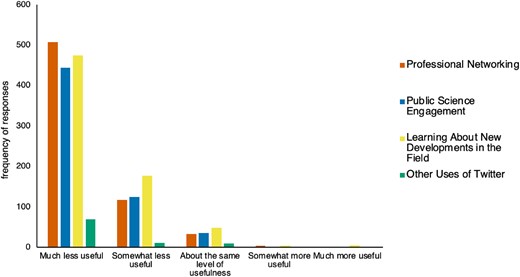
Synopsis Social media has become widely used by the scientific community for a variety of professional uses, including networking and public outreach. For the past decade, Twitter has been a primary home of scientists on social media. In recent years, new leadership at Twitter has made substantive changes that have resulted in increases in the prevalence of pseudoscience, conspiracy theory, and harassment on the platform, causing many scientists to seek alternatives. Bluesky has been suggested as a good alternative to Twitter, but the phenomenon of academics switching social media platforms has not previously been studied. Here we report on the results of a survey distributed to scientists on Twitter and Bluesky (n = 813). Results overwhelmingly confirm that changes to Twitter have made the social media platform no longer professionally useful or pleasant, and that many scientists have abandoned it in favor of Bluesky. Results show that for every reported professional benefit that scientists once gained from Twitter, scientists can now gain that benefit more effectively on Bluesky than on Twitter.
Social Media Is Now Parasocial Media
When practitioners used the term “social media” to describe the internet tools that emerged in the mid-aughts, they were giving a name to the kinds of platforms and protocols that allowed people to socialize with friends and communities of interest by using digital technologies. Twenty years later, users of social media are far more likely to scroll than post – and the content that they consume is often strategically produced and algorithmically curated. In this essay, I argue that the very essence of social media has changed. To more effectively interrogate what we are witnessing, we need to stop presuming that these tools are “social media” and begin recognizing that they are now “parasocial media.” Doing so raises new questions about digitally mediated sociality, not to mention the politics and governance of these platforms.

Platform Wars (part 4): A Public Option for Social Media
Welcome to StateBook.

The promise of ATproto is social media without corporate overlords | The Web Dev Podcast Series 1
Developers building apps on ATproto, the technology behind social media apps like Bluesky and Leaflet, are promising us a future where we own our content and aren’t at the whims of a tiny handful of companies. Software engineer Zeu Capua talks to host Jason Lengstorf about the promise of social media where we can actually own our own data.

WTF: the who to follow service at Twitter
As part of the Digital Library's transition to Open Access, new features for researchers are available in the Premium Edition. Click here to learn more.

Death by a thousand likes: How Facebook and Twitter are killing the open web
Here’s one way to understand the symbiotic relationship between publications and platforms in the digital age. Publications depend on advertising dollars to keep producing content, so they need to hold readers’ attention. Big platforms like Facebook and Twitter already have plenty of attention, but they need vast quantities of content to fill up their newsfeeds. It seems natural, then, that publications have started relying on platforms to drive readership.
