

To design the future of social media, rethink the interface before the algorithm.
Algorithmic Choice with Custom Feeds - Bluesky
Our implementation of algorithmic choice lets users customize one of the most important parts of their social media experience: their feed.
New_ Public | After the Feed
What happens after the social media feed? A presentation on the future of conversation, community, and social connection, and how AI will affect the everyday lives of billions.
Social media algorithms can be redesigned to bridge divides — here’s how
"It falls to both the tech companies that built these systems and an engaged public to create technologies designed for social cohesion."
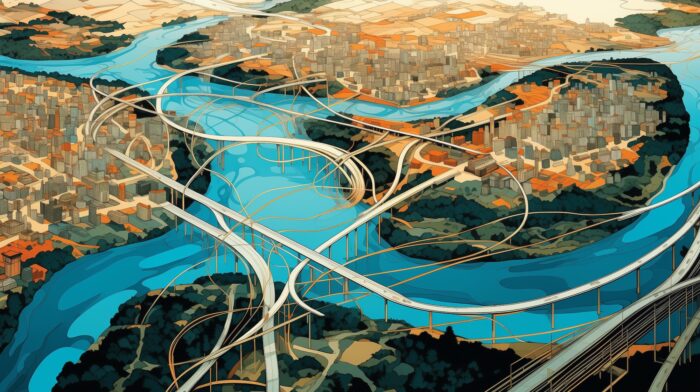
Collective knowledge foraging in trail-based social networks beyond feeds
Sharing insights about moving beyond feeds from building Semble, a community knowledge garden built on the AT Protocol. The World Wide Web is called a web for good reason. We navigate this web of interconnected websites by clicking hyperlinks and opening new tabs in tools called browsers. This kind of browsing experience is defined by its open-endedness and interwoveness; every website we visit becomes a step along a path. With the rise of social media, we lost touch with this vast trail network. Rather than creating a social web where our trails got woven onto a shared map, they were instead paved over by information superhighways: the algorithmic feeds. Hyper-scaled social media platforms reduced the vast web of interconnected pages into a stripped down ad-ridden and attention-extracting monoculture. Our online experiences became reduced to the flick of a finger, the doom scroll. With the rise of open social protocols, like ATProto, we have an opportunity to leave these misaligned profit-driven and ad-based feeds behind and rediscover the magic of shared knowledge trails. what might that look like? In this lightning talk I’ll share insights and lessons my team and I have learned from building [Semble](https://semble.so/), a community knowledge garden built on ATProto. Semble is an open social network based on knowledge trails rather than feeds. I’ll explore what trail-based social networks of the future could look like, grounded in features and use-cases we’ve uncovered while building Semble. In the transition from feeds back to trails, we aim to co-create an open social web that centres the value of human attention and sparks a new era of collective wisdom. This lightning talk is an invitation to co-create this future together. It will similar to a prior [lightning talk](https://www.youtube.com/watch?v=ptOMKK1lC4Q) we gave at ATmosphereConf 2026, adapted for DWeb Camp. Recorded at DWeb Camp 2026, Open Social Space, 2026-07-10. Schedule entry: https://talx.dod.ngo/dwebcamp-2026/talk/TA3NY7/
Social Media Feed Ranking Algorithms: Guide to Field Experiments
IC2S2'26 Tutorial | Social Media Feed Ranking Algorithms: Guide to Field Experiments
Welcome to the GreenEarth Feeds
Social media algorithms built for people who hate social media algorithms
Semble: Collective knowledge foraging in trail-based social networks beyond feeds (Lightning Talk)
Algorithmic choice - Bluesky
Your attention is an invaluable resource. We want a future where you control what you see on social media.
FediFind: Discover the Open Social Web, Your Way
Live search across Mastodon, Flipboard Social and Bluesky. No algorithm, no walls — your keywords become your feed.

The poster’s guide to the internet of the future
The best of blogging meets the best of social media.

Shifts in U.S. Social Media Use, 2020–2024: Decline, Fragmentation, and Enduring Polarization
The social media ecosystem appears to be in flux. Twitter’s rebranding to X has come to symbolize a broader reorganization of online publics – political reshuffling, user attrition, and uncertainty over the role of legacy platforms. Simultaneously, the shift from text-based, networked feeds toward algorithmically curated, short-form video has accelerated, with TikTok setting the pace for the wider ecosystem [18, 14, 16]. At the same time, everyday communication increasingly migrates from large, open networks to semi-private spaces such as group chats and messaging apps. Commentators describe a digital public sphere in transition: smaller, more fragmented, less dominated by traditional social networking sites, and rise of more broadcast-oriented forms of media – with some even suggesting that we are seeing the beginning of the end of the social media era.
Social media algorithms don't allow us to understand or control what we see online and why... until now! Top scholars @jonathanstray.com and @noupside.bsky.social are sharing @mysky.social, a tool that allows users to adjust their feed’s priorities and explains why certain posts appear over others.

🎛️📲 Meet the algorithm you can actually control and understand
newpublic.substack.com🧵 On social media, we feel trapped in “filter bubbles” and “echo chambers.” Often, we see this as a problem with the algorithm. Our new essay argues the problem is the feed interface itself: it constrains our movement—all we can do is scroll. We lay out an alternative vision:

From Feeds to Trails
leaflet.pub🧵 On social media, we feel trapped in “filter bubbles” and “echo chambers.” Often, we see this as a problem with the algorithm. Our new essay argues the problem is the feed interface itself: it constrains our movement—all we can do is scroll. We lay out an alternative vision:
From Feeds to Trails
leaflet.pub
