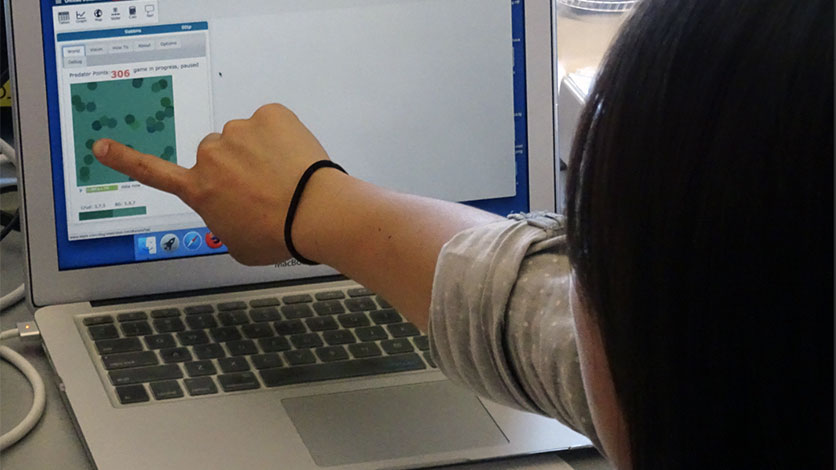
<p>Use our Common Online Data Analysis Platform (CODAP) to explore dynamic data science activities and gain fluency in data moves to examine large datasets.</p>
A first introduction to data science education in secondary schools: Teaching and learning about data exploration with <span style="font-variant:small-caps;">CODAP</span> using survey data
Abstract In this paper, we will describe an introduction to Data Science for secondary school students. We will report on the design and implementation of an introductory unit on “Data and data detectives with CODAP” in which secondary school students used the online tool CODAP to explore real and meaningful survey data on leisure time activities and media use (so‐called JIM‐PB data) in a statistical project setting as a starting point for data science. The JIM‐PB data set served as a valuable data set that offered meaningful and exciting opportunities for data exploration for secondary school students, and CODAP proved to be a valuable tool for the first explorations of this data.

Innovation in Data Science Education
Data science is a new field of research focuses on extracting knowledge and value from data. The radical growth in recent years in the availability of data and of the computational resources required to process them, has led to a corresponding increase ...

Data Science in 2020: Computing, Curricula, and Challenges for the Next 10 Years
In the past 10 years, new data science courses and programs have proliferated at the collegiate level. As faculty and administrators enter the race to provide data science training and attract new ...

Dremel: interactive analysis of web-scale datasets: Proceedings of the VLDB Endowment: Vol 3, No 1-2
Dremel is a scalable, interactive ad-hoc query system for analysis of read-only nested data. By combining multi-level execution trees and columnar data layout, it is capable of running aggregation queries over trillion-row tables in seconds. The system ...

Adopting Foundational Data Science Curriculum with Diverse Institutional Contexts
This summary was generated using automated tools and was not authored or reviewed by the article's author(s). It is provided to support discovery, help readers assess relevance, and assist readers from adjacent research areas in understanding the work. It is intended to complement the author-supplied abstract, which remains the primary summary of the paper. The full article remains the authoritative version of record. Click here to learn more.

Broadening Access to Data Science Education: Open Source Tools and Training in High School and Higher Education · Issue 8.3, Summer 2026
As data play a more integral part to our daily lives, there is a growing need for data science education. However, access to curriculum, tooling, and infrastructure is not readily available to many students in the United States. We review the current state of data science education tools and implementations as well as highlight a set of emerging tools and technologies. We conclude that broadening data science education requires a multifaceted approach, involving technological accessibility, instructional equity, curricular relevance, and long-term sustainability.

Integrated Data Science for Secondary Schools: Design and Assessment of a Curriculum
This summary was generated using automated tools and was not authored or reviewed by the article's author(s). It is provided to support discovery, help readers assess relevance, and assist readers from adjacent research areas in understanding the work. It is intended to complement the author-supplied abstract, which remains the primary summary of the paper. The full article remains the authoritative version of record. Click here to learn more.

Teaching Data Science by Visualizing Data Table Transformations: Pandas Tutor for Python, Tidy Data Tutor for R, and SQL Tutor
As part of the Digital Library's transition to Open Access, new features for researchers are available in the Premium Edition. Click here to learn more.
Teaching Programming for First-Year Data Science
This summary was generated using automated tools and was not authored or reviewed by the article's author(s). It is provided to support discovery, help readers assess relevance, and assist readers from adjacent research areas in understanding the work. It is intended to complement the author-supplied abstract, which remains the primary summary of the paper. The full article remains the authoritative version of record. Click here to learn more.

Foundations of Data Science for Students in Grades K-12
On September 13 and 14, 2022, the Board on Science Education at the National Academies of Sciences, Engineering, and Medicine held a workshop entitled Foundations of Data Science for Students in Grades K–12. Speakers and participants explored the rapidly growing field of K-12 data science education, by surveying the current landscape, surfacing what is known, and identifying what is needed to support student learning, develop curriculum and tools, and prepare educators. To support these conversations, four papers were commissioned and discussed during the workshop. This publication summarizes the presentations and discussion of the workshop.

Data Feminism
Today, data science is a form of power. It has been used to expose injustice, improve health outcomes, and topple governments. But it has also been used to d...
Broadening Access to Data Science Education in High School and Higher Education through Open Source Tools and Training
As data plays a more integral part to our daily lives, there is a growing need for data science education. However, access to curriculum, tooling, and infrastructure is not readily available to many students in the U.S. We review the current state of data science education tools and implementations as well as highlight a set of emerging tools and technologies. We conclude that broadening data science education requires a multifaceted approach, involving technological accessibility, instructional equity, curricular relevance, and long-term sustainability.
Doing Data Science on the Shoulders of Giants: The Value of Open Source Software for the Data Science Community · Issue 2.2, Spring 2020
Open source software is ubiquitous throughout data science, and enables the work of nearly every data scientist in some way or another. Open source projects, however, are disproportionately maintained by a small number of individuals, some of whom are institutionally supported, but many of whom do this maintenance on a purely volunteer basis. The health of the data science ecosystem depends on the support of open source projects, on an individual and institutional level.

Introductory data science across disciplines, using Python, case studies, and industry consulting projects
Abstract Data and its applications are increasingly ubiquitous in the rapidly digitizing world and consequently, students across different disciplines face increasing demand to develop skills to answer both academia's and businesses' increasing need to collect, manage, evaluate, apply and extract knowledge from data and critically reflect upon the derived insights. On the basis of recent experiences at the University of Ttingen, Germany, we present a new approach to teach the relevant data science skills as an introductory service course at the university or advanced college level. We describe the outline of a complete course that relies on case studies and project work built around contemporary data sets, including openly available online teaching resources.

Datacurve | The data engine for frontier AI
Custom data for long-horizon reasoning, software engineering, and data science.