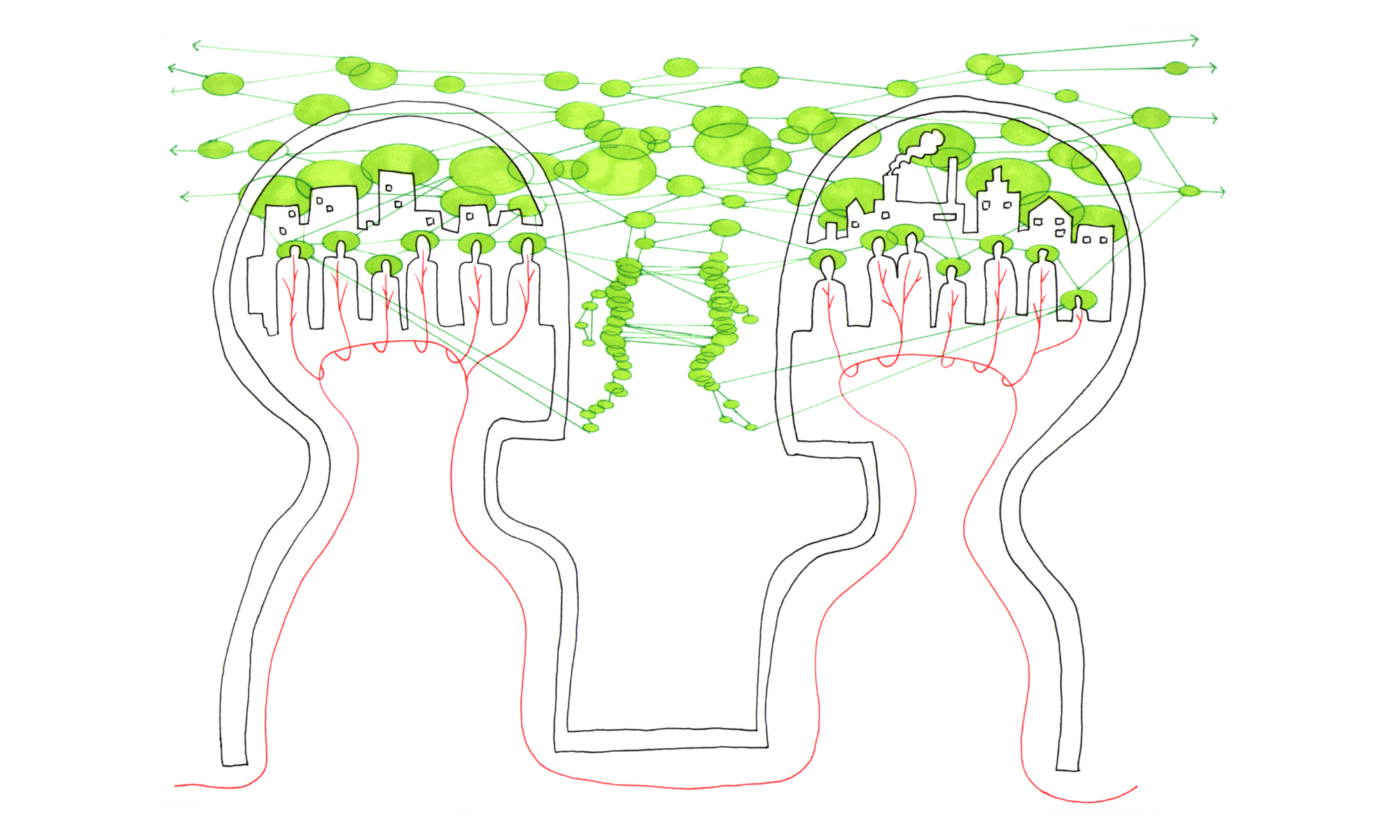
This essay outlines a set of capabilities and goals comprising decent social computing and then establishes a framework for assessing how well an ecosystem’s identity system supports those goals and capabilities.
Human identity: the number one challenge in computer science
If the modern ‘problem of identity’ was how to construct an identity and keep it solid and stable, the postmodern ‘problem of identity’ is primarily how to avoid fixation and keep the options open. (Bauman 2011)
Identity is the Platform
This is the talk I gave at Mindtrek in Tampere, Finland. Slides are available here: http://factoryjoe.com/blog/2009/10/01/identity-is-the-platform/
Governing Together: Toward Infrastructure for Community-Run Social Media
Decentralizing the governance of social computing systems to communities promises to empower them to make independent decisions, with nuance and in accordance with their values. Yet, communities do not govern in isolation. Many problems communities face are common, or move across their boundaries. We therefore propose designing for "inter-community governance:" mechanisms that support relationships and interactions between communities to coordinate on governance issues. Drawing from workshops with 24 individuals on decentralized, community-run social media, we present six challenges in designing for inter-community governance surfaced through ideas proposed in workshops. Together, these ideas come together as an ecosystem of resources, infrastructures, and tools that highlight three key principles for designing for inter-community governance: modularity, forkability, and polycentricity. We end with a discussion of how the ideas proposed in workshops might be implemented in future work aiming to support community governance in social computing systems broadly.

IIW – Internet Identity Workshop
The Internet Identity Workshop — where the identity community meets to discuss and advance digital identity.

Decentralized Identity | The Paper Pilot
The Paper Pilot's digital garden of thoughts on philosophy, politics, and sociology
The Path to Self-Sovereign Identity
Today I head out to a month-long series of events associated with identity: I’m starting with the 22st (!) Internet Identity Workshop next week; then I’...

The Path to Self-Sovereign Identity
Today I head out to a month-long series of events associated with identity: I’m starting with the 22st (!) Internet Identity Workshop next week; then I’...
The Digital Identity Event Horizon
A five year investigation into digital identity and its central role in creating brittle societies.
Ecosystem Review
A review of decentralized social media ecosystems published by Twitter's "bluesky" team on the 21st January 2021

Defining “Participatory Ecosystem” — Grow the Pie, N...
A blog on social software, collaboration, trust, security, privacy, and internet tools by Christopher Allen. Defining “Participatory Ecosystem” — Grow t...
An ecological perspective to master the complexities of the digital economy
Economic and social interactions are shifting to digital platforms which grow into vast ecosystems where user engagement creates value for members while ecosystem orchestrators harvest massive revenue. The digital ecosystem business model succeeds by adeptly navigating fast-changing environments, including new technologies and volatile demands, through dynamic innovation in a decentralized decision-making setting. This renders digital platform ecosystems complex adaptive systems. Recognizing that natural ecosystems are a prime example of complex adaptive systems, we propose a systematic hierarchical framework for describing and understanding digital ecosystems, rooted in ecology and evolution. Our framework compares digital ecosystems hosted by societies to natural ecosystems embedded in biomes, products to species, and technologies and elements of business strategy to the genetic makeup of a species. As digital platforms face heightened scrutiny about their socio-economic power and societal value, our approach contributes to the development of deeper understanding and sustainable governance of the digital economy.
The Mask-Off Moment for Digital Identity
Our 18-month investigation reveals how digital identity systems create brittle societies. This foreword traces eight case studies that demonstrate the catastrophic failures of digital identity across Estonia, the US, Israel, Ukraine, and beyond.
Building a Solidarity Ecosystem for AI (SSIR)
How cooperatives, public institutions, and social movements can come together to intentionally build a practical, community-owned alternative to extractive AI systems. <meta property=

Community by Design
Social media empower distributed content creation by algorithmically harnessing "the social fabric" (explicit and implicit signals of association) to serve this content. While this overcomes the bottlenecks and biases of traditional gatekeepers, many believe it has unsustainably eroded the very social fabric it depends on by maximizing engagement for advertising revenue. This paper participates in open and ongoing considerations to translate social and political values and conventions, specifically social cohesion, into platform design. We propose an alternative platform model that includes the social fabric an explicit output as well as input. Citizens are members of communities defined by explicit affiliation or clusters of shared attitudes. Both have internal divisions, as citizens are members of intersecting communities, which are themselves internally diverse. Each is understood to value content that bridge (viz. achieve consensus across) and balance (viz. represent fairly) this internal diversity, consistent with the principles of the Hutchins Commission (1947). Content is labeled with social provenance, indicating for which community or citizen it is bridging or balancing. Subscription payments allow citizens and communities to increase the algorithmic weight on the content they value in the content serving algorithm. Advertisers may, with consent of citizen or community counterparties, target them in exchange for payment or increase in that party's algorithmic weight. Underserved and emerging communities and citizens are optimally subsidized/supported to develop into paying participants. Content creators and communities that curate content are rewarded for their contributions with algorithmic weight and/or revenue. We discuss applications to productivity (e.g. LinkedIn), political (e.g. X), and cultural (e.g. TikTok) platforms.
The ecosystem is moving
Considerations for distributed and decentralized technologies from the perspective of a product that many would like to see decentralize....