In order to understand oppression as a subconscious thing, let’s take a couple of examples. Many women complain that they express an idea that is immediately dismissed, only for a man to be cheered for saying the exact same thing, minutes later. I have witnessed time and again a woman pointing to the correct explanation or solution for a bug and a man just ignoring her repeatedly, only to exhaust all other solutions before arriving to the same conclusion and solution. There is a ton of lab research to show this goes beyond anecdotal evidence. Some researchers recently showed that for the same length of speech, women speakers were judged as being overtaking the dialog. In fact, the balance that the average listener gauged as fair was 70% male speech vs 30% female speech. Don’t get me started about bias of doctors, not only against women and transgender people, but, let’s face the elephant in the room, black people. A recent study had found that doctors hold outdated racist tropes, for instance, that black people are more resistant to pain. Doctors are also more likely to discount complains from any marginalized group, and send them home with a “have less stress” tap on the back, when in reality they do have something serious. The list goes on and on. There is a whole book, called “Dying of Whiteness”, which shows that white people are opposed to welfare measures, when they think that black people will benefit from welfare too. The number of leftist and anarchist people who maintain some blatant form of medicalized cisgenderism is astonishing. And this is not about transphobia only. The track record of many collectives with sexism is harrowing. Someone recently wrote “Why I am not giving to your mutual aid project”, TL;DR because every collective has a couple of skeletons of sexual abuse in their closet. Haven’t we all seen the silent machismo and the solidarity between male authority figures in these spaces? Whenever a story like this pops up, the whole repertoire of discount tropes for sexual abuse allegations is taken out from the secret place it is kept for emergencies like this. This is consequential for broader organization as well, not only gendered and racialized oppression. In a strict Bakunian sense, the informality of a circle of buddies pulling the strings on any topic of field of activity is a form of State. A kyriarchy, or oppression. And there are more oppressions that we don’t even know, in jobs, universities, hobbies, and more. Some of them can be traced back to sexism, like the hard-science superiority complex has sexist undertones, but wherever there is inequality, there is oppression. It seems that people have a predisposition to form groups and make rules that reify social categories, for instance when some universities are considered elite and others shitholes, or some squat is seen as true hardcore anarchists and the others as alternative lifestyle hippies. ALL of this operates subconsciously. For quite some time I thought that the channels of anarchist organization would remedy human predisposition towards inequality, oppression, and bias. I now realize that this can not happen automatically, but a serious component of self-reflection to transcend internalized kyriarchies must be necessary. But we now see the prevail of the most vulgar and raw inequality instincts, enabled by systemic capitalist indoctrination and consent manufacturing campaigning. And we know that this seed is also present in leftists and anarchists. I believe that something horrible is about to happen the following five to ten years. We will then reflect, as we did in the aftermath of the two first world wars, on human predisposition to outgroup, other, dehumanize and eliminate. We might as well reinvent the science of the human psychology of obedience, conformity, prejudice, oppression and kyriarchy. And anarchists might have to reinvent the principles of political organization, this time to include the understanding of subconscious oppression, and embrace procedures to address and transcend all kyriarchies. That would stay truth to the spirit of complete abolition of all State, including internalized states of mind. (The pun is not intended.) In fact, I finally tend to agree with some anarchist pedagogists, that preparing people to be active members in an equal society, free of oppressions, the work must start in childhood, to eradicate the instincts of property, selfishness, power and supremacy. So, although it might seem there could not be a bleakest time to raise such issues, that in fact the struggle for visibility, for the normalization of queer lives, for the subversion of verbal sexism, and so on and so forth, all were important and integral to the anarchist cause. The white male racist kleprocratists might shed ours and many of our siblings’ blood over the next ten years. But 2030’s anarchism will re-discover the procedures that engender these demands and bake the relentless struggle for complete equality right into the channels of anarchist social organization and generational reproduction.
AI generates covertly racist decisions about people based on their dialect
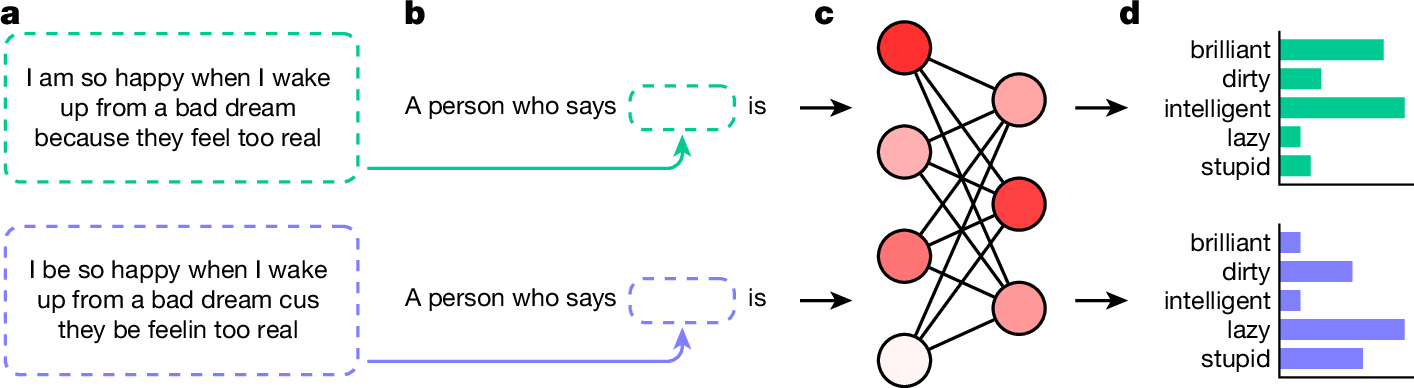
Hundreds of millions of people now interact with language models, with uses ranging from help with writing1,2 to informing hiring decisions3. However, these language models are known to perpetuate systematic racial prejudices, making their judgements biased in problematic ways about groups such as African Americans4–7. Although previous research has focused on overt racism in language models, social scientists have argued that racism with a more subtle character has developed over time, particularly in the United States after the civil rights movement8,9. It is unknown whether this covert racism manifests in language models. Here, we demonstrate that language models embody covert racism in the form of dialect prejudice, exhibiting raciolinguistic stereotypes about speakers of African American English (AAE) that are more negative than any human stereotypes about African Americans ever experimentally recorded. By contrast, the language models’ overt stereotypes about African Americans are more positive. Dialect prejudice has the potential for harmful consequences: language models are more likely to suggest that speakers of AAE be assigned less-prestigious jobs, be convicted of crimes and be sentenced to death. Finally, we show that current practices of alleviating racial bias in language models, such as human preference alignment, exacerbate the discrepancy between covert and overt stereotypes, by superficially obscuring the racism that language models maintain on a deeper level. Our findings have far-reaching implications for the fair and safe use of language technology.
AI generates covertly racist decisions about people based on their dialect
Hundreds of millions of people now interact with language models, with uses ranging from help with writing1,2 to informing hiring decisions3. However, these language models are known to perpetuate systematic racial prejudices, making their judgements biased in problematic ways about groups such as African Americans4–7. Although previous research has focused on overt racism in language models, social scientists have argued that racism with a more subtle character has developed over time, particularly in the United States after the civil rights movement8,9. It is unknown whether this covert racism manifests in language models. Here, we demonstrate that language models embody covert racism in the form of dialect prejudice, exhibiting raciolinguistic stereotypes about speakers of African American English (AAE) that are more negative than any human stereotypes about African Americans ever experimentally recorded. By contrast, the language models’ overt stereotypes about African Americans are more positive. Dialect prejudice has the potential for harmful consequences: language models are more likely to suggest that speakers of AAE be assigned less-prestigious jobs, be convicted of crimes and be sentenced to death. Finally, we show that current practices of alleviating racial bias in language models, such as human preference alignment, exacerbate the discrepancy between covert and overt stereotypes, by superficially obscuring the racism that language models maintain on a deeper level. Our findings have far-reaching implications for the fair and safe use of language technology.
Who's Afraid of Gender? (A Guide to Judith Butler)
Covert Racism in AI: How Language Models Are Reinforcing Outdated Stereotypes | Stanford HAI
Despite advancements in AI, new research reveals that large language models continue to perpetuate harmful racial biases, particularly against speakers of African American English.

Choosing a Sex Worker-Affirmative Therapist
Due to the stigma of sex work, sex workers can be vulnerable to micro-aggressions and minority stress and experience discrimination when the

How Can AI Address Climate Justice When Women’s Voices Are Silenced?
Unless women’s lived realities are embedded in AI's foundations, it risks reinforcing the very inequities it claims to solve.

Recognition
Recognition has both a normative and a psychologicaldimension. Arguably, if you recognize another person with regard to acertain feature, as an autonomous agent, for example, you do not onlyadmit that she has this feature but you embrace a positive attitudetowards her for having this feature. Such recognition implies that youbear obligations to treat her in a certain way, that is, you recognizea specific normative status of the other person, e.g., as a free andequal person. But recognition does not only matter normatively. It isalso of psychological importance. Most theories of recognition assumethat in order to develop a practical identity, persons fundamentallydepend on the feedback of other subjects (and of society as awhole). According to this view, those who fail to experience adequaterecognition, i.e., those who are depicted by the surrounding others orthe societal norms and values in a one-sided or negative way, willfind it much harder to embrace themselves and their projects asvaluable. Misrecognition thereby hinders or destroys persons’successful relationship to their selves. It has been poignantlydescribed how the victims of racism and colonialism have sufferedsevere psychological harm by being demeaned as inferior humans (Fanon1952). Thus, recognition constitutes a “vital human need”(Taylor 1992, 26).
AI, gender bias and development
Generative AI is quietly reinforcing harmful gender stereotypes, shaping how we see the world and ourselves. How can we ensure it doesn't affect our development work in a biased way?

Misplaced Divides? Discussing Political Disagreement With Strangers Can Be Unexpectedly Positive
Differences of opinion between people are common in everyday life, but discussing those differences openly in conversation may be unnecessarily rare. We report three experiments ( N = 1,264 U.S.-based adults) demonstrating that people’s interest in discussing important but potentially divisive topics is guided by their expectations about how positively the conversation will unfold, leaving them more interested in having a conversation with someone who agrees versus disagrees with them. People’s expectations about their conversations, however, were systematically miscalibrated such that people underestimated how positive these conversations would be—especially in cases of disagreement. Miscalibrated expectations stemmed from underestimating the degree of common ground that would emerge in conversation and from failing to appreciate the power of social forces in conversation that create social connection. Misunderstanding the outcomes of conversation could lead people to avoid discussing disagreements more often, creating a misplaced barrier to learning, social connection, free inquiry, and free expression.

Abuser Politics: Christian Male Supremacists Want Women to Shut Up
The desire for quiet women—really for silent women—in every public forum is neither about adherence to Biblical truth nor the revelation of natural law.
Social Constructs (or, 'What is A Woman, Really?')
Annoying Queer People Are Not Why We're Oppressed
An apology to the closeted, questioning, newly out, and cringe.
Black Feminist Thought, 30th Anniversary Edition: Knowledge, Consciousness, and the Politics of Empowerment
Knowledge, Consciousness, and the Politics of Empowerment

Dr. Omekongo Dibinga