


After implementing the small-change pattern, Imprint Engineering’s next focus in improving our development loop has been implementing a verification loop for our software development. This is an increasingly common pattern, particularly popularized by poteto’s pstack, but you’ll find similar ideas emerging in other places as well, e.g. Niko Matsakis’ post on the correctness ratchet, among others. This captures some of the confusion I’ve seen in our initial rollout, and the particulars of how we are implementing the approach.
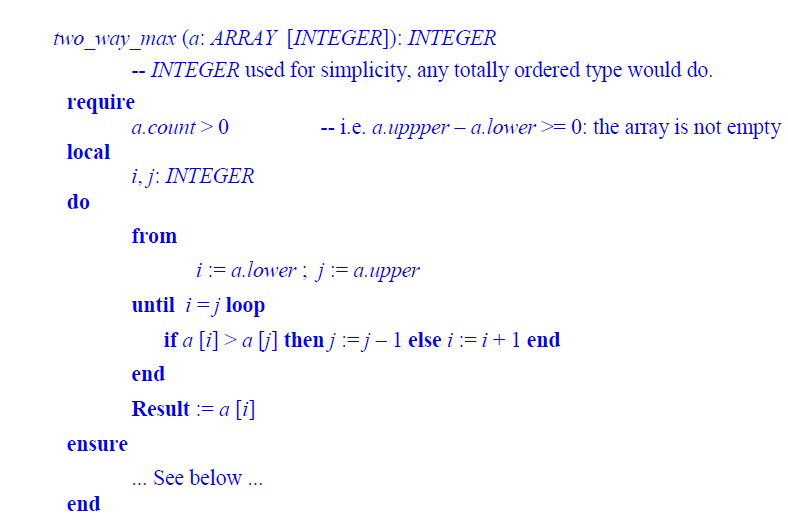
Domain Theory: the forgotten step in program verification - Bertrand Meyer's technology+ blog
Program verification is making considerable progress but is hampered by a lack of abstraction in specifications. A crucial step is, almost always, absent from the process; this omission is the principal obstacle to making verification a standard component of everyday software development. 1. Steps in software verification In the first few minutes of any ... Read more
Tutorial: Introduction to Formal Verification with Lean (Part 1) - HashCloak
A tutorial Formal Verification using Lean for cryptographic engineers. Implement and prove correctness of the One-Time pad following a cryptography book.
Formal Verification of Signal’s Protocol with Gemini
AlphaProof Code agents wrote over three million lines of machine-checked proof in Lean to verify the core cryptographic protections in Signal down to machine instructions.

Palomar – a registry of Lean verified mathematics
In recent months there has been a proliferation of AI-generated proofs of various old and new results, some of which have been formalized in the proof assistant language Lean. However, checking tha…

VerifiedIDA | Making LLM-Driven Reverse Engineering Inspectable, Continuable and Reusable
LLM reverse engineering scales only if analysis stays inspectable. A new standard and its open-source IDA Pro implementation tie annotations to evidence.
Testing with feature flags: what we expected and what actually happened
Feature flags entered our workflow as a quality safeguard.

LLMs are making formal software verification feasible at a much larger scale
Claude formally proved security properties in the compiled code of 123 open-source libraries. Along the way, it found bugs that had eluded detection for years.

A New Form of Verification on Bluesky - Bluesky
We’re introducing a new layer of verification — a user-friendly, easily recognizable badge. Additionally, independent organizations can verify accounts directly through our Trusted Verifiers feature.

Building the world's trusted identity platform • Yoti
Our comprehensive suite of customer verification tools make it easy for businesses to be compliant and safe for people to prove who they are.
What Functional Programmers Get Wrong About Systems - Ian Duncan
Type systems verify properties of programs. Production correctness is a property of systems. The gap between these is where the interesting failures live.
Trying the Software factory pattern.
One of the interesting challenges of the AI ecosystem in 2026 is that new, effective patterns emerge faster than I can adopt them. I’ll find a handful, get back to work, and realize a month later that I’d missed four or five more. The adoption cycle for Imprint this year has been something like: January: get every engineer onto Claude Code every single day March: ok, let’s also get everyone else onto Claude Code or Claude Cowork every single day April: local development is bottlenecked on checkout and worktree model, instead create ~10 local workspaces which each have an independent checkout of every repository, and operate at the workspace level, not at the repository level, so it can generate cross-repository pull requests across frontend, backend, infrastructure and data monorepos June: oh boy, agent-driven development is heavily constrained by lack of a common task management system with higher visibility and less permission complexity than Jira, so let’s migrate the entire company over to Linear and hard stop on Jira July: yikes, now we have visibility into all these tickets, many of them are trivial but managing them through local development isn’t scaling, let’s roll out an orchestrated harness which internally we call “Agent Fleet”, along the lines of Stripe’s Minions The most recent question for me has been figuring out how to adopt the software factory pattern. (After some light research, the specific AI-context origin of this term is slightly messy to attribute, but I think it might be Justin McCarthy in February 2026’s Software Factories And The Agentic Moment.)
Formal Verification Reference - Aura
This document describes the formal verification infrastructure that provides mathematical guarantees for Aura protocols through Quint model checking, Lean theorem proving, and Telltale session type verification.
Refine — AI Verification Trusted by World-Class Experts
Good decisions require verified quality. Refine devotes hours of frontier compute to protect your work and reputation from fixable mistakes.
Blink: Intent to Experiment: Signature-based Integrity
Blink: Intent to Experiment: Signature-based Integrity
groups.google.com