


Once you become an engineering executive, an invisible timer starts ticking in the background. Tick tick tick. At some point that timer will go off, at which point someone will rush up to you demanding an engineering strategy. It won’t be clear what they mean, but they will want it, really, really badly. If we just had an engineering strategy, their eyes will implore you, things would be okay. For a long time, those imploring eyes haunted me, because I simply didn’t know what to give them: what is an engineering strategy?
Engineering strategy notes.
Recently, I am thinking quite a bit about engineering strategy, and as part of that, I have started re-reading previous resources on the topic, and looking for new things to read while I refine my point of view on what makes for good engineering strategy. The best introduction to my current theory of engineering strategy is Solving the Engineering Strategy Crisis, which has both written and video versions. You can also read my other strategy writing via the strategy tag.
Solving the Engineering Strategy crisis.
These are speaking notes for my October 4th, QCon talk in San Francisco. See a video of this talk. Slides for this talk. Over the course of my career, I’ve frequently heard from colleagues, team members and random internet strangers with the same frustration: the company doesn’t have an Engineering strategy. I don’t think this problem is unique to Engineering: it’s also common to hear folks complain that they’re missing a strategy for Product, Design or Business. But, whereas I don’t feel particularly confident speaking to why so many companies are missing a clear Business or Product strategy, I’ve come to have some clear opinions about why so many engineering organizations don’t have a written strategy.
Write five, then synthesize: good engineering strategy is boring.
Few companies understand their engineering strategy and vision. One consequence of this uncertainty is the industry belief that these documents are difficult to write. In some conversations it can feel like you’re talking about something mystical, but these are just mundane documents. The reality is that good engineering strategy is boring, and that it’s easier to write an effective strategy than a bad one.
Engineering managers have a new job description
Why engineering managers are expected to be hands-on again and how AI tools are making it possible to stay technically sharp while still leading.

How to not screw up your product strategy | Jade Rubick - Engineering Leadership
An overview of common mistakes people make while developing a product strategy, tips for creating a successful strategy, and how to communicate and execute on a product strategy.

Strategy in Life
What is Strategy? Why is it easy to get wrong and so hard to get right? Strategy Structures in Life Concept-Space Getting from one point to another In a predefined direction Stars as Concept-space analogy By predefined actions Strategy in Life Know your surroundings Creating Strategies Using Strategies Summary Strategy...

Bring a Product Manager Mindset to Your Next Engineering Job
The age of AI demands strong ideas, data driven methods, and experimentation

Many Strategies Fail Because They’re Not Actually Strategies
Many strategy execution processes fail because “new strategies” are often not strategies at all. A real strategy involves a clear set of choices that define what the firm is going to do and what it’s not going to do. Many strategies fail to get implemented because they do not represent such a set of clear choices. And many so-called strategies are in fact goals. “We want to be the number one or number two in all the markets in which we operate” is one of those. It does not tell you what you are going to do; all it does is tell you what you hope the outcome will be. But you’ll still need a strategy to achieve it. Another reason why many implementation efforts fail is that executives see it as a pure top-down, two-step process: “The strategy is made; now we implement it.” That’s unlikely to work. A successful strategy execution process is seldom a one-way trickle-down cascade of decisions.

Life Is More Than an Engineering Problem | Los Angeles Review of Books
Julien Crockett speaks with Ted Chiang about the search for a perfect language, the state of AI, and the future direction of technology.

Don't Feed the Thought Leaders
In this article, the author shares their experience as an engineering manager and the challenges they faced when trying to reach alignment and prev...

Cognitive engineering
Cognitive engineering is an interdisciplinary field that applies principles from cognitive psychology, cognitive neuroscience, and human factors to design and develop engineering systems that effectively support or enhance human cognitive processes.[1][2] The field emerged in the 1980s when Donald Norman and others recognized the need to better understand how humans interact with complex technological systems.[3]
Having no Strategy is a Strategy in Ottawa
What I said at my recent keynote for the Ottawa Tech Investment Summit — and what the government said three days later.

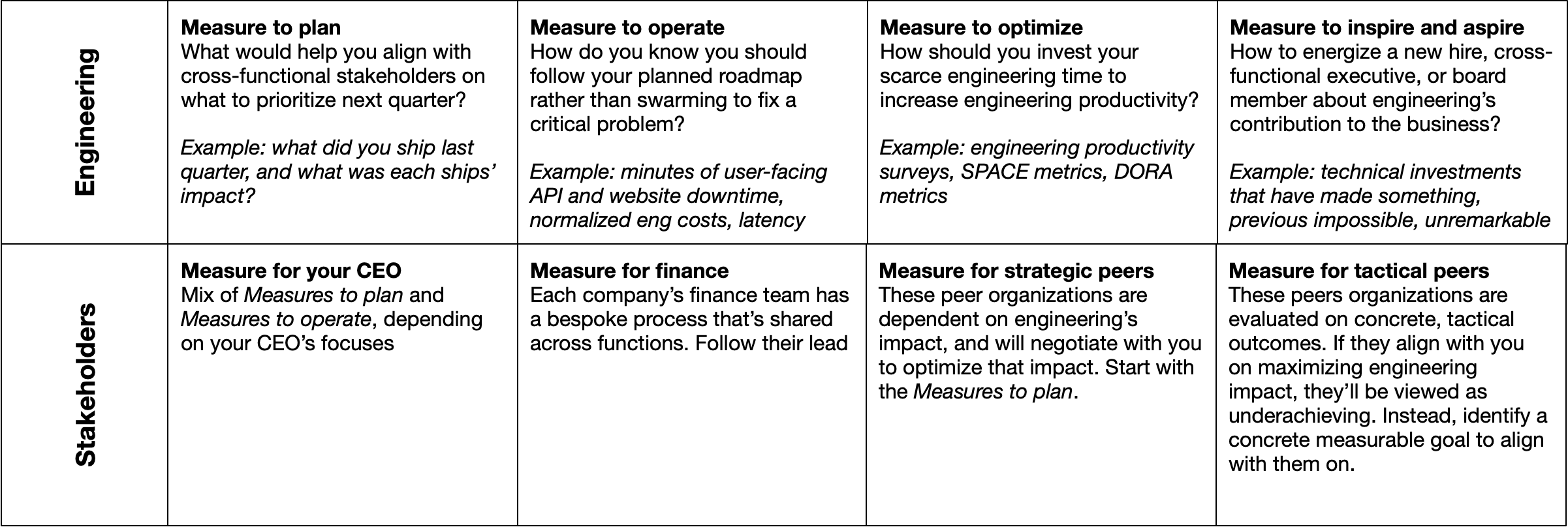
Measuring an engineering organization.
For the past several years, I’ve run a learning circle with engineering executives. The most frequent topic that comes up is career management–what should I do next? The second most frequent topic is measuring engineering teams and organizations–my CEO has asked me to report monthly engineering metrics, what should I actually include in the report? Any discussion about measuring engineering organizations quickly unearths strong opinions. Anything but sprint points! Just use SPACE! Track incident frequency! Wait, absolutely do not track incident frequency! Just make a pretty chart, they won’t look at it anyway! All of these answers, even the last one, have a grain of truth to them, but they skip past an important caveat: there are many reasons to measure engineering, many stakeholders asking for metrics, and addressing each requires a different approach.
Resetting on engineering expectations in the age of AI
I’m accepting new sponsorships for The Modern Leader for 2026. If you’re interested (or you think your company may be interested), you can learn more here.
What are engineers for? - The Philosopher Developer
I was once out with a team of software engineers who were talking about a challenging project, and one of them said, "It's our job to say what's impossible."