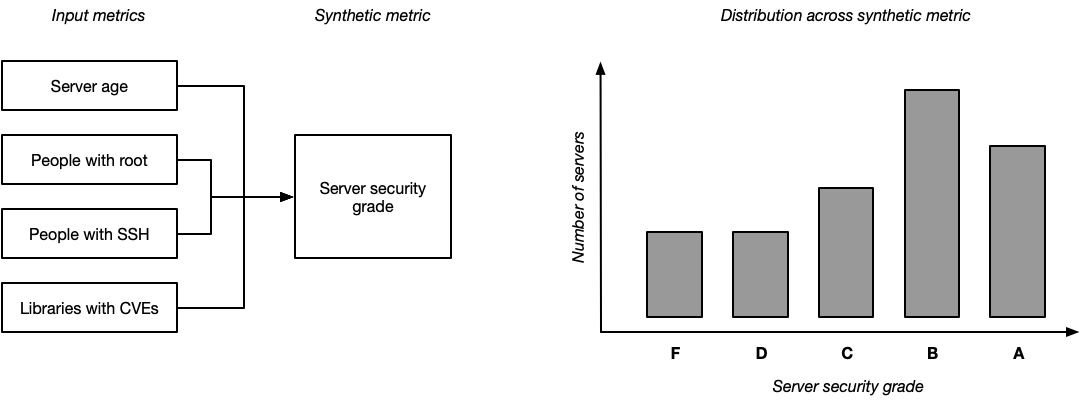
As organizations grow more complex, the folks running them interface with reality through increasingly incorporeal abstractions. On the smallest teams, leadership might be deep in the code on a daily basis. A bit larger, and you’re talking about tasks in sprints. Larger still, and you’re talking about collections of tasks, and adopting fancy terminology like ’epics.’ At a hundred plus engineers, you’re likely talking primarily in themes of work with focus on several key initiatives. Next, you might be talking about the investment frameworks for making prioritization decisions.
Adopt and scale Team Topologies: platform-as-a-product, templates, more. — Team Topologies - Organizing for fast flow of value
Accelerate value with Team Topologies: measure cognitive load, define team boundaries, apply inverse Conway, readiness assessments, and more for fast delivery.

Measuring an engineering organization.
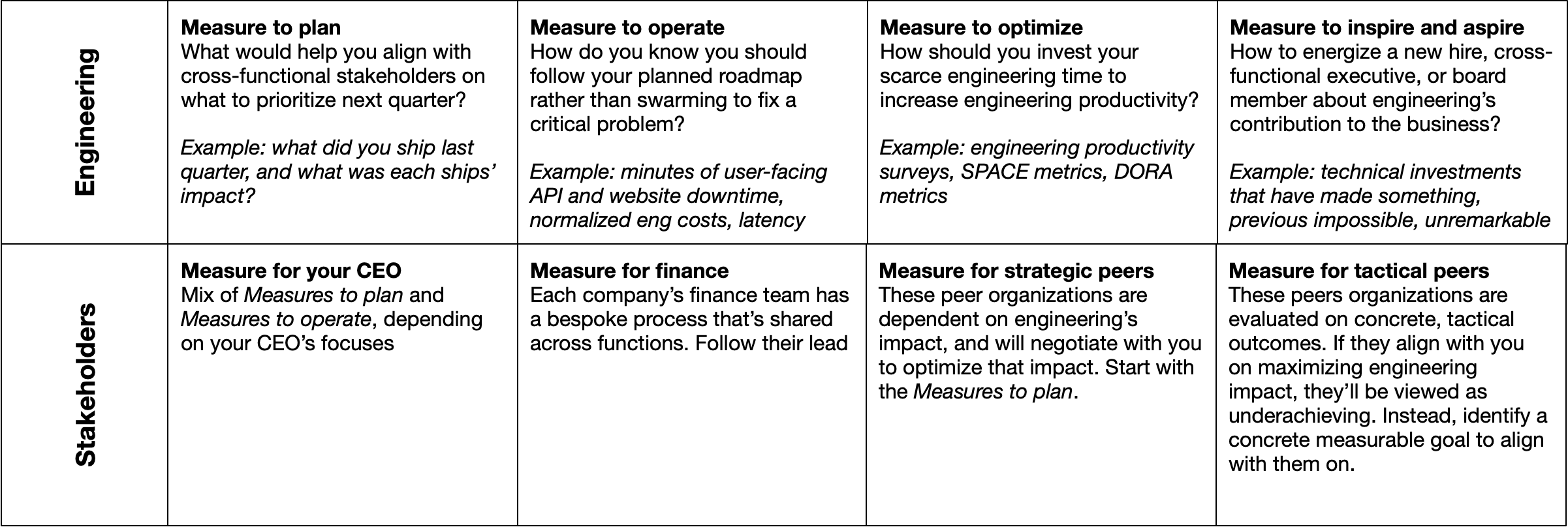
For the past several years, I’ve run a learning circle with engineering executives. The most frequent topic that comes up is career management–what should I do next? The second most frequent topic is measuring engineering teams and organizations–my CEO has asked me to report monthly engineering metrics, what should I actually include in the report? Any discussion about measuring engineering organizations quickly unearths strong opinions. Anything but sprint points! Just use SPACE! Track incident frequency! Wait, absolutely do not track incident frequency! Just make a pretty chart, they won’t look at it anyway! All of these answers, even the last one, have a grain of truth to them, but they skip past an important caveat: there are many reasons to measure engineering, many stakeholders asking for metrics, and addressing each requires a different approach.
A Guide to Measuring Engineering Team Performance
“You can’t manage what you can’t measure.” While software development practices constantly change, there will always be a tier of truly top engineering teams who stand above…

Great engineering teams focus on milestones instead of projects | Jade Rubick - Engineering Leadership
Programs are more complicated than projects which are more complicated than milestones. Instead of projects, focus on milestonesMost engineering organizations focus on delivering projects. You can get better results by focusing on milestones instead.

Against optimization
One of the most inescapable edicts when leading a team is the order to optimize the system towards the organization’s goals.

The Value of Getting Closer to the Work
Scaling The core problem of scaling a team is that not everyone can know everything. Scaling is the work of systematizing that – so that things are understandable, knowable. It’s turnin…

Habits of High-Functioning Teams
I often struggle to explain what it means to be part of a high-functioning software team. Sure, there are mountains of literature, and an entire genre of LinkedIn thought leadership that professes all kinds of guidelines and heuristics about what makes teams work, but in my experience, it’s hard to internalize these ideas and follow someone else’s model if you’ve never seen what good looks like.
Case Studies — Team Topologies - Organizing for fast flow of value
Examples of Team Topologies used in industry
Scaling Engineering Teams: Lessons from Google, Facebook, and Netflix
After spending over a decade in engineering leadership roles at some of the world’s most chaotic innovation factories—Google, Facebook, and Netflix—I’ve learned one universal truth: scaling e…

relearn Leadership - the over-optimisation problem in organisations
Large tech companies don't need heroes
Large tech companies operate via systems. What that means is that the main outcomes - up to and including the overall success or failure of the company - are driven by a complex network of processes and incentives. These systems are outside the control of any particular person. Like the parts of a large codebase, they have accumulated and co-evolved over time, instead of being designed from scratch.

Open Source Goal Setting — Open Tech Strategies | Blog
Treat this list as a menu, not a buffet. Pick three items and make them your high priority targets. Focus on effects that connect best to your strategy, and, ultimately, to your organization's mission. You need to know where you want to go before you can chart a course to get there. We've broken the goals into three categories, but you can mix and match across or within categories as you please.
Bye Bye Velocity! Kanban metrics as an alternative to story points & velocity.
Design Sprints
A structured, time-boxed process for rapidly exploring problems, generating ideas, and validating solutions with real users.

What Is Strategy?
Today’s dynamic markets and technologies have called into question the sustainability of competitive advantage. Under pressure to improve productivity, quality, and speed, managers have embraced tools such as TQM, benchmarking, and re-engineering. Dramatic operational improvements have resulted, but rarely have these gains translated into sustainable profitability. And gradually, the tools have taken the place of strategy. In his five-part article, Michael Porter explores how that shift has led to the rise of mutually destructive competitive battles that damage the profitability of many companies. As managers push to improve on all fronts, they move further away from viable competitive positions. Porter argues that operational effectiveness, although necessary to superior performance, is not sufficient, because its techniques are easy to imitate. In contrast, the essence of strategy is choosing a unique and valuable position rooted in systems of activities that are much more difficult to match. Porter thus traces the economic basis of competitive advantage down to the level of the specific activities a company performs. Using cases such as Ikea and Vanguard, he shows how making trade-offs among activities is critical to the sustainability of a strategy. Whereas managers often focus on individual components of success such as core competencies or critical resources, Porter shows how managing fit across all of a company’s activities enhances both competitive advantage and sustainability. While stressing the role of leadership in making and enforcing clear strategic choices, Porter also offers advice on how companies can reconnect with strategies that have become blurred over time.

Writing an engineering strategy.
Once you become an engineering executive, an invisible timer starts ticking in the background. Tick tick tick. At some point that timer will go off, at which point someone will rush up to you demanding an engineering strategy. It won’t be clear what they mean, but they will want it, really, really badly. If we just had an engineering strategy, their eyes will implore you, things would be okay. For a long time, those imploring eyes haunted me, because I simply didn’t know what to give them: what is an engineering strategy?