


These are speaking notes for my October 4th, QCon talk in San Francisco. See a video of this talk. Slides for this talk. Over the course of my career, I’ve frequently heard from colleagues, team members and random internet strangers with the same frustration: the company doesn’t have an Engineering strategy. I don’t think this problem is unique to Engineering: it’s also common to hear folks complain that they’re missing a strategy for Product, Design or Business. But, whereas I don’t feel particularly confident speaking to why so many companies are missing a clear Business or Product strategy, I’ve come to have some clear opinions about why so many engineering organizations don’t have a written strategy.
Writing an engineering strategy.
Once you become an engineering executive, an invisible timer starts ticking in the background. Tick tick tick. At some point that timer will go off, at which point someone will rush up to you demanding an engineering strategy. It won’t be clear what they mean, but they will want it, really, really badly. If we just had an engineering strategy, their eyes will implore you, things would be okay. For a long time, those imploring eyes haunted me, because I simply didn’t know what to give them: what is an engineering strategy?
Write five, then synthesize: good engineering strategy is boring.
Few companies understand their engineering strategy and vision. One consequence of this uncertainty is the industry belief that these documents are difficult to write. In some conversations it can feel like you’re talking about something mystical, but these are just mundane documents. The reality is that good engineering strategy is boring, and that it’s easier to write an effective strategy than a bad one.
Engineering strategy notes.
Recently, I am thinking quite a bit about engineering strategy, and as part of that, I have started re-reading previous resources on the topic, and looking for new things to read while I refine my point of view on what makes for good engineering strategy. The best introduction to my current theory of engineering strategy is Solving the Engineering Strategy Crisis, which has both written and video versions. You can also read my other strategy writing via the strategy tag.
Many Strategies Fail Because They’re Not Actually Strategies
Many strategy execution processes fail because “new strategies” are often not strategies at all. A real strategy involves a clear set of choices that define what the firm is going to do and what it’s not going to do. Many strategies fail to get implemented because they do not represent such a set of clear choices. And many so-called strategies are in fact goals. “We want to be the number one or number two in all the markets in which we operate” is one of those. It does not tell you what you are going to do; all it does is tell you what you hope the outcome will be. But you’ll still need a strategy to achieve it. Another reason why many implementation efforts fail is that executives see it as a pure top-down, two-step process: “The strategy is made; now we implement it.” That’s unlikely to work. A successful strategy execution process is seldom a one-way trickle-down cascade of decisions.

How to not screw up your product strategy | Jade Rubick - Engineering Leadership
An overview of common mistakes people make while developing a product strategy, tips for creating a successful strategy, and how to communicate and execute on a product strategy.

THE BRAND GAP — MARTY NEUMEIER
How to bridge the distance between business strategy and design
Having no Strategy is a Strategy in Ottawa
What I said at my recent keynote for the Ottawa Tech Investment Summit — and what the government said three days later.

6 steps to perfecting an open source product strategy
The future of building great products lies in breaking down the boundaries between business and technical thinking.

Hot Take: Google has a company strategy, not a product strategy
Or, Why Google keeps killing products

Measuring an engineering organization.
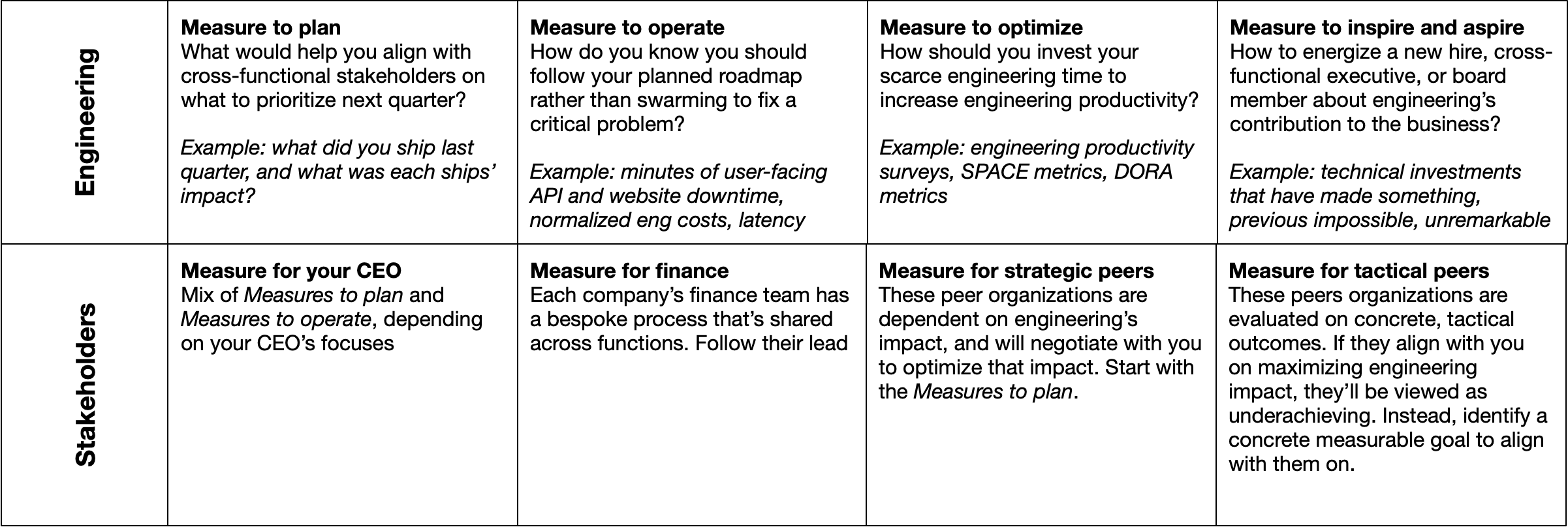
For the past several years, I’ve run a learning circle with engineering executives. The most frequent topic that comes up is career management–what should I do next? The second most frequent topic is measuring engineering teams and organizations–my CEO has asked me to report monthly engineering metrics, what should I actually include in the report? Any discussion about measuring engineering organizations quickly unearths strong opinions. Anything but sprint points! Just use SPACE! Track incident frequency! Wait, absolutely do not track incident frequency! Just make a pretty chart, they won’t look at it anyway! All of these answers, even the last one, have a grain of truth to them, but they skip past an important caveat: there are many reasons to measure engineering, many stakeholders asking for metrics, and addressing each requires a different approach.
Don't Feed the Thought Leaders
In this article, the author shares their experience as an engineering manager and the challenges they faced when trying to reach alignment and prev...

Rebuilding product strategy for the next era
For tech leaders navigating change, this is how we’re doing it differently. By Suba Vasudevan, COO, Mozilla.

What Is Strategy?
Today’s dynamic markets and technologies have called into question the sustainability of competitive advantage. Under pressure to improve productivity, quality, and speed, managers have embraced tools such as TQM, benchmarking, and re-engineering. Dramatic operational improvements have resulted, but rarely have these gains translated into sustainable profitability. And gradually, the tools have taken the place of strategy. In his five-part article, Michael Porter explores how that shift has led to the rise of mutually destructive competitive battles that damage the profitability of many companies. As managers push to improve on all fronts, they move further away from viable competitive positions. Porter argues that operational effectiveness, although necessary to superior performance, is not sufficient, because its techniques are easy to imitate. In contrast, the essence of strategy is choosing a unique and valuable position rooted in systems of activities that are much more difficult to match. Porter thus traces the economic basis of competitive advantage down to the level of the specific activities a company performs. Using cases such as Ikea and Vanguard, he shows how making trade-offs among activities is critical to the sustainability of a strategy. Whereas managers often focus on individual components of success such as core competencies or critical resources, Porter shows how managing fit across all of a company’s activities enhances both competitive advantage and sustainability. While stressing the role of leadership in making and enforcing clear strategic choices, Porter also offers advice on how companies can reconnect with strategies that have become blurred over time.

How to build a generative engineering culture
A generative engineering culture is one where nothing seems to fall through the cracks, “we should” gets prioritized and becomes reality, and original ideas and value come primarily from engineers, rather than management. A culture like this is an engine for building capacity, quality, innovation, and sophistication.

Scaling Engineering Teams: Lessons from Google, Facebook, and Netflix
After spending over a decade in engineering leadership roles at some of the world’s most chaotic innovation factories—Google, Facebook, and Netflix—I’ve learned one universal truth: scaling e…

Bring a Product Manager Mindset to Your Next Engineering Job
The age of AI demands strong ideas, data driven methods, and experimentation
