

Historically, I’ve struggled to find a concise, simple way to explain what it means to practice type-driven design. Too often, when someone asks me “How did you come up with this approach?” I find I can’t give them a satisfying answer. I know it didn’t just come to me in a vision—I have an iterative design process that doesn’t require plucking the “right” approach out of thin air—yet I haven’t been very successful in communicating that process to others.
Rusty thoughts on "Parse, don't validate" - Eli Bendersky's website
Like many programmers, I find Alexis King's Parse, don't validate article fascinating, because it gives a name to an idiom that seems familiar and important - one I've observed and used in the past without naming it explicitly. This post is a review of the "Parse, don't validate" pattern applied to the Rust programming language (the original post uses Haskell). I was particularly interested in finding educational examples of this pattern in the Rust standard library and other well-known projects.
Formal methods and the future of programming
I’ve been telling people for the last 25 years that Jane Street as an organization was just not interested in formal methods.

Jenny Wen: The design process is dead. Why Designers can no longer trust it.
On Design Thinking | Maggie Gram
By embracing “design thinking,” we attribute to design a kind of superior epistemology: a way of knowing, of “solving,” that is better than the old and local and blue-collar and municipal and unionized and customary ways. We bring in “design thinkers” — some of them designers by trade, many of them members of adjacent knowledge fields — to “empathize” with Kaiser hospital nurses, Gainesville city workers, church leaders, young mothers, and guerrilla fighters the world over.

Communicating in Types • Kris Jenkins • GOTO 2024
Paul Chiusano: The future of software, the end of apps, and why UX designers should care about type theory
[ econ fp tech unison ux ]
What Functional Programmers Get Wrong About Systems - Ian Duncan
Type systems verify properties of programs. Production correctness is a property of systems. The gap between these is where the interesting failures live.
You can't design software you don't work on
Only the engineers who work on a large software system can meaningfully participate in the design process. That’s because you cannot do good software design without an intimate understanding of the concrete details of the system. In other words, generic software design advice is typically useless for most practical software design problems.

How To Think Real Good | Meta-rationality
Practical epistemology: heuristics for how to think about difficult things, particularly using formal methods.
Evolving Design Language in the AI Era: From Good to Great
Explore how the AI era reshapes design language, emphasizing objective critique over subjective opinions for successful outcomes.

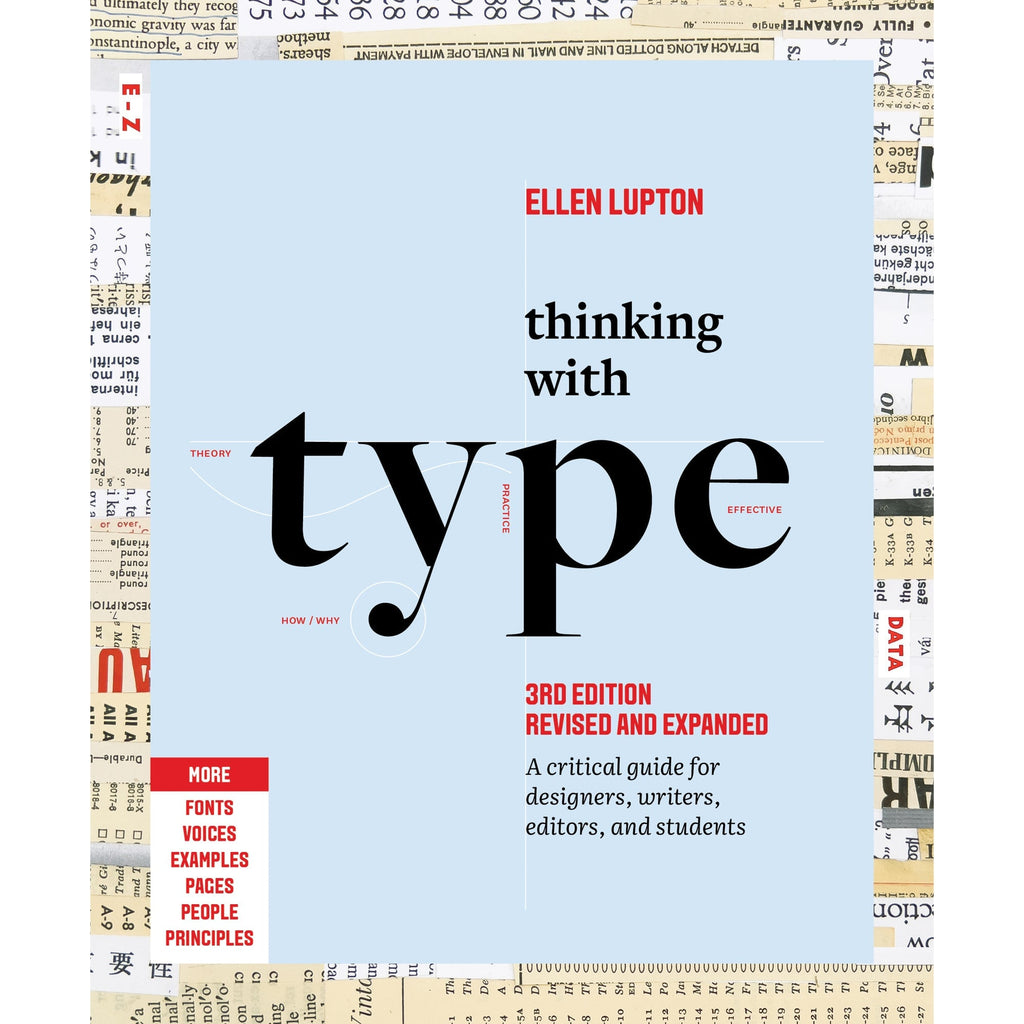
Thinking with Type
The essential and bestselling guide to typography from beloved design educator Ellen Lupton—revised and expanded to include new and additional voices, examples, and principles, and a wider array of typefaces. "Thinking with Type is to typography what Stephen Hawking's A Brief History of Time is to physics."—I Love TypographyThe bestselling Thinking with Type in a revised and expanded third edition: This is the definitive guide to using typography in visual communication. Covering the essentials of typography, this book explores everything from typefaces and type families to kerning and tracking to grids and layout principles.Ellen Lupton provides clear and focused guidance on how letters, words, and paragraphs should be aligned, spaced, ordered, and shaped. Historical and contemporary examples of graphic design show how to learn the rules and how to break them. Critical essays, eye-opening diagrams, helpful exercises, and dozens of examples and illustrations show readers how to be inventive within systems that inform and communicate.Featuring 32 pages of new content, the third edition is revised and refined from cover to cover: More fonts: old fonts, new fonts, weird fonts, libre fonts, Google fonts, Adobe fonts, fonts from independent foundries, and fonts and lettering by women and BIPOC designersIntroductions to diverse writing systems, contributed by expert typographers from around the worldDemonstrations of basic design principles, such as visual balance, Gestalt grouping, and responsive layoutCurrent approaches to typeface design, including variable fonts and optical sizes; tips for readability, legibility, and accessibility; and stunning reproductions from the Letterform Archive Thinking with Type is the typography book for everyone: designers, writers, editors, students, anyone who works with words on page or screen, and enthusiasts of type and lettering. Readers will also love Ellen Lupton's book Extra Bold: A Feminist, Inclusive, Anti-racist, Nonbinary Field Guide for Graphic Designers. Ellen Lupton is a designer, writer, and educator. She has written numerous books about graphic design, including Thinking with Type, Graphic Design Thinking, and Extra Bold: A Feminist, Inclusive, Anti-racist, Nonbinary Field Guide for Graphic Designers. She teaches in the Graphic Design MFA program at Maryland Institute College of Art in Baltimore (MICA), where she proudly serves as the Betty Cooke and William O. Steinmetz Design Chair. She is Curator Emerita at Cooper Hewitt, Smithsonian Design Museum in New York City, where her exhibitions included Herbert Bayer: Bauhaus Master and The Senses: Design Beyond Vision. Lupton loves reading, writing, teaching, and learning new things about design.
Thoughts on thinking | Hacker News
The process of forming expressions just is the process of conceptual and rational articulation (as per Brandom). Those who misunderstand this -- believing that concepts are ready made, then encoded and decoded from permutations of tokens, or, worse, who have no room to think of reasoning or conceptualization at all -- they will be automated away.
Deconstructing the algorithmic sublime
This special theme contextualizes, examines, and ultimately works to dispel the feelings of “sublime”—of awe and terror that overrides rational thought—that much of the contemporary public discourse on algorithms encourages. Employing critical, reflexive, and ethnographic techniques, these authors show that while algorithms can take on a multiplicity of different cultural meanings, they ultimately remain closely connected to the people who define and deploy them, and the institutions and power relations in which they are embedded. Building on a conversation we began at the Algorithms in Culture conference at U.C. Berkeley in December 2016, we collectively study algorithms as culture (Seaver, this special theme), fetish (Thomas et al.), imaginary (Christin), bureaucratic logic (Caplan and boyd), method of governance (Coletta and Kitchin; Lee; Geiger), mode of inquiry (Baumer), and mode of power (Kubler). [Box: see text]

Designs for the pluriverse: radical interdependence, autonomy, and the making of worlds
"Arturo Escobar presents a new vision of design theory by arguing for the creation of what he calls 'autonomous design'--a design practice aimed at channeling design's world-making capacity toward ways of being and doing that are deeply attuned to justice and the Earth"--Publisher description

A Design Science Research Methodology for Expert Systems Development
The knowledge of design science research (DSR) can have applications for improving expert systems (ES) development research. Although significant progress of utilising DSR has been observed in particular information systems design – such as decision support systems (DSS) studies – only rare attempts can be found in the ES design literature. Therefore, the aim of this study is to investigate the use of DSR for ES design. First, we explore the ES development literature to reveal the presence of DSR as a research methodology. For this, we select relevant literature criteria and apply a qualitative content analysis in order to generate themes inductively to match the DSR components. Second, utilising the findings of the comparison, we determine a new DSR approach for designing a specific ES that is guided by another result – the findings of a content analysis of examination scripts in Mathematics. The specific ES artefact for a case demonstration is designed for addressing the requirement of a ‘wicked’ problem in that the key purpose is to assist human assessors when evaluating multi-step question (MSQ) solutions. It is anticipated that the proposed design knowledge, in terms of both problem class and functions of ES artefacts, will help ES designers and researchers to address similar issues for designing information system solutions.