

Liccium builds the fundamental infrastructure that enables creators and rightsholders to publish machine-readable declarations about their digital works that…
Personal sync servers for composable data
Exploring the possibilities of interoperability and composability for local-first software & data by using a personal sync server tied to an atproto identity
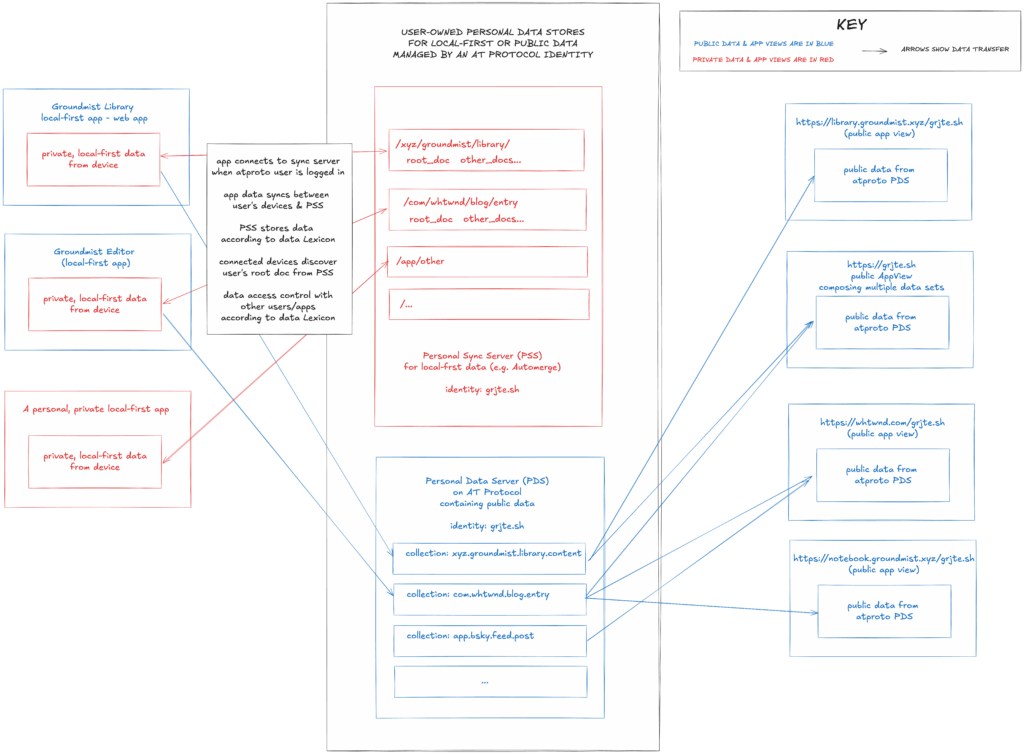
Personal sync servers for composable data
Exploring the possibilities of interoperability and composability for local-first software & data by using a personal sync server tied to an atproto identity
Basic | The Personal Computing Platform
We build products, tools, and standards to make computers more personal.

From Albums to Streams: How Modularity Changes Systems
Scientific publishing is breaking under document-centric formats designed for a physical world. Borrowing from music’s shift from albums to streaming, we make the case that open access alone cannot deliver reuse, trust, or scale. The future of science depends on modular, interoperable research components that move across tools, enabling new workflows, tools, and ecosystems.
science.latha.org
A permissioned appview for scientific documents on AT Protocol. True data ownership with optional monetization.
openPDS/SafeAnswers - The privacy-preserving Personal Data Store
Protecting the Privacy of Metadata through SafeAnswers
Manuscript submission systems and metadata completeness in Crossref: Patterns and associations
The importance of open research information, particularly publication metadata, is widely recognised. Crossref is one of the most important infrastructures for registering open metadata as part of DOI record registration. It is widely known, however, that the metadata of many publications is far from complete, with many publishers making certain metadata openly available, but failing to do so for other metadata elements. Publishers’ ability to register this metadata with Crossref depends on their capacity to capture and retain this data in their production workflows. Manuscript submission systems are an important, yet largely overlooked, factor in the extent to which publishers make metadata available through Crossref. In this paper, we present the results of an analysis investigating the relation between the level of metadata that publishers deposit with Crossref and the submission systems that they deploy for their journals. We have looked at the 153 publishers with the largest amounts of publications in Crossref and concentrate on the four most commonly used systems: Editorial Manager, ScholarOne, Open Journal Systems (OJS) and eJournalPress. We show that some submission systems appear better suited to capturing certain metadata elements. However, there are always cases where publishers using the same system differ widely in the level of metadata they register, suggesting that technology is not the only prohibiting factor and other considerations are at play.
Local-first software: You own your data, in spite of the cloud
A new generation of collaborative software that allows users to retain ownership of their data.
Local-first software: You own your data, in spite of the cloud
A new generation of collaborative software that allows users to retain ownership of their data.
Local-first software: You own your data, in spite of the cloud
A new generation of collaborative software that allows users to retain ownership of their data.
Local-first software: You own your data, in spite of the cloud
A new generation of collaborative software that allows users to retain ownership of their data.
What if a PDS became more than a repository for posts? We propose using AT Protocol as a creator-controlled publication layer for declaration metadata describing digital works, making rights, provenance, and other trusted metadata independently verifiable and easier to discover.

From Personal Data Server to Personal Metadata Server
liccium.leaflet.pubThis approach to a data commons could extend to so many typically shared things. For businesses to easily and authoritatively publish things like open hours or product catalogs, discographies, every kind of -ography... creative appmakers could do so much with all that

JB Hutch
Testing an idea that I've had for a while, but I think is even better suited for atproto Internet, meet plts.at
#atproto devs, I know data is public and accessible But we need more tools to help people download their data in *familiar and user-friendly* formats Data ownership is also about enabling people to use and move their data in whatever way they desire, even if they wish to take it outside the protocol

Victoria
I'd argue that having an export tool to fetch the data from the PDSes into familiar data files would be very much appreciated by the general public, both webcomic authors and readers (especially converting the block content into something clean to import anywhere they might desire)
Aye > Data Ownership as a conversation changes when data resides primarily with people (..). > Instead of arguing for what kinds of data we ought to be able to download from the corporate silos, the platforms should be asking us what kinds of data they may copy from *our* servers.

Erlend Sogge Heggen
The web can be made personal again. blog.muni.town/personal-data-storage-idea/

