


Lifecycle Journal aims to put publishing and evaluation in the control of the scholarly community itself. As a 3-year research and development project initiated by the Center for Open Science (COS), the ultimate goal is to transform the vision and value of a journal as an effective facilitator of knowledge production and self-correction while aligning the rewards of publishing with transparency and rigor. It commits to transparency in innovation, evaluation, and continuous improvement through research in order to raise the quality and trustworthiness of the research, reduce bias and increase overall accountability.
Center for Open Science
At the Center for Open Science, our mission is to increase openness, integrity, and reproducibility of scholarly research. Promoting these practices within the research funding and publishing communities accelerates scientific progress

Leading the future of open science publishing - PLOS
Discover how we are transforming scholarly publishing with a mission-driven commitment to open science, research integrity, and innovation that benefits researchers, institutions, and society worldwide.

Open Evaluation: A Vision for Entirely Transparent Post-Publication Peer Review and Rating for Science
The two major functions of a scientific publishing system are to provide access to and evaluation of scientific papers. While open access (OA) is becoming a reality, open evaluation (OE), the other side of coin, has received less attention. Evaluation steers the attention of the scientific community and thus the very course of science. It also influences the use of scientific findings in public policy. The current system of scientific publishing provides only journal prestige as an indication of the quality of new papers and relies on a non-transparent and noisy pre-publication peer review process, which delays publication by many months on average. Here I propose an OE system, in which papers are evaluated post-publication in an ongoing fashion by means of open peer review and rating. Through signed ratings and reviews, scientists steer the attention of their field and build their reputation. Reviewers are motivated to be objective, because low-quality or self-serving signed evaluations will negatively impact their reputation. A core feature of this proposal is a division of powers between the accumulation of evaluative evidence and the analysis of this evidence by paper evaluation functions (PEFs). PEFs can be freely defined by individuals or groups (e.g. scientific societies) and provide a plurality of perspectives on the scientific literature. Simple PEFs will use averages of ratings, weighting reviewers (e.g. by H-factor) and rating scales (e.g. by relevance to a decision process) in different ways. Complex PEFs will use advanced statistical techniques to infer the quality of a paper. Papers with initially promising ratings will be more deeply evaluated. The continual refinement of PEFs in response to attempts by individuals to influence evaluations in their own favor will make the system ungameable. OA and OE together have the power to revolutionize scientific publishing and usher in a new culture of transparency, constructive criticism, and collaboration.

ScienceOpen
Ideal for sharing early results, building dialogue, and gaining recognition — all while staying flexible for future publication.
Unjournal | Transparent Evaluation of Impactful Research
The Unjournal enables open, expert evaluation of economics and social science research, without the constraints of traditional journals. Discover how we make rigorous research more transparent.

A New Paradigm for Scientific Publishing, Peer Review, and Impact Assessment
Scientific publishing and peer review have evolved little in three centuries, while the demands placed on them have grown profoundly. The growing role of artificial intelligence has underscored deep, systemic shortcomings of an aging system that has largely evaded innovation, a system whose origins are appallingly closer to the invention of the printing press than to the internet. We can do better – much better. This article is intended as the beginning of a communal experiment: a living document that critically reviews the modern academic publishing and peer-review system and presents a concrete framework to address what bibliometrics experts¹ have characterized as "the pervasive misapplication of indicators to the evaluation of scientific performance". Building on the Leiden Manifesto, DORA, and a body of scholarship spanning many disciplines and decades, we present a community-governed, non-profit platform organized around three trust-weighted impact factors, for articles, authors, and reviewers, with full algorithmic transparency, an open development log, and structural decoupling of credibility scoring from content moderation and from monetization. We invite the community to discuss, critique, and help shape it.
Research Integrity and Peer Review
Research Integrity and Peer Review is an open access journal led by a renowned Editorial Board and occupying a unique niche in the field as the only journal ...
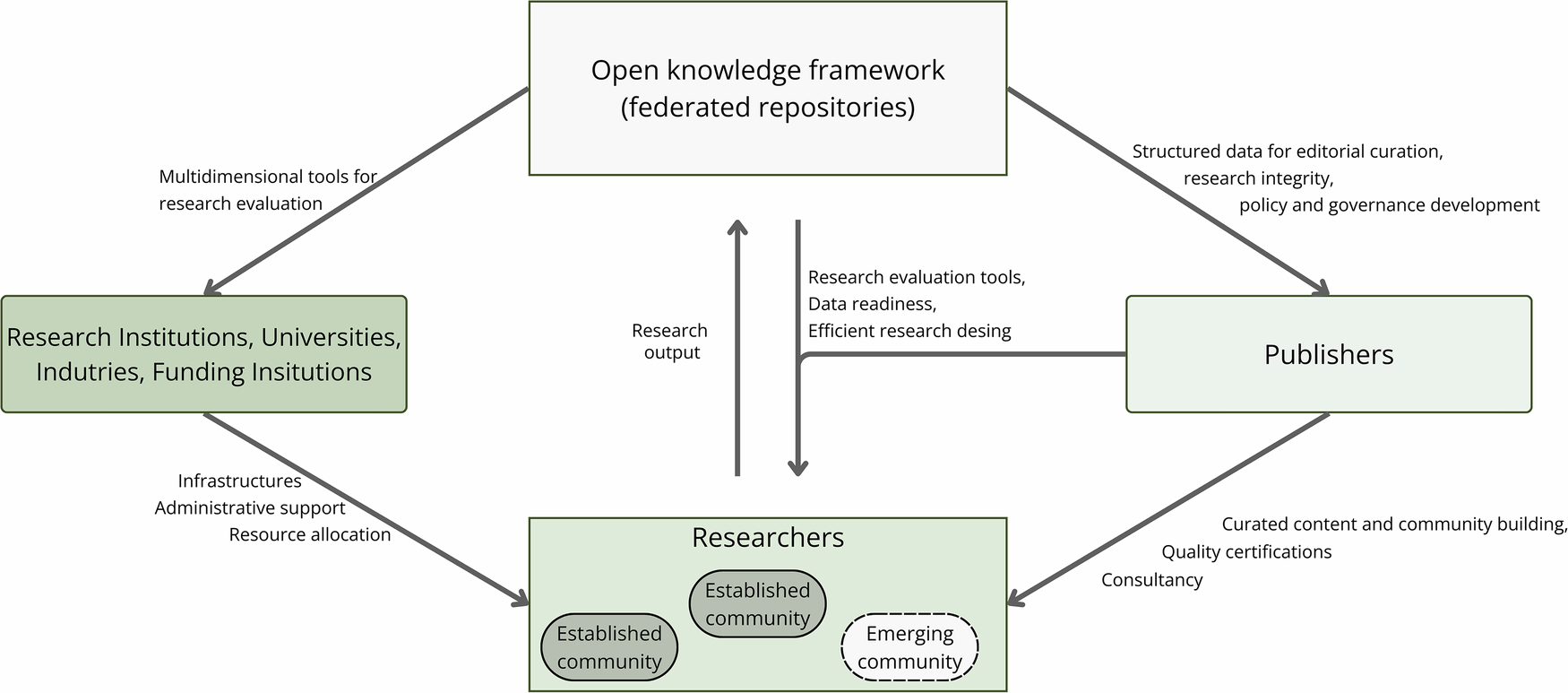
Fostering cultural change in research through innovative knowledge sharing, evaluation, and community engagement strategies
Bringing together researchers, funders, industry partners, and publishers from 14 countries across five continents, we advance the debate around open-science, assessment and learning. We introduce an integrative “open-knowledge system” framework linking knowledge production, validation, assessment, and reuse into one ecosystem view, and translate it into actionable recommendations for each stakeholder. Shifting focus to modular, machine-readable knowledge objects, these recommendations are intended to help diagnose misaligned incentives and guide reforms that properly value all scientific contributions.
Making sense of preprints by adding context – The Publish Your Reviews initiative - LSE Impact
Improving scientific publishing is often framed as an issue of openness and speed and less often as one of context. In this post, Ludo Waltman and Jessica Polka make the case for a more contextualised approach to open access publishing and preprinting, and introduce the Publish Your Reviews initiative. Launched today by ASAPbio, the initiative

Single-Source Publishing Community
Join the Single-Source Publishing Community for open, interoperable, and sustainable scholarly publishing workflows.
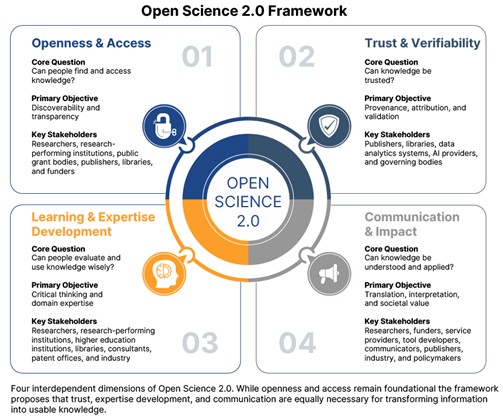
Open Science 2.0: Building Understanding in an AI-Mediated World - The Scholarly Kitchen
Open Science 2.0 must focus not only on access, but also on trust, interpretation, learning, and effective communication. The challenge facing the scholarly publishing ecosystem is ensuring that what is open is also trustworthy, understandable, and genuinely useful.
Why the Stockholm Declaration will never work
Abstract The Stockholm Declaration calls for a moral reformation of scientific publishing—replacing commercial publishers with scholar-led journals, rewarding quality over quantity and instituting independent oversight. While noble in spirit, it fundamentally misdiagnoses the disease. The crisis of science stems not from paper mills or profit motives but from systemic incentives that reward volume, novelty and prestige over validity and reliability. Non-profit ownership will not neutralize the prestige economy, sleuth-led policing cannot scale, and ‘integrity registries’ would merely replace metrics with surveillance. True reform requires rebuilding the publishing infrastructure as a public utility: publicly funded, free to publish and read, and stripped of hierarchy and financial incentives.
Publishing Beyond the Market: Open Access, Care, and the Commons
<I>Publishing Beyond the Market</I> argues that the move to open access should focus less on the free accessibility of research outputs and more on who controls the publications and infrastructures for scholarly communication. By deploying theoretical literature on science and technology studies, care ethics, and the commons, the book critically interrogates open access and reimagines a more ethical future for researcher-led publishing. A case study of Plan S—the multifunder European policy for open access publishing—explores its tendency to rehearse all the failures of commercialisation. Through critical engagement with the open access landscape, the book reveals the shortcomings of market-centric and policy-based approaches to open access book and journal publishing, particularly their tendency to reinforce conservatism, commercialism, and private control of publishing.<BR /><BR /> Going forward, <I>Publishing Beyond the Market</I> explores the importance of collectivity and democratic governance within the transition to open access publishing. It suggests that developing a commons-based, scholar-led publishing landscape through a series of presses that are each managed by working academics could offer a productive counterpoint to marketised systems of open access and subscription publishing. In weaving themselves together in order to "scale small" these publishing initiatives would act as a counter-hegemonic project based on mutual reliance and care. By illustrating how these projects build toward a commons-based publishing future, and how they may complement other approaches to publishing within university presses and libraries, the book culminates in an argument for the infrastructures, policies, and forms of governance needed to nurture such a collective vision.

Reformation of science publishing: the Stockholm Declaration
Science relies on integrity and trustworthiness. But scientists under career pressure are lured to purchase fake publications from ‘paper mills’ that use AI-generated data, text and image fabrication. The number of low-quality or fraudulent publications is rising to hundreds of thousands per year, which—if unchecked—will damage the scientific and economic progress of our societies. The result is editor and reviewer fatigue, irreproducible experiments, misguided experiments, disinformation and escalating costs that devour funding from taxpayers intended for research. It is high time to reevaluate current publishing models and outline a global plan to stop this unhealthy development. A conference was therefore organized by the Royal Swedish Academy of Sciences to draft an action plan with specific recommendations, as follows. (i) Academia should resume control of publishing using non-profit publishing models (e.g. diamond open-access). (ii) Adjust incentive systems to merit quality, not quantity, in a reputation economy where the gaming of publication numbers and citation metrics distorts the perception of academic excellence. (iii) Implement mechanisms to prevent and detect fake publications and fraud which are independent of publishers. (iv) Draft and implement legislations, regulations and policies to increase publishing quality and integrity. This is a call to action for universities, academies, science organizations and funders to unite and join this effort.
Landing — Open Journals Collective
We're a collective of libraries, university presses, and non-profit publishers reshaping academic research.
The Dissemination of Scholarly Information: Journals, Open-Access and Distributed Filtering
Current methods of disseminating scholarly information focus on the use of journals who retain exclusive rights in the material they publish. Recently there has been increasing dissatisfaction with this model, with suggestions for alternative approaches such as "Open Access".