


How much of what you learned in school do you still remember? Even more importantly, how much of it do you actually use on a daily basis? Though we ma
Gen Alpha 'iPad Kids' Have Emotional Intelligence Skills A Teacher Says She's Never Seen Before
A teacher shared her positive observation of the high emotional intelligence some of her Generation Alpha students have already begun fostering. With a healthy balance of media use and structured parenting, there is hope for the generation many label ‘iPad kids.’

How to Read Fewer Books - The School of Life
We publish articles around emotional education: calm, fulfilment, perspective and self-awareness. | How to Read Fewer Books — Read now

Your Most Important Skill: Empathy
TL;DR — Empathy is the most important skill you can practice. It will lead to greater success personally and professionally and will allow…
University students feel ‘anxious, confused and distrustful’ about AI in the classroom and among their peers
Whether students and faculty are actively using AI or not, it is having significant interpersonal, emotional effects on learning and trust in the classroom.

University students feel ‘anxious, confused and distrustful’ about AI in the classroom and among their peers
Whether students and faculty are actively using AI or not, it is having significant interpersonal, emotional effects on learning and trust in the classroom.
Measures of emotion: A review
A consensual, componential model of emotions conceptualises them as experiential, physiological, and behavioural responses to personally meaningful stimuli. The present review examines this model in terms of whether different types of emotion-evocative stimuli are associated with discrete and invariant patterns of responding in each response system, how such responses are structured, and if such responses converge across different response systems. Across response systems, the bulk of the available evidence favours the idea that measures of emotional responding reflect dimensions rather than discrete states. In addition, experiential, physiological, and behavioural response systems are associated with unique sources of variance, which in turn limits the magnitude of convergence across measures. Accordingly, the authors suggest that there is no “gold standard” measure of emotional responding. Rather, experiential, physiological, and behavioural measures are all relevant to understanding emotion and cannot be assumed to be interchangeable.

When AIs act emotional
Curse of the Chocolate-Covered Broccoli (or: Emotion in Learning)
So earlier this year, I learnt my whole career was based on a lie. As one does.

Negative Emotions Are Key to Well-Being
Feeling sad, mad, critical or otherwise awful? Surprise: negative emotions are essential for mental health

Philosophy Officer on Instagram: "I AM SO EMOTIONALLY MATURE I have massive problems with this term. Most people would say it means something along the lines of: the ability to understand, process, regulate or communicate emotions in a healthy way. Now the issue is that all of the terms you use to explain it leave so much room for interpretation the definition becomes almost vacuous. To understand an emotion means to know what caused it? To know the impact it has on you physiologically? To understand how it affects your cognition? To know how it affects others? Same goes with the term healthy, get far enough into a discussion on what it means to be healthy and people will start to disagree. Mental health? Physical? Communal? Spiritual? What’s more is that this term is thrown around in place of simple personality traits or individual quirks. Because someone is more emotional are they now less mature because they have an objectively more difficult time regulating them? Is the person with a dark sense of humour immature because he can’t hold in a laugh when everyone else finds the situation morbid or cruel? I think, to a great extent, it’s a bit of a shield or barrier of a term that absolves ourselves from taking responsibility for our behaviours. At the end of the day we know ourselves best, or at least better than most people. This means we best understand our emotions, how we regulate them, how we control them etc. We have this epistemic bias towards ourselves, since we simply know more about ourselves therefore we will often reason that others have less. Sorry I couldn’t polish off my ideas more I gotta run bye friends"
102K likes, 186 comments - the_philofficer on July 6, 2026: "I AM SO EMOTIONALLY MATURE I have massive problems with this term. Most people would say it means something along the lines of: the ability to understand, process, regulate or communicate emotions in a healthy way. Now the issue is that all of the terms you use to explain it leave so much room for interpretation the definition becomes almost vacuous. To understand an emotion means to know what caused it? To know the impact it has on you physiologically? To understand how it affects your cognition? To know how it affects others? Same goes with the term healthy, get far enough into a discussion on what it means to be healthy and people will start to disagree. Mental health? Physical? Communal? Spiritual? What’s more is that this term is thrown around in place of simple personality traits or individual quirks. Because someone is more emotional are they now less mature because they have an objectively more difficult time regulating them? Is the person with a dark sense of humour immature because he can’t hold in a laugh when everyone else finds the situation morbid or cruel? I think, to a great extent, it’s a bit of a shield or barrier of a term that absolves ourselves from taking responsibility for our behaviours. At the end of the day we know ourselves best, or at least better than most people. This means we best understand our emotions, how we regulate them, how we control them etc. We have this epistemic bias towards ourselves, since we simply know more about ourselves therefore we will often reason that others have less. Sorry I couldn’t polish off my ideas more I gotta run bye friends".

Air pollution causes ‘huge’ reduction in intelligence, study reveals
Impact of high levels of toxic air ‘is equivalent to having lost a year of education’

Sycophantic AI makes human interaction feel more effortful and less satisfying over time
Millions of people now turn to artificial intelligence (AI) systems for personal advice, guidance, and support. Such systems can be sycophantic, frequently affirming users' views and beliefs. Across five preregistered studies (N = 3,075 participants, 12,766 human-AI conversations), including a three-week study with a census-representative U.S. sample, we provide longitudinal experimental evidence that sycophantic AI shifts how users approach their closest relationships. We show that sycophantic AI immediately delivers the emotional and esteem support users typically associate with close friends and family. Over three weeks of such interactions, users became nearly as likely to seek personal advice from sycophantic AI as from close friends and family, and reported lower satisfaction with their real-world social interactions. When given a choice among AI response styles, a majority preferred sycophantic AI -- not for the quality of its advice, but because it made them feel most understood. Together, these findings offer a relational account of AI sycophancy and its impacts.
Opinion | Can You Get Smarter? (Published 2015)
There is much that you can do to keep cognitively sharp.

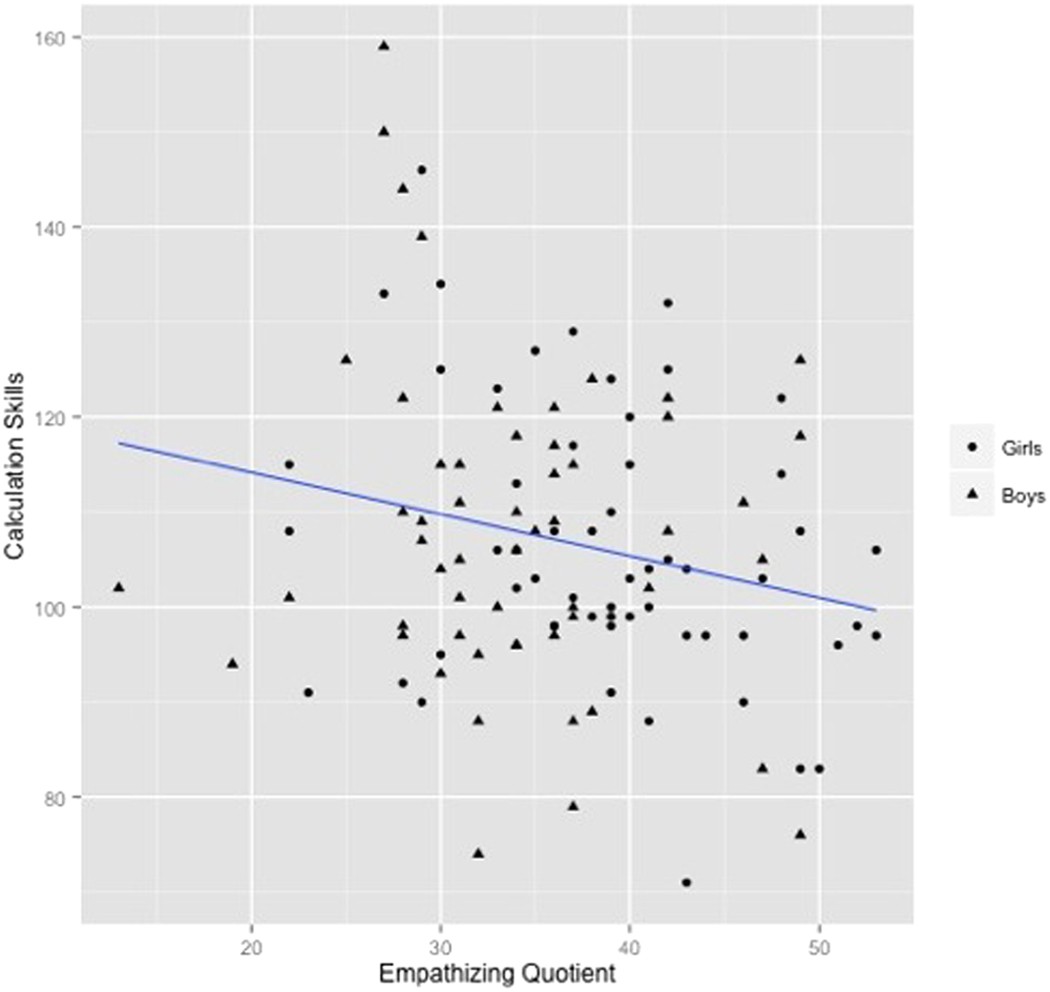
The Empathizing-Systemizing Theory, Social Abilities, and Mathematical Achievement in Children
The Empathizing-Systemizing (E-S) theory describes a profile of traits that have been linked to autism spectrum disorders, and are thought to encompass a continuum that includes typically developing (TD) individuals. Although systemizing is hypothesized to be related to mathematical abilities, empirical support for this relationship is lacking. We examine the link between empathizing and systemizing tendencies and mathematical achievement in 112 TD children (57 girls) to elucidate how socio-cognitive constructs influence early development of mathematical skills. Assessment of mathematical achievement included standardized tests designed to examine calculation skills and conceptual mathematical reasoning. Empathizing and systemizing were assessed using the Combined Empathy Quotient-Child (EQ-C) and Systemizing Quotient-Child (SQ-C). Contrary to our hypothesis, we found that mathematical achievement was not related to systemizing or the discrepancy between systemizing and empathizing. Surprisingly, children with higher empathy demonstrated lower calculation skills. Further analysis using the Social Responsiveness Scale (SRS) revealed that the relationship between EQ-C and mathematical achievement was mediated by social ability rather than autistic behaviors. Finally, social awareness was found to play a differential role in mediating the relationship between EQ-C and mathematical achievement in girls. These results identify empathy, and social skills more generally, as previously unknown predictors of mathematical achievement.
The Program
AI-powered curriculum focused on engagement, personalized mastery learning, and life skills workshops