

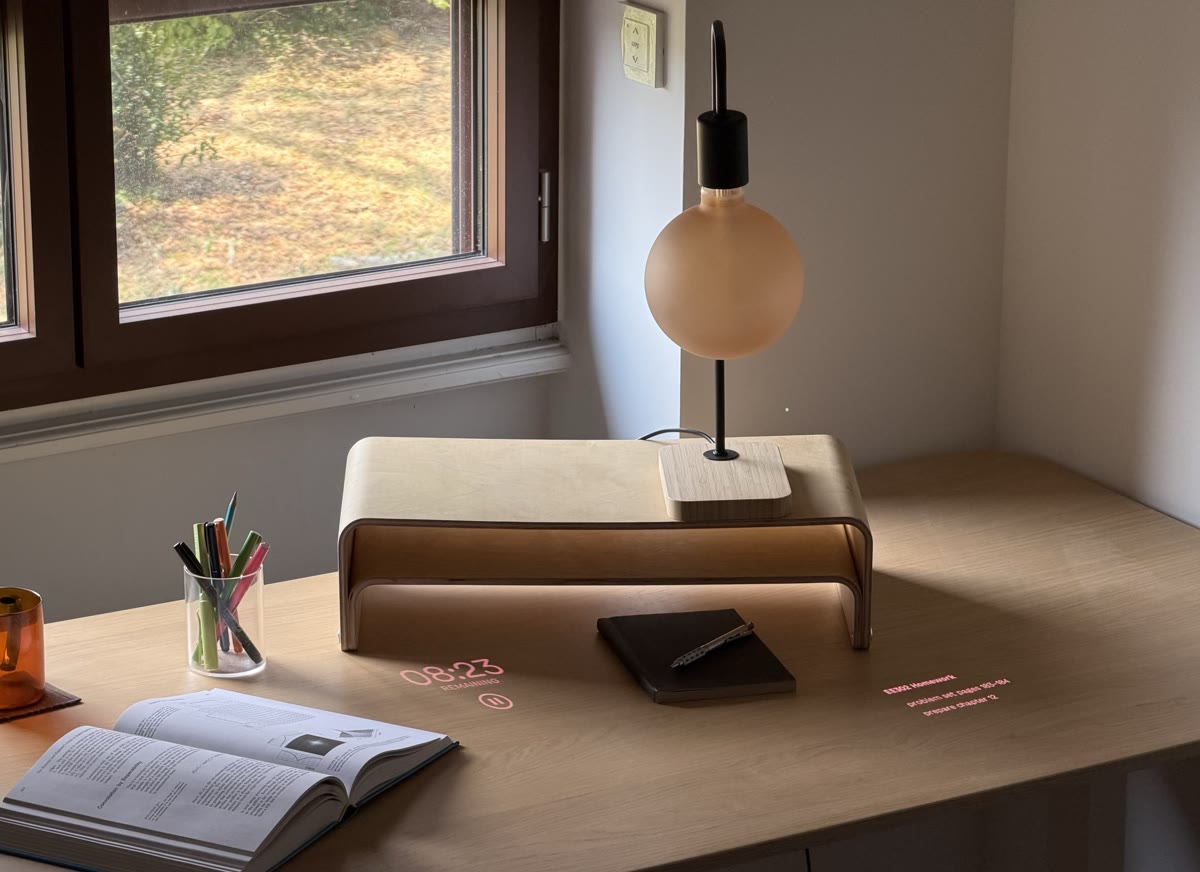
A new direction for computing: projecting information into the real world to augment it, with a device that combines a projector and computer vision in the shape of a large lightbulb.
The Lightbulb Computer: Reimagining Spatial & Ambient Computing
The Lightbulb Computer: Reimagining Spatial & Ambient Computing
Retrocomputing as a Model for Sustainable and Cognitive Computing: Lessons from Low-Resource Systems
This paper argues that retrocomputing constitutes a conceptually productive model for rethinking sustainability in contemporary computing. Early computing systems operated under strict hardware constraints, necessitating efficiency, clarity, and minimalism in both software and interaction design. In contrast, contemporary systems are frequently characterised by computational excess, software bloat, and attention-fragmenting interfaces. Drawing on examples from early home computing and command-line environments, this paper analyses how low-resource systems make visible forms of computational minimalism with relevance to present-day design challenges. A central theoretical contribution is the distinction between interface-level and system-structure-level design analysis, which demonstrates that cognitive effects arise not only from visual and interactional surface features but from deeper computational organisation. The discussion integrates perspectives from human-computer interaction and cognitive science, particularly in relation to attention, cognitive load, and user experience. The paper adopts a conceptual and exploratory approach grounded in systematic literature review, aiming to identify design-relevant patterns rather than to provide empirical validation. It introduces the concepts of computational minimalism and cognitive sustainability as complementary analytical frameworks, and derives five principles for sustainable system design. Crucially, the paper also address

ambientROOM
paint: a timeline — Kristen Roos
This timeline is the result of researching the origins of digital paint and draw software, and the tools that were developed to allow for hand manipulation (versus plotter drawn) drawing and painting - the mouse, light pen & drawing tablet. If we look at the software that has become commonplace today (such as adobe photoshop), which allows for painting, animation and photo manipulation in one, we can trace the roots of this software to the University and Corporate Labs that housed large computers with advanced capabilities for their time - MIT Lincoln Labs & Radiation Labs, DARPA & the Augmented Research Centre (ARC), Bell Labs, NYIT’s Computer Graphics Lab, Xerox Palo Alto Research Centre (Xerox PARC), NASA’s Jet Propulsion Labs (JPL). The artistic collaborations that grew out of these labs fueled the advent of Computer Graphics, Computer Art and Video Art from the 1960's to the 1990's.
Set Lighting Technician's Handbook : Film Lighting Equipment, Practice, and Electrical Distribution
A friendly, hands-on training manual and reference for lighting technicians in motion picture and television production, this handbook is the most comprehensive guide to set lighting available. It provides a unique combination of practical detail with a big-picture understanding of lighting, technology, safety, and professionalism, essential to anyone doing motion picture lighting. The fifth edition delves into every aspect of lighting and features vastly expanded sections on controlling LED lights, color science, lighting control systems, wireless systems, Ethernet-based control systems, battery power, and modern set protocol for productions small and large. With a generous number of original images, the book illustrates the use of soft light, the effect of lighting angles, and how the gaffer and DP build an effective lighting plan around the blocking of the actors. This encyclopedic volume of technical knowhow is tempered with years of practical experience and a much-needed sense of humor.This is the ideal text for professional lighting technicians across film and television including lighting directors, gaffers, DOPs, and rigging crews, as well as film and television production students studying lighting, camera techniques, film production, and cinematography.It includes a revamped companion website with supplementary resources, forms, checklists, and images.

inFORM: dynamic physical affordances and constraints through shape and object actuation
We propose a new approach to Physical Telepresence, based on shared workspaces with the ability to capture and remotely render the shapes of people and objects. In this paper, we describe the concept of shape transmission, and propose interaction ...

AI-powered visual workspace for team collaboration | Mural
Boost team collaboration and innovation with Mural, the AI-powered visual workspace. Plan, strategize, and execute projects seamlessly on one intuitive tool.

The Computer for the 21st Century
Specialized elements of hardware and software, connected by wires, radio waves and infrared, will be so ubiquitous that no one will notice their presence

The Glimmer — thefugue.space
A brief history of my attempts to bring Spatial Computing to the wider audience..

Smart Disorganized Individuals: SpimeScript
These days, I'm thinking a lot about 3D printers, desktop manufacturing and software to create physical things. Last year I did some art...
Prof. Judy Fan: Cognitive Tools for Making the Invisible Visible
Prof. Judy Fan: Cognitive Tools for Making the Invisible Visible
Urp: a luminous-tangible workbench for urban planning and design
In recent years, virtual reality technology has gradually attracted widespread attention from the society, because virtual reality technology could produce many scenes that humans cannot experience personally, such as diving into the deep sea or into ...

Stuart K. Card and Thomas P. Moran, "User Technology—From Pointing to Pondering"
Using functional lenses we can project a reactive notebook to also be a slide deck (at the same time). observablehq.com/@tomlarkworthy/slides riffed from @jwolondon.bsky.social slides design but with offline-first support
