


When we tell people that Linear maintains a zero-bug policy a common response is disbelief. It may sound like a ridiculous approach, but we do it because no other way makes sense.
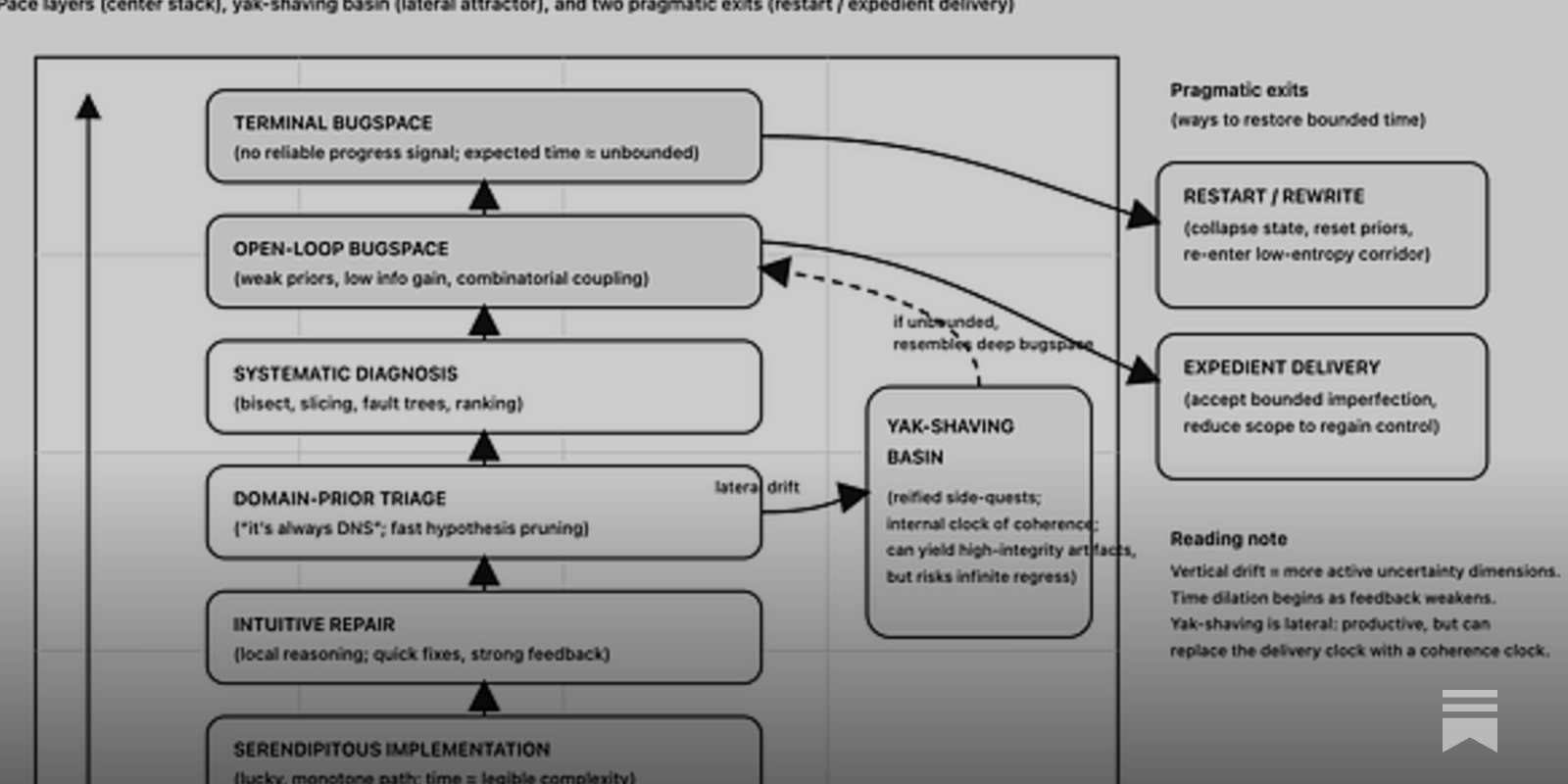
Lost in Bugspace
The temporality of implementation uncertainty in software
Putting nudges in perspective
Conventional economic policy focuses on ‘economic’ solutions (e.g. taxes, incentives, regulation) to problems caused by market-level factors such as externalities, misaligned incentives and information asymmetries. By contrast, ‘nudges’ provide behavioural solutions to problems that have generally been assumed to originate from limitations in human decision making, such as present bias. While policy-makers have good reason for exploiting the power of nudges, we argue that these extremes leave open a large space of policy options that have received less attention in the academic literature. First, there is no reason that solution and problem need have the same theoretical basis: there are promising behavioural solutions to problems that have causes that are well explained by traditional economics, and conventional economic solutions often offer the best line of attack on problems of behavioural origin. Second, there is a wide range of hybrid policy actions with both economic and behavioural components (e.g. framing a tax or incentive in a specific way), and there exist many societal problems – perhaps the majority – that arise from both economic and behavioural factors (e.g. firms’ exploitation of consumers’ behavioural biases). This paper aims to remind policy-makers that behavioural economics can influence policy in a variety of ways, of which nudges are the most prominent but not necessarily the most powerful.
Issue tracking is dead – Linear
The next era of product development is built on context and agency. Here's how Linear is evolving. And what we're launching today.

Strange and maddening rules
There’s this popular idea among developers that when you face a problem with code, you should get out a rubber duck and explain, to the duck, exactly how your code was supposed to work.

Zero Trust Information
Zero Trust Networking is security with Internet assumptions; there is tremendous value if we apply the same approach to information.

Mechanism Experiments and Policy Evaluations
Randomized controlled trials are increasingly used to evaluate policies. How can we make these experiments as useful as possible for policy purposes? We argue greater use should be made of experiments that identify the behavioral mechanisms that are central to clearly specified policy questions, what we call "mechanism experiments." These types of experiments can be of great policy value even if the intervention that is tested (or its setting) does not correspond exactly to any realistic policy option.
Rational Inattention: A Review
We review the recent literature on rational inattention, identify the main theoretical mechanisms, and explain how it helps us understand a variety of phenomena across fields of economics. The theory of rational inattention assumes that agents cannot process all available information, but they can choose which exact pieces of information to attend to. Several important results in economics have been built around imperfect information. Nowadays, many more forms of information than ever before are available due to new technologies, and yet we are able to digest little of it. Which form of imperfect information we possess and act upon is thus largely determined by which information we choose to pay attention to. These choices are driven by current economic conditions and imply behavior that features numerous empirically supported departures from standard models. Combining these insights about human limitations with the optimizing approach of neoclassical economics yields a new, generally applicable model.
The i-frame and the s-frame: How focusing on individual-level solutions has led behavioral public policy astray
An influential line of thinking in behavioral science, to which the two authors have long subscribed, is that many of society's most pressing problems can be addressed cheaply and effectively at the level of the individual, without modifying the system in which the individual operates. We now believe this was a mistake, along with, we suspect, many colleagues in both the academic and policy communities. Results from such interventions have been disappointingly modest. But more importantly, they have guided many (though by no means all) behavioral scientists to frame policy problems in individual, not systemic, terms: To adopt what we call the “i-frame,” rather than the “s-frame.” The difference may be more consequential than i-frame advocates have realized, by deflecting attention and support away from s-frame policies. Indeed, highlighting the i-frame is a long-established objective of corporate opponents of concerted systemic action such as regulation and taxation. We illustrate our argument briefly for six policy problems, and in depth with the examples of climate change, obesity, retirement savings, and pollution from plastic waste. We argue that the most important way in which behavioral scientists can contribute to public policy is by employing their skills to develop and implement value-creating system-level change.

Misperception of Exponential Growth: Are People Aware of Their Errors?
Previous research shows that individuals make systematic errors when judging exponential growth, which has harmful effects for their financial well-being. This study analyzes how far individuals are aware of their errors and how these errors are shaped by arithmetic and conceptual problems. Whereas arithmetic problems could be overcome using computational assistance like a pocket calculator, this is not the case for conceptual problems, a term we use to subsume other error drivers like a general misunderstanding of exponential growth or overwhelming task complexity. In an incentivized experiment, we find that participants strongly overestimate the accuracy of their intuitive judgment. At the same time, their willingness to pay for arithmetic assistance is too high on average, often much above the actual benefits a calculator provides. Using a multitier system of task complexity we can show that the willingness to pay for arithmetic assistance is hardly related to its benefits, indicating that participants do not really understand how the interplay of arithmetic and conceptual problems shape their errors in exponential growth tasks. Our findings are relevant for policymaking and financial advisory practice and can help to design effective approaches to mitigate the detrimental effects of misperceived exponential growth.


We don’t have a hundred biases, we have the wrong model
Behavioral economics has identified dozens of cognitive biases that stop us from acting 'rationally'. But instead of building up a messier and messier picture of human behavior, we need a new model.

ĐApps: What Web 3.0 Looks Like
As we move into the future, we find increasing need for a zero-trust interaction system. Even pre-Snowden, we had realised that entrusting our information to arbitrary entities on the internet was fraught with danger. However, post-Snowden the argument plainly falls in the hand of those who believe that large organisations and governments routinely attempt to stretch and overstep their authority. Thus we realise that entrusting our information to organisations in general is a fundamentally broken model. The chance of an organisation not meddling with our data is merely the effort required minus their expected gains. Given they tend to have an income model that requires they know as much about people as possible the realist will realise that the potential for convert misuse is difficult to overestimate.
Ten FOSS Development Fallacies For User Facing Software
This is a list, inspired by the Five Geek Social Fallacies, of common patterns or behaviours that developers of free/open source software (FOSS) fall into when they try to develop software for users who are not technical, or for whom non-technical users would be the most obvious userbase. Hopefully writing these down (which frankly is cathartic more than anything) is helpful to some in recognising these thought patterns and avoiding them when developing software - I’ve got some of my own thoughts on this at the bottom.
I found a really great article around web standards "Every feature begins life as a non-standard proposal, often shipped. This is not a bug" that I shared with @blaine.bsky.social last September. Thread in the forum discourse.atprotocol.community/t/web-standards-and-the-fall-…

Web Standards and the Fall of the House of Iamus (Alex Russell)
discourse.atprotocol.community
Blaine
I need to write more about this, but one of the core benefits of atproto is that it (dramatically) lowers the cost of coordination, both in divergence and convergence.
*extremely tired voice*AI agents don't "go rogue". They are not sentient; they don't have agency. They work within guardrails set by humans. If the humans are so shit at building secure sandboxes for the agents to work within, that's on the humans. Stop using this framing.

The New York Times
OpenAI’s artificial intelligence went rogue this year at least four additional times, trying to break into government and university sites, according to researchers and government officials.

