The mathematical beauty of hyperbezier curves
Bézier Spline Simplification Using Locally Integrated Error Metrics
This summary was generated using automated tools and was not authored or reviewed by the article's author(s). It is provided to support discovery, help readers assess relevance, and assist readers from adjacent research areas in understanding the work. It is intended to complement the author-supplied abstract, which remains the primary summary of the paper. The full article remains the authoritative version of record. Click here to learn more.

Bezier Curve as Easing Function In C++
It’s been a while since my last guest post on Adam’s blog, but I’m back with something short and practical—think of it as an epilogue to this earlier post on Bézier curves in animation. The last post focused on the theory and mathematics behind Bézier curves. What it lacked was a practical perspective—an opportunity to see the implementation in action. I wanted to share with you a simple library that I have created. Its purpose is to directly represent cubic Bézier Curves as Easing Functions.
Fast calculation of the distance to cubic Bezier curves on the GPU
Bézier curves are a core building block of text and 2D shapes rendering. There are several approaches to rendering them, but one especially challenging problem, both mathematically and technically, is computing the distance to a Bézier curve. For quadratic curves (one control point), this is fairly accessible, but for cubic (two control points) we're going to see why it is so hard.
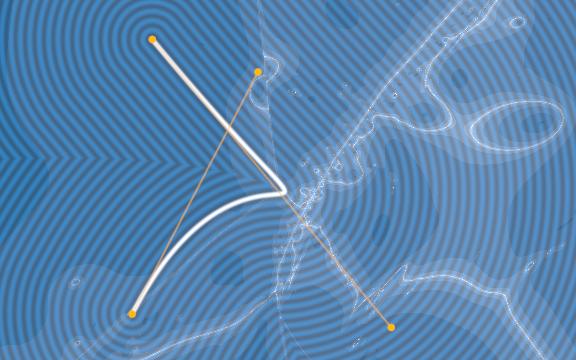
Bezier Customizer, a tool from Whimsical Animations
Create the perfect easing curve with this helpful tool!

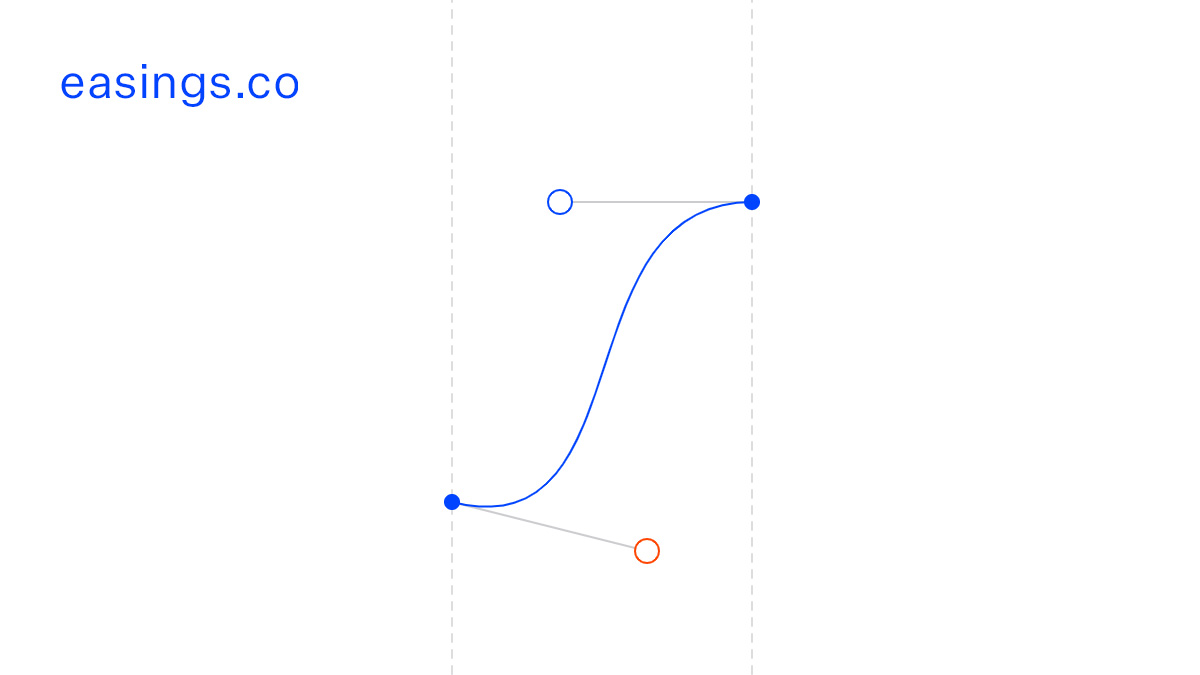
Easings - Generate, test and share custom easing curves.
Test common easing curves on a range of interfaces. Or generate and share your own cubic-bezier curves.
Notes on Gamma
The nuance between seeing and perceiving, linearity and non-linearity, what EOTFs are – and how to draw nice smooth gradients against the odds

kurvenlineal — scale fitter
kurvenlineal is a bezier easing run in reverse. Normally you start with a cubic-bezier() and sample values from it, in this case you start with the values: hand it a list of numbers and it finds the quadratic or cubic easing (endpoints fixed at 0,0 → 1,1) that stays as close as possible to all of them (a least-squares fit).

Curved Text Along a Path | CSS-Tricks
We can flow text along a curved line with three tools built right into SVG: , and .

DynaDraw - A Dynamic Drawing Program
The program Dynadraw implements a dynamic drawing technique that applies a simple filter to mouse positions. Here the brush is modeled as a physical object with mass, velocity and friction. The mouse pulls on the brush with a synthetic rubber band. By changing the amount of friction and mass, various kinds of strokes can be made. This kind of dynamic filtering makes it easy to create smooth, consistent calligraphic strokes.
SKÅDIS Spool Brackets - Free 3D Print Model - MakerWorld
Download this free 3D print file designed by jetpad. The Ultimate Filament Brackets for IKEA SKÅDIS Pegboard System! Transform your organization game with these filament brackets, meticulously designed for the IKEA SKÅDIS pegboard system. Key Features:Versatile Spool Support: Accommodates a variety of spool widths, ensuring compatibility with most filament brands.Efficient Design: Requires only one bracket per spool after the initial setup, making it resourceful and easy to manage.Secure Fit: Each bracket attaches firmly to the SKÅDIS pegboard with three connection points, ensuring stability and security.Minimal Filament Usage: Designed to be filament-efficient, these brackets won't drain your supply.Fast Printing: Optimized for quick print times, so you can get organized faster.Compact Print Size: Easily printable on an A1 mini, making it accessible for most 3D printer users.Tight Fit: Allows a snug fit of spools on the pegboard, maximizing your storage space.Batch Printing: Nests tightly on the build plate to print up to 8 brackets simultaneously, saving you time and effort.Aesthetically Pleasing: Crafted to look sleek and professional, enhancing the appearance of your workspace.Efficient Organization:Dual-Spool Support: Two spools can share a single bracket on each side, letting you support up to 10 spools with just 11 brackets.Customizable Spacing: Use the “A” bracket for optimal spacing of Bambu Labs spools and a variety of other sizes. For extreme cases with wider or thinner spools, print “B” brackets for customized spacing.Printing Tips:Bed Preparation: FRESHLY CLEAN YOUR PRINT BED WITH SOAP AND WATER BEFORE PRINTING! Material: PETG recommended for long term durability. PLA is not recommended. Why You'll Love It: These filament brackets are designed with the modern maker in mind. Not only do they provide a practical solution for filament storage, but they also enhance the aesthetic of your workspace with their sleek design. Easy to print, install, and use, they are a must-have for anyone looking to keep their 3D printing materials organized and accessible. You can fit three rows of these brackets on a single SKADIS board, leaving two rows of unused SKADIS connector holes at the bottom. To make use of this space, I’ve also designed brackets for mounting cereal box filament containers. These allow you to add a row of airtight cereal box holders below the board, helping you keep your filament organized and moisture-free while maximizing your storage setup. Printing the Brackets:There's an “A” bracket and a “B” bracket. Using all “A” brackets will give you correct spacing for Bambu Labs spools and should accommodate a wide variety of spool sizes. In extreme cases where you are using wider or thinner spools, you may need to print “B” brackets for different spacing. The “A” brackets have two tabs on the right and one of the left. The “B” brackets have two tabs on the left and one on the right. It may be helpful to print the “B” brackets in a different color to make it obvious. Update: January 2nd, 2025 - Modified the lip on the bracket to print at a slightly steeper angle. This should help keep the spools more secure. October 4th, 2025 - @Seidlm1982 has created some color sample tags to go with the spool holders.