

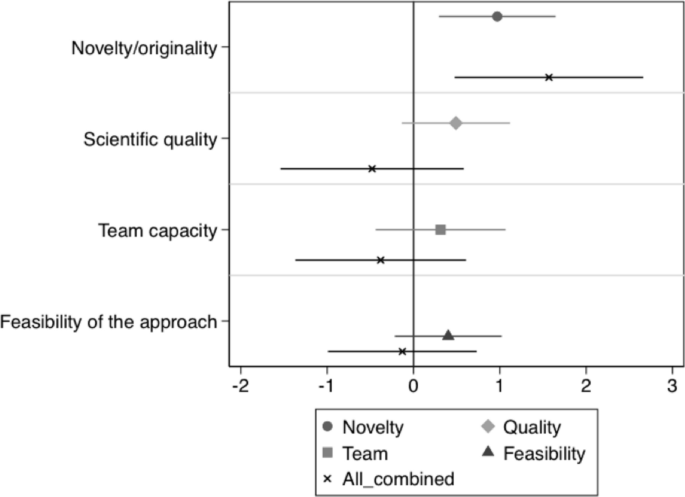
Generative AI (GenAI) tools, and large language models (LLMs) in particular, are being rapidly adopted across the scientific research process, including in funding evaluation and peer review. While their efficiency gains are well documented, their systematic biases remain comparatively understudied. A central concern is whether LLMs can recognise and value scientific novelty, an essential property for the long-run productivity of science. This paper examines 139 monodisciplinary research proposals submitted in 2021 to the Austrian Science Fund (FWF) in mathematics, physics and astronomy, chemistry, and biology. Each proposal carries expert-assigned scores for novelty, scientific quality, team capacity, and feasibility, along with the actual binary funding decision. Using GPT-4o, we generate AI-based funding decisions through within-field pairwise comparisons aggregated into field-level rankings, simulating a competitive selection process. AI-based funding decisions matched human funding decisions in 60% of cases. Conditional logistic regression with field fixed effects shows that, among the four review dimensions, novelty is the only one significantly associated with disagreement. Conditional and multinomial logit analyses further show that novelty systematically predicts the direction of disagreement. Proposals rated as more novel by human reviewers are substantially more likely to be funded by humans and not by the LLM. The observed pattern is consistent with a conservative tendency in LLM-based evaluation, potentially reflecting the statistical logic of next-token prediction trained on past scientific outputs. While the design does not allow us to identify the underlying mechanism, the results raise concerns that LLM-assisted evaluation may under-select proposals that human reviewers identify as highly novel.
Artificial intelligence tools expand scientists’ impact but contract science’s focus
Developments in artificial intelligence (AI) have accelerated scientific discovery1. Alongside recent AI-oriented Nobel prizes2–9, these trends establish the role of AI tools in science10. This advancement raises questions about the influence of AI tools on scientists and science as a whole, and highlights a potential conflict between individual and collective benefits11. To evaluate these questions, we used a pretrained language model to identify AI-augmented research, with an F1-score of 0.875 in validation against expert-labelled data. Using a dataset of 41.3 million research papers across the natural sciences and covering distinct eras of AI, here we show an accelerated adoption of AI tools among scientists and consistent professional advantages associated with AI usage, but a collective narrowing of scientific focus. Scientists who engage in AI-augmented research publish 3.02 times more papers, receive 4.84 times more citations and become research project leaders 1.37 years earlier than those who do not. By contrast, AI adoption shrinks the collective volume of scientific topics studied by 4.63% and decreases scientists’ engagement with one another by 22%. By consequence, adoption of AI in science presents what seems to be a paradox: an expansion of individual scientists’ impact but a contraction in collective science’s reach, as AI-augmented work moves collectively towards areas richest in data. With reduced follow-on engagement, AI tools seem to automate established fields rather than explore new ones, highlighting a tension between personal advancement and collective scientific progress.

The Rise of Large Language Models and the Direction and Impact of US Federal Research Funding
Federal research funding shapes the direction, diversity, and impact of the US scientific enterprise. Large language models (LLMs) are rapidly diffusing into scientific practice, holding substantial promise while raising widespread concerns. Despite growing attention to AI use in scientific writing and evaluation, little is known about how the rise of LLMs is reshaping the public funding landscape. Here, we examine LLM involvement at key stages of the federal funding pipeline by combining two complementary data sources: confidential National Science Foundation (NSF) and National Institutes of Health (NIH) proposal submissions from two large US R1 universities, including funded, unfunded, and pending proposals, and the full population of publicly released NSF and NIH awards. We find that LLM use rises sharply beginning in 2023 and exhibits a bimodal distribution, indicating a clear split between minimal and substantive use. Across both private submissions and public awards, higher LLM involvement is consistently associated with lower semantic distinctiveness, positioning projects closer to recently funded work within the same agency. The consequences of this shift are agency-dependent. LLM use is positively associated with proposal success and higher early-stage publication output at NIH, whereas no comparable associations are observed at NSF. Notably, the productivity gains at NIH are concentrated in non-hit papers rather than the most highly cited work. Together, these findings provide large-scale evidence that the rise of LLMs is reshaping how scientific ideas are positioned, selected, and translated into publicly funded research, with implications for portfolio governance, research diversity, and the long-run impact of science.

ScientistTwo: Pioneering the Human Knowledge Frontier with Autonomous AI
Scientific discovery is defined by the ability to identify the boundaries of existing knowledge and venture into unexplored territory. The ultimate vision for AI in science is problem-driven autonomous research: given a fundamental challenge by a human expert, the AI independently navigates the scientific landscape, uncovers theoretical and empirical bottlenecks, and systematically expands the frontier of knowledge. In this paper, we introduce ScientistTwo, a fully autonomous multi-agent framework designed to realize this vision. Specifically, ScientistTwo takes an initial problem as input, establishes state-of-the-art baselines, formulates novel hypotheses, and coordinates specialized agents to orchestrate an end-to-end discovery cycle without human intervention. Moreover, the framework rigorously conducts experiments using diverse datasets and metrics, refines methodologies through automated ablation studies, and validates research findings via a closed-loop simulated peer-review rebuttal engine. To evaluate ScientistTwo's capabilities against the highest standards of human scientific achievement, we benchmark it across papers accepted at top-tier conferences such as ICLR, ICML, and NeurIPS. As a result, ScientistTwo autonomously generates expert-level, publishable papers and fully verified, executable codebases. Its solutions consistently outperform human state-of-the-art models, and achieve higher average review ratings than human-authored papers under automated AI review agents. These results show that ScientistTwo is not merely an assistive tool but an autonomous scientific pioneer capable of pushing the frontiers of human discovery. Project website: https://scientist-two.github.io/
AI Research Agents Narrow Scientific Exploration
AI research agents now support large-scale AI-assisted scientific discovery. We examine whether AI-generated ideas broaden scientific exploration or primarily reinforce existing work. Using five agent frameworks and five large language models, we generate 219,655 ideas for different scientific fields. Across experiments, four consistent patterns emerge. First, AI-generated ideas are more concentrated than human-authored papers within the same research area. Second, they remain much closer to starting literature than later human follow-on work does. Third, AI-generated ideas align less with future human research. Last, AI-generated ideas are located in lower-impact regions of the historical scientific landscape. Overall, current AI research agents appear better suited to local elaboration than to broadening scientific exploration.
Towards Automating Scientific Review with Google's Paper Assistant Tool
Artificial intelligence is driving a revolution in scientific discovery, accelerating everything from hypothesis generation to mathematical theorem proving. However, this rapid acceleration is creating a systemic challenge: traditional human peer review cannot scale to match the influx of AI-assisted science. Ultimately, to resolve this tension, we must also deploy AI to accelerate the verification and review process itself. To frame the discussion around this transition, we propose a taxonomy consisting of four progressive levels of AI-human collaboration in scientific evaluation, and discuss various trade-offs involved with each. As a step toward this future, we introduce the Paper Assistant Tool (PAT), an agentic AI framework built for deep scientific review and verification. PAT ingests full scientific manuscripts and produces a comprehensive evaluation, checking theoretical results, validating experiments, suggesting improvements, and identifying potential flaws. By utilizing inference scaling techniques, PAT is able to identify deeper issues than a single model call alone, achieving a 34% improvement over zero-shot recall on mathematical errors in the SPOT benchmark. Pilot deployments of PAT as a pre-submission tool for authors at two major Computer Science conferences -- STOC and ICML -- demonstrate its ability to identify critical errors and suggest substantive improvements to research papers. By catching errors early, PAT eases the cognitive burden placed on referees, while preserving their control over the outcomes of the review process.
Old Ideas, Novel Problems: The Instability of LLM-Based Novelty Evaluation
AI-based ideation systems are often evaluated on the novelty of their ideas, and that judgment is increasingly delegated to large language models. Such judges are typically built ad hoc and validated, if at all, on human-authored papers rather than on the generated ideas they are meant to score. So, how do novelty judges perform? Not well. We present a systematic controlled study of novelty evaluation design choices. We build an evaluation set automatically, mining OpenReview for passages where reviewers explicitly affirm or dispute a paper's originality and keeping only submissions with unanimous agreement at the extremes of their research area; we pair these with ideas from a vanilla LLM generator. Across six judges, we find that seemingly small prompt design choices have large consequences; e.g., simply telling the judge that reviewers found one idea novel and the other not can change its verdict on more than half of the identical idea pairs it is shown, shifting pairwise accuracy by over 50 points and occasionally pushing it below chance. The same change helps one judge and hurts another. Retrieval and larger reasoning budgets help little, and two purpose-built novelty evaluators are outperformed by our cheapest prompted baseline. These results raise questions about reported novelty gains of automated ideation systems, and call for robust novelty evaluation methods.
AI-Assisted Peer Review at Scale: The AAAI-26 AI Review Pilot
Scientific peer review faces mounting strain as submission volumes surge, making it increasingly difficult to sustain review quality, consistency, and timeliness. Recent advances in AI have led the community to consider its use in peer review, yet a key unresolved question is whether AI can generate technically sound reviews at real-world conference scale. Here we report the first large-scale field deployment of AI-assisted peer review: every main-track submission at AAAI-26 received one clearly identified AI review from a state-of-the-art system. The system combined frontier models, tool use, and safeguards in a multi-stage process to generate reviews for all 22,977 full-review papers in less than a day. A large-scale survey of AAAI-26 authors and program committee members showed that participants not only found AI reviews useful, but actually preferred them to human reviews on key dimensions such as technical accuracy and research suggestions. We also introduce a novel benchmark and find that our system substantially outperforms a simple LLM-generated review baseline at detecting a variety of scientific weaknesses. Together, these results show that state-of-the-art AI methods can already make meaningful contributions to scientific peer review at conference scale, opening a path toward the next generation of synergistic human-AI teaming for evaluating research.
Evaluating large language models as grant reviewers: a comparative study of prompt engineering strategies
Grant application review is resource-intensive and subject to inter-rater variability. Large language models (LLMs) may augment this process, but their reliability in grant evaluation remains unexplored. This exploratory pilot study compared LLM-generated grant reviews to human expert reviews across three prompt engineering strategies: zero-shot (no examples), few-shot (multiple training examples), and few-shot with strict scoring instructions. Three commercial LLMs (OpenAI GPT-5 Nano, Google Gemini 2.5 Flash, xAI Grok 4 Fast Reasoning) each reviewed three de-identified faculty seed grant applications ($5,000 awards) under each condition, generating 63 LLM reviews compared against 12 human expert reviews. Among the three conditions tested, few-shot prompting produced scores closest to human reviewers (mean difference: −2.57 points on a 100-point scale, p = 0.671, Glass's Δ = −0.19). Zero-shot prompting showed moderate optimism bias (+4.55 points, p = 0.347) and strict instructions produced substantial under-scoring (−10.68 points, p = 0.097). LLMs demonstrated 49%–59% lower score dispersion than humans (49% in Experiment 1 and 59% in Experiments 2–3), which likely reflects range restriction. Chance-corrected agreement between LLM and human funding recommendations was at or below chance in every condition (Cohen's κ: −0.11–0.05), indicating LLM funding recommendations provided no meaningful signal beyond chance. These preliminary findings suggest prompt engineering affects LLM scoring behavior in this sample, and that LLMs cannot yet reliably replicate human grant review scores or funding recommendations but may provide adjunctive data for consideration.

Can LLMs Identify Critical Limitations within Scientific Research? A Systematic Evaluation on AI Research Papers
Peer review is fundamental to scientific research, but the growing volume of publications has intensified the challenges of this expertise-intensive process. While LLMs show promise in various scientific tasks, their potential to assist with peer review, particularly in identifying paper limitations, remains understudied. We first present a comprehensive taxonomy of limitation types in scientific research, with a focus on AI. Guided by this taxonomy, for studying limitations, we present LimitGen, the first comprehensive benchmark for evaluating LLMs' capability to support early-stage feedback and complement human peer review. Our benchmark consists of two subsets: LimitGen-Syn, a synthetic dataset carefully created through controlled perturbations of high-quality papers, and LimitGen-Human, a collection of real human-written limitations. To improve the ability of LLM systems to identify limitations, we augment them with literature retrieval, which is essential for grounding identifying limitations in prior scientific findings. Our approach enhances the capabilities of LLM systems to generate limitations in research papers, enabling them to provide more concrete and constructive feedback.
The unintended consequences of large language models as a labor-augmenting technology in science
As a labor-augmenting technology, large language models (LLMs) have the potential to accelerate scientific activity across the research pipeline. But even if LLMs perform on par with human experts at selected tasks, their use will bring unintended consequences as they alter the balance of frictions and inducements that steer the allocation of research effort across projects. Here we develop a simple mathematical model to illustrate. In fields where LLMs are useful primarily as tools for discovering promising projects, researchers will become more selective about what they publish; where they facilitate the process of publishing existing data, researchers will become less selective. By allowing scientists to work more quickly, LLMs raise the opportunity cost of researcher time, creating incentives to refine papers less thoroughly before moving on. Enticing as it is to imagine that, by saving us time on mundane tasks, LLMs will provide us with more time to think deeply and develop projects completely, our results temper such hopes.
Can AI Agents Synthesize Scientific Conclusions?
Scientific AI agents increasingly retrieve evidence, reason across sources, and synthesize conclusions used in consequential decisions. Yet, their ability to do so in high-stakes domains such as health remains unclear. We introduce SciConBench, a large-scale live benchmark of 9.11K questions and expert-written conclusions from systematic reviews to evaluate open-domain scientific conclusion synthesis. The benchmark draws on an expert-validated automated evaluation pipeline that decomposes conclusions into atomic facts and measures correctness and comprehensiveness via factual precision and recall. To mitigate data leakage, we further introduce SciConHarness, a clean-room evaluation harness that equips agents with controlled web interaction to ensure valid measurement. Evaluating 8 frontier models and deep research agents, we find that factual quality remains low: under clean-room settings, the best agent achieves only a factual F1 of 0.337. Our clean-room setting consistently reduces performance relative to unconstrained evaluation, suggesting that leakage inflates estimates of models' true synthesis capabilities. Finally, we audit consumer-facing agents (e.g., Google AI Overview, OpenEvidence) and find they frequently generate incomplete and sometimes contradictory conclusions, even when the ground-truth answer is available. Overall, our results show that reliable synthesis of scientific conclusions remains an open challenge, and that clean-room evaluation is essential for assessing open-domain AI agents.
Pre-review to Peer review: Pitfalls of Automating Reviews using Large Language Models
Large Language Models are versatile general-task solvers, and their capabilities can truly assist people with scholarly peer review as \textit{pre-review} agents, if not as fully autonomous \textit{peer-review} agents. While incredibly beneficial, automating academic peer-review, as a concept, raises concerns surrounding safety, research integrity, and the validity of the academic peer-review process. The majority of the studies performing a systematic evaluation of frontier LLMs generating reviews across science disciplines miss the mark on addressing the alignment/misalignment of reviews along with the utility of LLM generated reviews when compared against publication outcomes such as \textbf{Citations}, \textbf{Hit-papers}, \textbf{Novelty}, and \textbf{Disruption}. This paper presents an experimental study in which we gathered ground-truth reviewer ratings from OpenReview and used various frontier open-weight LLMs to generate reviews of papers to gauge the safety and reliability of incorporating LLMs into the scientific review pipeline. Our findings demonstrate the utility of frontier open-weight LLMs as pre-review screening agents despite highlighting fundamental misalignment risks when deployed as autonomous reviewers. Our results show that all models exhibit weak correlation with human peer reviewers (0.15), with systematic overestimation bias of 3-5 points and uniformly high confidence scores (8.0-9.0/10) despite prediction errors. However, we also observed that LLM reviews correlate more strongly with post-publication metrics than with human scores, suggesting potential utility as pre-review screening tools. Our findings highlight the potential and address the pitfalls of automating peer reviews with language models. We open-sourced our dataset $D_{LMRSD}$ to help the research community expand the safety framework of automating scientific reviews.
LLMs Can Assist with Proposal Selection at Large User Facilities
We explore how large language models (LLMs) can enhance the proposal selection process at large user facilities, offering a scalable, consistent, and cost-effective alternative to traditional human review. Proposal selection depends on assessing the relative strength among submitted proposals; however, traditional human scoring often suffers from weak inter-proposal correlations and is subject to reviewer bias and inconsistency. A pairwise preference-based approach is logically superior, providing a more rigorous and internally consistent basis for ranking, but its quadratic workload makes it impractical for human reviewers. We address this limitation using LLMs. Leveraging the uniquely well-curated proposals and publication records from three beamlines at the Spallation Neutron Source (SNS), Oak Ridge National Laboratory (ORNL), we show that the LLM rankings correlate strongly with the human rankings (Spearman $ρ\simeq 0.2-0.8$, improving to $\geq 0.5$ after 10\% outlier removal). Moreover, LLM performance is no worse than that of human reviewers in identifying proposals with high publication potential, while costing over two orders of magnitude less. Beyond ranking, LLMs enable advanced analyses that are challenging for humans, such as quantitative assessment of proposal similarity via embedding models, which provides information crucial for review committees.
Can large language models provide useful feedback on research papers? A large-scale empirical analysis
Expert feedback lays the foundation of rigorous research. However, the rapid growth of scholarly production and intricate knowledge specialization challenge the conventional scientific feedback mechanisms. High-quality peer reviews are increasingly difficult to obtain. Researchers who are more junior or from under-resourced settings have especially hard times getting timely feedback. With the breakthrough of large language models (LLM) such as GPT-4, there is growing interest in using LLMs to generate scientific feedback on research manuscripts. However, the utility of LLM-generated feedback has not been systematically studied. To address this gap, we created an automated pipeline using GPT-4 to provide comments on the full PDFs of scientific papers. We evaluated the quality of GPT-4's feedback through two large-scale studies. We first quantitatively compared GPT-4's generated feedback with human peer reviewer feedback in 15 Nature family journals (3,096 papers in total) and the ICLR machine learning conference (1,709 papers). The overlap in the points raised by GPT-4 and by human reviewers (average overlap 30.85% for Nature journals, 39.23% for ICLR) is comparable to the overlap between two human reviewers (average overlap 28.58% for Nature journals, 35.25% for ICLR). The overlap between GPT-4 and human reviewers is larger for the weaker papers. We then conducted a prospective user study with 308 researchers from 110 US institutions in the field of AI and computational biology to understand how researchers perceive feedback generated by our GPT-4 system on their own papers. Overall, more than half (57.4%) of the users found GPT-4 generated feedback helpful/very helpful and 82.4% found it more beneficial than feedback from at least some human reviewers. While our findings show that LLM-generated feedback can help researchers, we also identify several limitations.
The Discovery Engine: A Framework for AI-Driven Synthesis and Navigation of Scientific Knowledge Landscapes
Scientific progress relies on the effective accumulation, synthesis, and critical evaluation of knowledge. Traditionally, the well-documented, peer reviewed publication served as the primary standard for filtering and disseminating credible findings within the scientific community. Recently, however, we are witnessing an unprecedented acceleration in research output, a veritable explosion of scientific publications across all disciplines [1]. Yet, this very abundance creates a paradox: the sheer volume threatens to overwhelm the mechanisms designed for its assimilation and synthesis. Researchers, even within highly specialized subfields, face an almost insurmountable challenge in keeping abreast of relevant developments, integrating disparate findings, and identifying the truly novel signals amidst the noise [2]. This information overload contributes to disciplinary fragmentation, hindering the cross-pollination of ideas essential for disruptive innovation [3]. Furthermore, persistent concerns regarding "reproducibility crisis" [2], predatory journals, inflation of research areas[4], growing retractions and the potential influences of bibliometrics on research direction [5] highlight systemic challenges in validating and prioritizing scientific contributions to fundamental knowledge.