Analyzed through the lens of the “computerization movement” (CM), the development of revolutionary technologies has consistently followed a recurring trajectory in terms of the origin, momentum, diffusion, and societal impact. Building on the analysis of selected historical trajectories, similar dynamics are discernible for the recent push towards the adoption of artificial intelligence (AI), being enhanced by capabilities provided by Big Data infrastructure. This paper explores Big Data and AI within the framework of CMs, analyzing their driving visions, trajectories, interconnectedness, and the societal discourses formed around their adoption. By drawing parallels with selected past CMs and situating current events within such historical context, this study provides a novel perspective hopefully facilitating a better understanding of the current technological landscape, and aiding in the navigation of the complex interplay between innovation, social change, and human expectations. The study shows that even if technological innovations remain central for the recent push towards AI adoption, shared beliefs and visionary ideals underpinning adoption are equally influential. These beliefs and ideals have continually mobilized people around the relevance of AI—in the past and today—even as the supporting infrastructure, core technologies, and their relevance for society have evolved.
The Scaling Era: An Oral History of AI, 2019–2025
An inside view of the AI revolution, from the people and companies making it happen.

Irresponsible AI: big tech’s influence on AI research and associated impacts
The accelerated development, deployment and adoption of artificial intelligence systems has been fuelled by the increasing presence of big tech in the AI field. This trend has been accompanied by growing ethical concerns and intensified societal and environmental impacts. This position paper argues that irresponsible AI development is strongly driven by big tech’s influence and involvement in the field. First, we examine the growing and disproportionate influence of big tech in AI research and argue that its drive for scaling and general-purpose systems is fundamentally at odds with the responsible, ethical, and sustainable development of AI. Second, we review key current environmental and societal negative impacts of AI and trace their connections to big tech’s influence. Third, we discuss the underlying economic forces driving big tech’s actions. Finally, as a call to action, we invite AI researchers to counter big tech’s influence in irresponsible AI development through strategies that build on the responsibility of implicated actors and collective action.
The Scaling Era: An Oral History of AI, 2019–2025
An inside view of the AI revolution, from the people an…

Irresponsible AI: big tech's influence on AI research and associated impacts
The accelerated development, deployment and adoption of artificial intelligence systems has been fuelled by the increasing presence of big tech in the AI field. This trend has been accompanied by growing ethical concerns and intensified societal and environmental impacts. This position paper argues that irresponsible AI development is strongly driven by big tech's influence and involvement in the field. First, we examine the growing and disproportionate influence of big tech in AI research and argue that its drive for scaling and general-purpose systems is fundamentally at odds with the responsible, ethical, and sustainable development of AI. Second, we review key current environmental and societal negative impacts of AI and trace their connections to big tech's influence. Third, we discuss the underlying economic forces driving big tech's actions. Finally, as a call to action, we invite AI researchers to counter big tech's influence in irresponsible AI development through strategies that build on the responsibility of implicated actors and collective action.
Andrej Karpathy on Twitter / X
Sharing an interesting recent conversation on AI's impact on the economy.AI has been compared to various historical precedents: electricity, industrial revolution, etc., I think the strongest analogy is that of AI as a new computing paradigm (Software 2.0) because both are…— Andrej Karpathy (@karpathy) November 16, 2025
Something Big Is Happening
A personal note for non-tech friends and family on what AI is starting to change.

70 years of AI hype
Quoting from Olivia Guest et al. (2025) "Against the Uncritical Adoption of AI Technologies in Academia."

A Collectivist, Economic Perspective on AI
Information technology is in the midst of a revolution in which omnipresent data collection and machine learning are impacting the human world as never before. The word ``intelligence'' is being...
A Collectivist, Economic Vision for AI
Information technology is in the midst of a revolution in which omnipresent data collection and machine learning are impacting the human world as never before. The word “intelligence” is being used as a North Star for the development of this technology, with human cognition viewed as a baseline. This view neglects the fact that humans are social animals and that much of our intelligence is social and cultural in origin. Moreover, failing to properly situate aspects of intelligence at the social level contributes to the treatment of the societal consequences of technology as an afterthought. The path forward is not merely more data and compute, and not merely more attention paid to cognitive or symbolic representations, but a thorough blending of economic and social concepts with computational and inferential concepts at the level of algorithm design. , The recent focus of AI has been on the exploitation of massive data to mimic and augment human cognitive capabilities. A complementary focus is provided by the social and economic aspects of intelligence.

Qualitative Research in an Era of Artificial Intelligence: A Pragmatic Approach to Data Analysis, Workflow, and Computation
Computational developments—particularly artificial intelligence—are reshaping social scientific research and raising new questions for in-depth methods such as ethnography and qualitative interviewing. Building on classic debates about computers in qualitative data analysis, we revisit possibilities and dangers in an era of automation, large language model chatbots, and big data. We introduce a typology of contemporary approaches to using computers in qualitative research: streamlining workflows, scaling up projects, hybrid analytical methods, the sociology of computation, and technological rejection. Drawing from scaled team ethnographies and solo research integrating computational social science alongside in-depth observation, we describe methodological choices across study life cycles, from literature reviews through data collection, coding, text retrieval, and representation. We argue that new technologies hold potential to address long-standing methodological challenges when deployed with knowledge, purpose, and ethical commitment. Yet, a pragmatic approach—moving beyond technological optimism and dismissal—is essential given rapidly changing tools that are both generative and dangerous. Computation now saturates research infrastructure, from algorithmic literature searches to scholarly metrics, making computational literacy a core methodological competence in and beyond sociology. We conclude that when used carefully and transparently, contemporary computational tools can meaningfully expand, rather than displace, the irreducible insights of qualitative research.

Intelligence Rising
Artificial Intelligence (AI) is expected to be one of the most transformative technologies in human history.

AI Slop and the End of Knowledge
As an early fan of the internet, I was amazed that all the knowledge of the world was becoming available to everyone, everywhere, all the time. But things have changed.

Large AI models are cultural and social technologies
Implications draw on the history of transformative information systems from the past , Debates about artificial intelligence (AI) tend to revolve around whether large models are intelligent, autonomous agents. Some AI researchers and commentators speculate that we are on the cusp of creating agents with artificial general intelligence (AGI), a prospect anticipated with both elation and anxiety. There have also been extensive conversations about cultural and social consequences of large models, orbiting around two foci: immediate effects of these systems as they are currently used, and hypothetical futures when these systems turn into AGI agents—perhaps even superintelligent AGI agents. But this discourse about large models as intelligent agents is fundamentally misconceived. Combining ideas from social and behavioral sciences with computer science can help us to understand AI systems more accurately. Large models should not be viewed primarily as intelligent agents but as a new kind of cultural and social technology, allowing humans to take advantage of information other humans have accumulated.

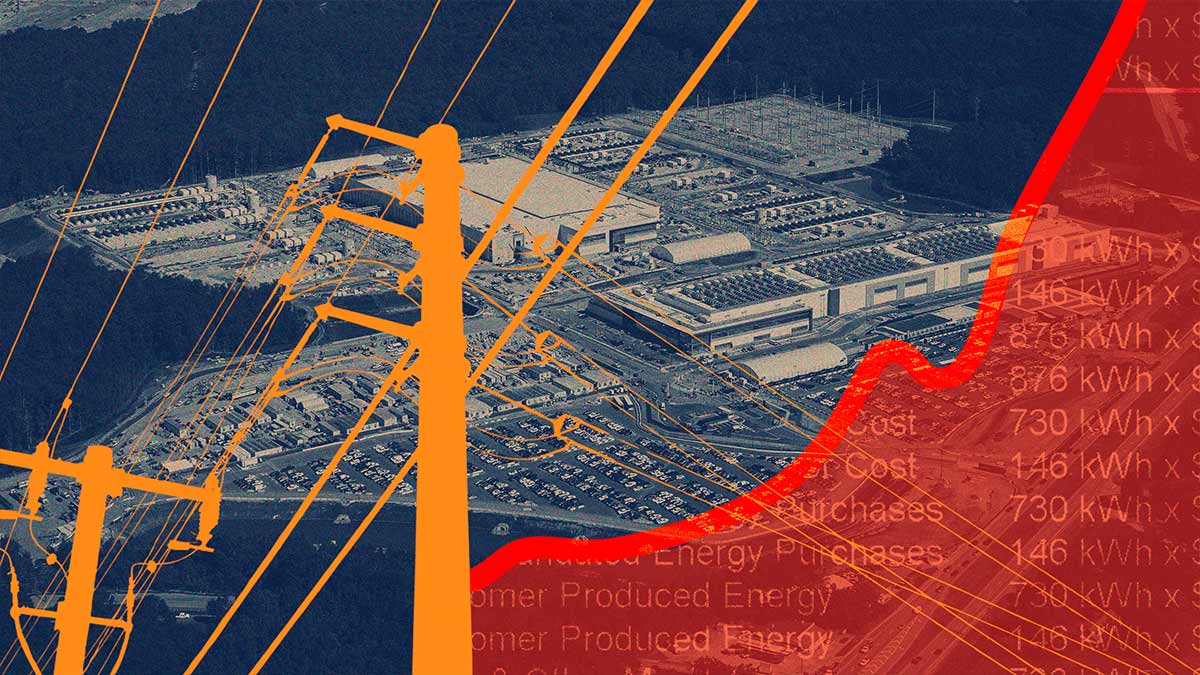
AI Data Centers: Big Tech's Impact on Electric Bills, Water, and More via @ConsumerReports
Massive data centers are gobbling up resources across the United States. The boom has just begun—and you may be paying for it.