

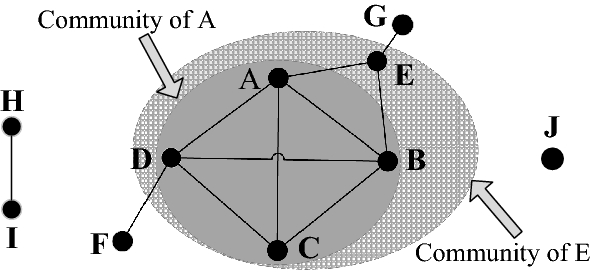
With the rapid development of information technologies, various big graphs are prevalent in many real applications (e.g., social media and knowledge bases). An important component of these graphs is the network community. Essentially, a community is a group of vertices which are densely connected internally. Community retrieval can be used in many real applications, such as event organization, friend recommendation, and so on. Consequently, how to efficiently find high-quality communities from big graphs is an important research topic in the era of big data. Recently, a large group of research works, called community search, have been proposed. They aim to provide efficient solutions for searching high-quality communities from large networks in real time. Nevertheless, these works focus on different types of graphs and formulate communities in different manners, and thus, it is desirable to have a comprehensive review of these works. In this survey, we conduct a thorough review of existing community search works. Moreover, we analyze and compare the quality of communities under their models, and the performance of different solutions. Furthermore, we point out new research directions. This survey does not only help researchers to have better understanding of existing community search solutions, but also provides practitioners a better judgment on choosing the proper solutions.
Span-reachability querying in large temporal graphs
Reachability is a fundamental problem in graph analysis. In applications such as social networks and collaboration networks, edges are always associated with timestamps. Most existing works on reachability queries in temporal graphs assume that two vertices are related if they are connected by a path with non-decreasing timestamps (time-respecting) of edges. This assumption fails to capture the relationship between entities involved in the same group or activity with no time-respecting path connecting them. In this paper, we define a new reachability model, called span-reachability, designed to relax the time order dependency and identify the relationship between entities in a given time period. We adopt the idea of two-hop cover and propose an index-based method to answer span-reachability queries. Several optimizations are also given to improve the efficiency of index construction and query processing. We conduct extensive experiments on eighteen real-world datasets to show the efficiency of our proposed solution.

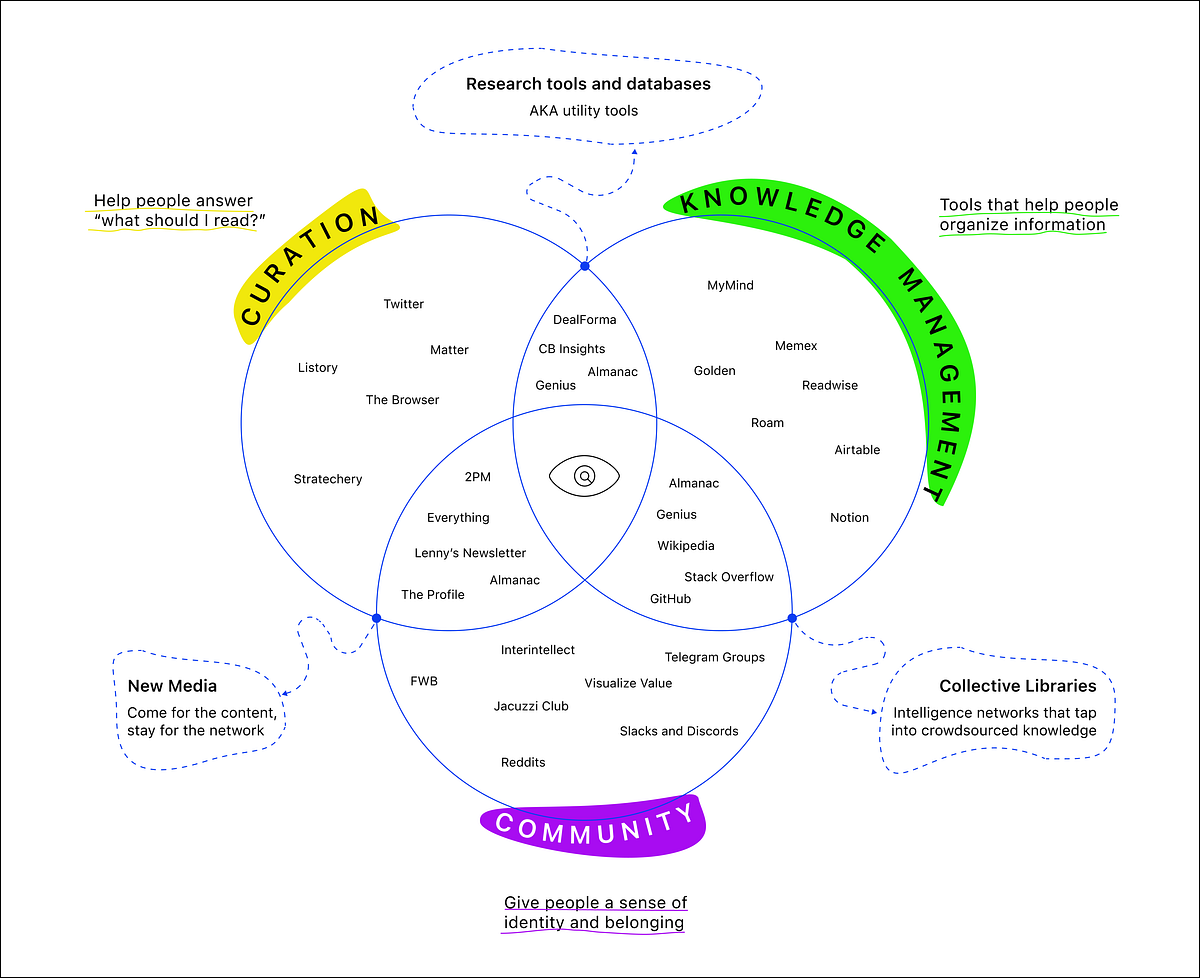
The rise of community-curated knowledge networks
The Internet put thousands of years of human thought at our fingertips, and enabled billions of people to create content. At least 2.5…
Fill The Sky
An interactive map of Bluesky communities — 545K people, 418 communities, discovered by graph analysis.
Tim Berners-Lee, Giant Global Graph (2007)
A new vision for the web where the users master their data and link them to everybody's benefit in a giant global graph.

Discord Alternatives, Ranked
Building an online community takes more than tools. But the right tool can make all the difference.
Optimizing web search using social annotations
This paper is concerned with the problem of browsing social annotations. Today, a lot of services (e.g., Del.icio.us, Filckr) have been provided for helping users to manage and share their favorite URLs and photos based on social annotations. Due to the ...

Open Villages - Community-run social networks: rest of the world
An entire Social Network in 1.6GB (GraphD Part 2)
Roaring Bitmaps offer an even more efficient way to store and query an entire social graph, fitting the entire network of 5.5M users and 164M+ follows into a ~1.6GB SQLite DB on disk.
surrealdb/surrealdb
A scalable, distributed, collaborative, document-graph database, for the realtime web
SemRepo: A Knowledge Graph for Research Software and Its Scholarly Ecosystem
We present SemRepo, an RDF knowledge graph comprising over 81 million triples describing nearly 200,000 GitHub repositories associated with scientific research. SemRepo captures repository-level metadata, such as contributors, issues, and programming languages, and interlinks this information with external scholarly knowledge graphs. In particular, repository authors are linked to their profiles in SemOpenAlex, repositories are connected to scholarly publications in LPWC, and research artifacts, such as datasets and experiments, are linked via MLSea-KG. This integration enables queries that span publications and their scholarly artifacts, which are typically fragmented across separate platforms. SemRepo supports analyses that are difficult to perform with existing resources in isolation, including provenance reconstruction across repositories and publications, as well as the systematic identification of risks to research reproducibility and software sustainability. By unifying research software with its scholarly context in a single graph, SemRepo provides an important infrastructure for large-scale analysis of software within the broader scientific research ecosystem.

Community Archive
An open, searchable archive of tweets that members of the community have chosen to make public. Browse profiles, search conversations, and build on the data.
Building the European Research Area as a social network - MyHub Experiments Wiki
Powerful communities, simple sites Event co-creation use case MyHub on the ATmosphere
lieu — alexander cobleigh / cblgh.org
a purpose-built community search engine and how to use it
A great little thread for distinct social graphs. @sprk.so will definitely be taking ‘hints’ from existing ones (like Bsky), already in the works.

Blaine
Definitely room for UX exploration, but no-ones has a single social graph. It's the biggest lie zuck ever told. 😅 There's a lot of writing on this, but a decent place to start is Erving Goffman; we wear different masks and perform to different audiences depending on social context.
