

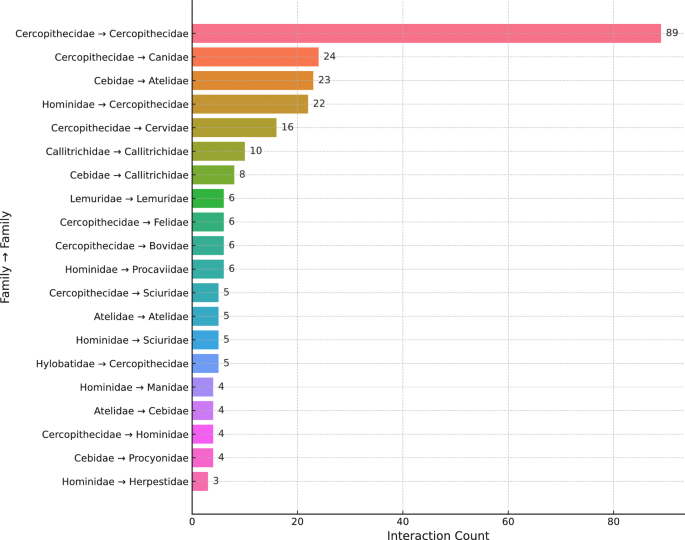
Primate interspecific interactions with both other primates and non-primate species range from predator–prey dynamics to affiliative behaviors such as grooming, play, and carrying. While many primates participate in interspecific associations or commensal relationships, to our knowledge interspecific social interactions have never been systematically synthesized. Here, we present the first comprehensive review of such interactions, compiling 427 cases from the literature, media sources, and a global survey of primatologists. These involved 88 primate species and 127 non-primate species (including mammals, birds, reptiles, amphibians, malacostracans, and insects) across wild (n = 311) and captive (n = 111) contexts. The most frequent interactions occurred within or between primate families (e.g., Cercopithecidae–Cercopithecidae, Cebidae–Atelidae), though affiliative behaviors were also directed toward distantly related taxa such as dogs and birds. Play (n = 139) and grooming (n = 136) were most common. Juveniles and infants predominantly engaged in play, while adult females were more likely to groom. Adult males were less affiliative overall. Contrary to expectations, affiliative behaviors were not more often directed toward immature than adult heterospecifics. Primates were the initiators in most interactions. These findings offer new insights into the diversity and contexts of heterospecific sociality in primates and suggest that some behavioral tendencies relevant to later forms of human–animal companionship – such as caregiving, tolerance, and exploratory play – may be more widespread among primates than previously recognized.
Humans Love Having Pets. Seems Like Some Other Primates Do, Too.
We aren’t the only animals that like to take care of other species. A new study finds that the roots of keeping a pet may stretch deep into our primate past.

Human–Animal Interaction and Human Prosociality: A Meta-Analytic Review of Experimental and Correlational Studies
Pet ownership and interactions with animals confer various physiological and psychological benefits to humans. Although interactions with animals are commonplace, there is no consensus in the liter...
Mechanisms of social cognition
Social animals including humans share a range of social mechanisms that are automatic and implicit and enable learning by observation. Learning from others includes imitation of actions and mirroring of emotions. Learning about others, such as their group membership and reputation, is crucial for social interactions that depend on trust. For accurate prediction of others' changeable dispositions, mentalizing is required, i.e., tracking of intentions, desires, and beliefs. Implicit mentalizing is present in infants less than one year old as well as in some nonhuman species. Explicit mentalizing is a meta-cognitive process and enhances the ability to learn about the world through self-monitoring and reflection, and may be uniquely human. Meta-cognitive processes can also exert control over automatic behavior, for instance, when short-term gains oppose long-term aims or when selfish and prosocial interests collide. We suggest that they also underlie the ability to explicitly share experiences with other agents, as in reflective discussion and teaching. These are key in increasing the accuracy of the models of the world that we construct.
Social Insects : Ecology and Behavioural Biology
1 online resource; Here is a guide to the ecology of social insects. It is intended for general ecologists and entomologists as well as for undergraduates and those about to start research on social insects; even the experienced investigator may find the comparison between different groups of social insects illuminating. Most technical terms are translated into common language as far as can be done without loss of accuracy but scientific names are unavoidable. Readers will become familiar with the name even though they cannot visualize the animal and could reflect that only a very few of the total species have been studied so far! References too are essential and with these it should be possible to travel more deeply into the vast research literature, still increasing monthly. When I have cited an author in another author's paper, this implies that I have not read the original and the second author must take responsi bility for accuracy! Many hands and heads have helped to make this book. I thank all my colleagues past and present for their enduring though critical support, and I thank with special pleasure: E.]. M. Evesham who fashioned the diagrams;]. Free, D.J. Stradling and]. P.E.C. Darlington who supplied photographs; D.Y. Brian and R.A. Weller who were meticulous on the linguistic side; and G. Frith and R.M. Jones who collated the references. List of plates 1. Fungus combs of Acromyrmex octospinosus and Macrotermes michaelseni. 13 2. Mouthparts of larval Myrmica; 1 Introduction -- 2 Food -- 2.1 Termites as decomposers -- 2.2 Wasps and ants as predators -- 2.3 Sugars as fuel save prey -- 2.4 Seed eaters -- 2.5 Leaf eaters -- 2.6 Pollen eaters -- 3 Foraging by individuals -- 3.1 Foraging strategy -- 3.2 Worker variability -- 4 Foraging in groups -- 4.1 Communication about food -- 4.2 Group slave-raiding -- 4.3 Tunnels and tracks -- 4.4 Nomadic foraging -- 5 Cavity nests and soil mounds -- 5.1 Cavities and burrows -- 5.2 Soil mounds -- 6 Nests of fibre, silk and wax -- 6.1 Mounds of vegetation and tree nests -- 6.2 Combs of cells -- 7 Microclimate -- 7.1 Environmental regulation -- 7.2 Metabolic regulation -- 8 Defence -- 8.1 Painful and paralysing injections -- 8.2 Toxic smears and repellants -- 9 Food processing -- 9.1 Mastication, extraction and regurgitation -- 9.2 Yolk food supplements -- 9.3 Head food glands -- 10 Early population growth -- 10.1 Food distribution -- 10.2 Colony foundation -- 10.3 The growth spurt -- 11 Maturation -- 11.1 Simple models of reproduction -- 11.2 Social control over caste -- 11.3 Males in social Hymenoptera -- 11.4 Maturation in general -- 12 Reproduction -- 12.1 Caste morphogenesis -- 12.2 Copulation and dispersal -- 12.3 Production -- 12.4 Summary -- 13 Evolution of insect societies -- 13.1 Theories of individual selection -- 13.2 Models of these theories -- 13.3 Group selection -- 13.4 Conclusions -- 14 Colonies -- 14.1 The colony barrier -- 14.2 Queen number and species ecology -- 14.3 Queen interaction and queen relatedness -- 15 Comparative ecology of congeneric species -- 15.1 Ant and termite races -- 15.2 Desert ants and termites -- 15.3 Ants and termites in grassland -- 15.4 Forest ants and termites -- 15.5 Wasps and bumblebees -- 15.6 Advanced bees -- 16 Communities -- 16.1 Temperate zone communities in grass and woodland -- 16.2 Desert communities -- 16.3 Tropical rain forest -- 16.4 Conclusions -- 17 Two themes -- 17.1 Plant mutualism -- 17.2 Social organization -- References -- Author index

Richard McElreath Director Department of Human Behavior, Ecology, and Culture [link] Max Planck Institute for Evolutionary Anthropology [link]
Eusociality
Eusociality is the highest level of organization of sociality. It is defined by the following characteristics: cooperative brood care, overlapping generations within a colony of adults, and a division of labor into reproductive and non-reproductive groups. The division of labor creates specialized behavioral groups within an animal society, sometimes called castes. Eusociality is distinguished from all other social systems because individuals of at least one caste usually lose the ability to perform behaviors characteristic of individuals in another caste. Eusocial colonies can be viewed as superorganisms.

Diverse Locations and a Long History: Historical Context for Urban Leopards (Panthera pardus) in the Early Anthropocene From Seoul, Korea
While the urban landscapes of the early Anthropocene may appear hostile to large carnivores, humans and leopards (Panthera pardus) are known to co-inhabit major urban centres like Mumbai (India), Nairobi (Kenya) and Johannesburg (South Africa). We provide evidence that the presence of leopards in urban landscapes is not, however, a new phenomenon and has occurred repeatedly over the early history of the Anthropocene. Using records of Amur leopards (P. p. orientalis) in Seoul, Korea, at the end of the 19th century, a capital city and major urban centre with a high human population density, we explore socio-cultural, political and ecological factors that may have facilitated human-leopard co-occurrence in an urban landscape and the factors that eventually led to the leopards' extirpation. We suggest that, in the absence of unsustainable levels of persecution by humans, leopards are able to persist in urban landscapes which contain small patches of dense vegetation and have sufficient alternative food supplies. In light of the continued expansion of urban landscapes in the 21st century and increasing conservation focus on the presence of large carnivore populations there, this paper provides historical context to human co-existence with leopards in urban landscapes during the Anthropocene – and what we can learn from it for the future.

Mutual Aid: A Factor of Evolution
From Mutual Aid In the animal world we have seen that the vast majority of species live in societies, and that they find in association the best arms for the struggle for life: understood, of course, in its wide Darwinian sense — not as a struggle for the sheer means of existence, but as a … Continued
Run, Spot, Run: The Ethics of Keeping Pets
A life shared with pets brings many emotions. We feel love for our companions, certainly, and happiness at the thought that we’re providing them with a safe, healthy life. But there’s another emotion, less often acknowledged, that can be nearly as powerful: guilt. When we see our cats gazing wistfully out the window, or watch a goldfish swim lazy circles in a bowl, we can’t help but wonder: are we doing the right thing, keeping these independent beings locked up, subject to our control? Is keeping pets actually good for the pets themselves? That’s the question that animates Jessica Pierce’s powerful Run, Spot, Run. A lover of pets herself (including, over the years, dogs, cats, fish, rats, hermit crabs, and more), Pierce understands the joys that pets bring us. But she also refuses to deny the ambiguous ethics at the heart of the relationship, and through a mix of personal stories, philosophical reflections, and scientifically informed analyses of animal behavior and natural history, she puts pet-keeping to the test. Is it ethical to keep pets at all? Are some species more suited to the relationship than others? Are there species one should never attempt to own? And are there ways that we can improve our pets’ lives, so that we can be confident that we are giving them as much as they give us? Deeply empathetic, yet rigorous and unflinching in her thinking, Pierce has written a book that is sure to help any pet owner, unsettling assumptions but also giving them the knowledge to build deeper, better relationships with the animals with whom they’ve chosen to share their lives.

Human Predators: Groundbreaking insights into the red f…
Discover and share books you love on Goodreads.

“I am Not the Grace of Doe” – Radiant Obscurities
There is a beautiful and romanticized image of the doe. The doe is graceful, elegant, and delicate. She is shy and unattainable, disappearing softly at the slightest sound. Her eyes have become a cliche for the vulnerable, docile feminine, and a glimpse of her, staring back at you for a profound moment before she flies, is precious and moving.I am not this doe.In fact, in a way I hate this doe. No doe is really this doe. Let me tell you a few things about cervids, the whitetail doe in particular. Cervids are olfactory animals. That means they learn things about other deer with their sense of smell. What that means is that the smelliest things about deer are pretty crucial to the way deer live. As with many animals, urine plays a large part in communication – males will urinate in pools and wallow in them to advertise; they will also urinate on their feet to leave their scent with their hoofprints. Females advertise their eligibility to mate by urinating, also.It means that does will ingest the excrement of their young in order to prevent fawns from having a scent that would give away their position to predators.Does aren’t always gentle or vulnerable.In winter, does that are healthier and more able to sense danger will actively prevent other does and fawns from having access to food. Even if a high-ranking doe no longer needs to eat, she will fend off others from the food area and not allow them access, even if they are starving.Nor do deer always flee in the face of danger – several accounts chronicle deer attacking dogs and humans when threatened, in some cases quite brutally. Not many animals hold up closely to their romanticized stereotypes when their survival is put into question, but the desperate deer is the exact opposite of its gentle popular image, its adorable hoofs formidable and unexpected weapons.Besides that, deer do kill, sometimes to eat. A number of articles bring to light the fact that deer do eat carrion, and there is record of deer killing and eating grounded birds.For me, though, there’s more that negates the image of the wholly graceful doe than just wildlife facts. Because the grace of deer, the elegance, is not what makes me deer. As far as the romantic stereotype goes, I do usually feel more inclined to flight, and can be standoffish as a mode of self-preservation. I feel vulnerable in the way that I recognize deer are very, very “killable” – living in Vermont, I saw a great deal of dead deer and the mortality of the whitetail in a hunting community that supports a healthy coyote population was impossible to ignore. I do not feel graceful; usually I feel colossally awkward, and something about deer speaks of that awkwardness to me. Being spooked about nothing, the awkward indignation of being disturbed, the skittering flight are all deer. These things are aspects of the romantic stereotype, but I do not perceive them in a romantic way. I do not think being deer makes me mysterious, desirable, or delicate. Since I’ve become able to consciously analyze my animality, I have found it extremely important to define myself by the more negative or humble aspects of an animal as well as the positive and proud ones. I have difficulty understanding people who speak of their animality primarily in terms of the powerful, beautiful, majestic, or strong. Yes, there are things about deer that I think are lovely and ideal and that I relate to very much. I love the flick of their ears, the clarity of their gaze, the small cloven hoof poised not quite touching the ground, the flag of the tail, the sudden and fleeting bounding away. These are things that I can feel. But I can also feel the awkward stretch of the neck for browse, the indignation of being encroached upon, the need to hide, to flee, to fear. I can feel the undignified sound of the grunt and wheeze, the frozen discomfort of surprise and being caught in headlights, so to speak, and the hurried skitter away. Even the olfactory things that we consider unpleasant or gross in our culture make some sense to me – conveniently, as a human, I do not need to use urine to communicate sexual availability, but I rarely feel the need to rid myself of sexual smells when I notice them. I can’t deny the beauty and seriousness of feeling deer, or of following a deer path through the woods. I can’t ignore the bark and smell, the moss and magic, but I also can’t ignore that these paths are liberally punctuated with droppings. And this, for me, is an adequate metaphor for my experience of being doe: I can acknowledge the beautiful and wonderful, but must take into account the awkward and uncomfortable as well. I would not be deer if I could not accept both the loveliness and the unpleasantness of the doe.
Reciprocal signaling in honeyguide-human mutualism
Honeyguide birds recognize human honey-hunters calls and help them find wild bees’ nests.

Rethinking Norm Psychology
Norms permeate human life. Most of people’s activities can be characterized by rules about what is appropriate, allowed, required, or forbidden—rules that are crucial in making people hyper-cooperative animals. In this article, I examine the current cognitive-evolutionary account of “norm psychology” and propose an alternative that is better supported by evidence and better placed to promote interdisciplinary dialogue. The incumbent theory focuses on rules and claims that humans genetically inherit cognitive and motivational mechanisms specialized for processing these rules. The cultural-evolutionary alternative defines normativity in relation to behavior—compliance, enforcement, and commentary—and suggests that it depends on implicit and explicit processes. The implicit processes are genetically inherited and domain-general; rather than being specialized for normativity, they do many jobs in many species. The explicit processes are culturally inherited and domain-specific; they are constructed from mentalizing and reasoning by social interaction in childhood. The cultural-evolutionary, or “cognitive gadget,” perspective suggests that people alive today—parents, educators, elders, politicians, lawyers—have more responsibility for sustaining normativity than the nativist view implies. People’s actions not only shape and transmit the rules, but they also create in each new generation mental processes that can grasp the rules and put them into action.

Links between the discovery of primates and anatomical comparisons with humans, the chain of being, our place in nature, and racism
- For more than a millennium humans knew more about the internal anatomy of a single monkey species than about that of their own bodies, because Galen used monkeys to infer human anatomy, in line wit...

Children's Acquisition and Application of Norms
All human societies are permeated by collectively shared entities that govern daily social interactions and promote coordination and cooperation: norms. While the study of norm development is not new to developmental psychology, it has only recently been the target of an interdisciplinary wave of research using new methodologies and (often) complementary theoretical accounts to describe and explain the origins and potentially species-unique aspects of human norm psychology. Here we review recent developmental research showing that young children swiftly acquire and infer norms in a variety of social contexts. Moreover, children actively enforce these norms, even as unaffected bystanders, when third parties do things the wrong way. This research suggests that the foundations of human norm psychology can be found in early childhood. Deeper insights into the ontogenetic roots of norm psychology may contribute to understanding the evolutionary emergence of human cooperation and its maintenance in the contemporary world.
