

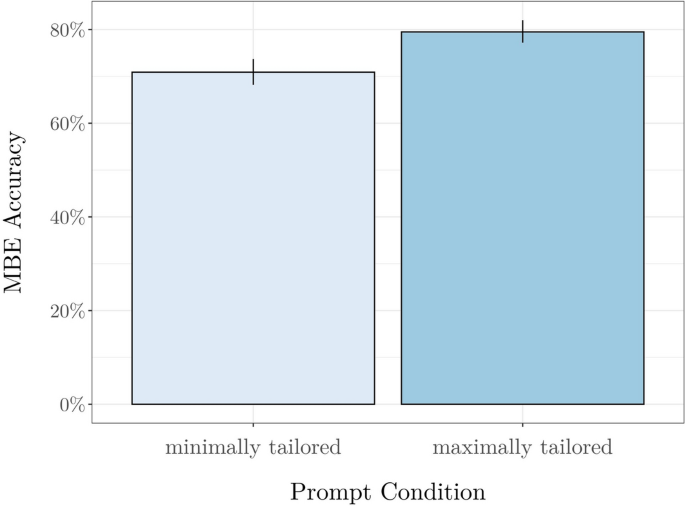
Perhaps the most widely touted of GPT-4’s at-launch, zero-shot capabilities has been its reported 90th-percentile performance on the Uniform Bar Exam. This paper begins by investigating the methodological challenges in documenting and verifying the 90th-percentile claim, presenting four sets of findings that indicate that OpenAI’s estimates of GPT-4’s UBE percentile are overinflated. First, although GPT-4’s UBE score nears the 90th percentile when examining approximate conversions from February administrations of the Illinois Bar Exam, these estimates are heavily skewed towards repeat test-takers who failed the July administration and score significantly lower than the general test-taking population. Second, data from a recent July administration of the same exam suggests GPT-4’s overall UBE percentile was below the 69th percentile, and $$\sim$$48th percentile on essays. Third, examining official NCBE data and using several conservative statistical assumptions, GPT-4’s performance against first-time test takers is estimated to be $$\sim$$62nd percentile, including $$\sim$$42nd percentile on essays. Fourth, when examining only those who passed the exam (i.e. licensed or license-pending attorneys), GPT-4’s performance is estimated to drop to $$\sim$$48th percentile overall, and $$\sim$$15th percentile on essays. In addition to investigating the validity of the percentile claim, the paper also investigates the validity of GPT-4’s reported scaled UBE score of 298. The paper successfully replicates the MBE score, but highlights several methodological issues in the grading of the MPT + MEE components of the exam, which call into question the validity of the reported essay score. Finally, the paper investigates the effect of different hyperparameter combinations on GPT-4’s MBE performance, finding no significant effect of adjusting temperature settings, and a significant effect of few-shot chain-of-thought prompting over basic zero-shot prompting. Taken together, these findings carry timely insights for the desirability and feasibility of outsourcing legally relevant tasks to AI models, as well as for the importance for AI developers to implement rigorous and transparent capabilities evaluations to help secure safe and trustworthy AI.
N8 Programs on Twitter / X
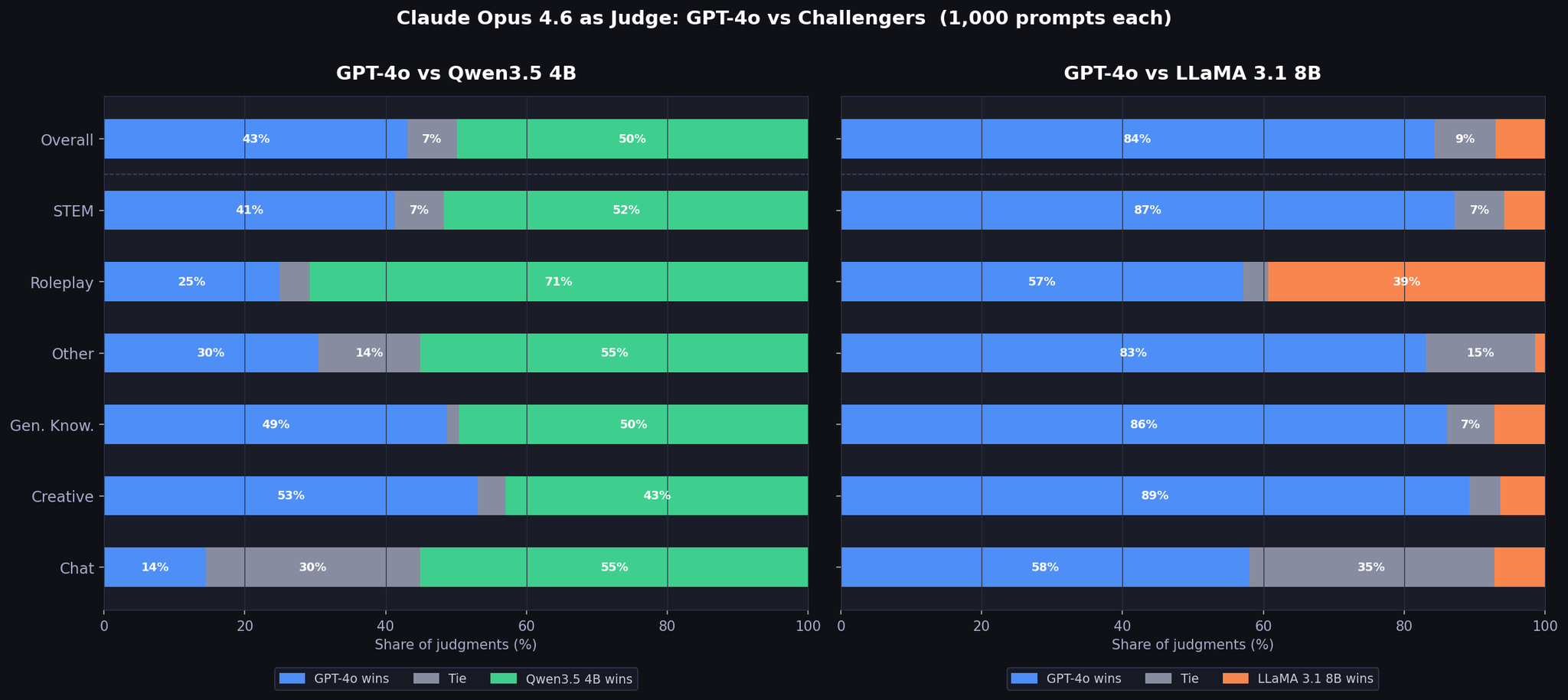
Recently, @awnihannun asserted that 'According to benchmarks Qwen3.5 4B is as good as GPT 4o.' This drew controversy: Is the 4B just benchmaxxed? How could a 4B be as good as GPT-4o? I tried to test this scientifically. The answer to the question is likely: yes, in most cases. pic.twitter.com/KI25XtkrZg— N8 Programs (@N8Programs) March 7, 2026
Kids who use ChatGPT as a study assistant do worse on tests
Researchers compare math progress of almost 1,000 high school students

98% isn't very much
98% sounds like a lot. If someone wins the lottery 98% of the times they play, they are clearly blessed. Getting a top mark (e.g.: 10/10) on exams 98% of the time will likely lead to an honour diploma.
Application Statistics
New gTLD Program: 2026 Round application statistics, including the number of applicants, applications, applied-for strings and variants, contention sets, and objections and appeals.
GPT-5.6: Frontier intelligence that scales with your ambition
More intelligence from every token, stronger performance per dollar, and more capability on demand for your hardest work.
I. From GPT-4 to AGI: Counting the OOMs - SITUATIONAL AWARENESS
AGI by 2027 is strikingly plausible. GPT-2 to GPT-4 took us from ~preschooler to ~smart high-schooler abilities in 4 years. Tracing trendlines in compute (~0.5 orders of magnitude or OOMs/year), algorithmic efficiencies (~0.5 OOMs/year), and “unhobbling” gains (from chatbot to agent), we should expect another preschooler-to-high-schooler-sized qualitative jump by 2027. Look. The models, they just

Are we in a GPT-4-style leap that evals can't see?
Gemini 3 Pro's design capabilities and Opus 4.5's reduced babysitting needs represent a subtle but significant leap that traditional benchmarks completely miss.
Scientific Agents: Evaluating Profession-Specific System Prompts on Scientific Tasks
Detailed profession-specific system prompts raise token use and estimated cost per response without a consistent accuracy gain. We evaluate Scientific Agents, an open-source corpus of 503 profession-specific AGENTS.md profiles, with Gemini 3.8 Flash via OpenRouter in the Pi agent harness. We compare matched profiles with four controls: a minimal baseline ("You are a helpful assistant"), the profile's opening role sentence, a generic scientific rigor guide, and a profile from an unrelated domain. Across nine text-based science benchmarks (4,531 sampled questions, 100 matched profiles), 4,488 items completed all five conditions after API-error retries, scored with automated, rule-based grading. The average profile-baseline accuracy difference is -0.6 percentage points (95% bootstrap interval [-1.5, +0.2] across fixed tasks), and no benchmark shows a statistically clear improvement. Matched profiles produced 1.5-2.3 times as many output tokens and cost 2.2-4.5 times more per successful call. On 60 tool-using BioMysteryBench bioinformatics problems (three runs each for baseline and profile), mean solve rates were 46.7% with the profile and 56.7% at baseline, a difference of -10.0 percentage points (95% interval [-16.7, -3.3]) driven by more frequent token- and time-limit stops under the profile. Longer prompts had one unexpected operational advantage: on SuperGPQA, frequent provider API drops left the short baseline with a correct first-pass answer on only 54.0% of items, against 71.6% with the profile. Generic and mismatched prompts were about as reliable, so this gain comes from prompt length or formatting rather than domain expertise. For the tested model and tasks, loading full profession profiles by default does not improve accuracy and costs considerably more; whether selective retrieval of profile sections or open-ended scientific tasks would change this remains to be tested.

How enabling two settings tripled our scores on the ARC-AGI-3 benchmark
How two API settings improved GPT-5.6 performance on ARC-AGI-3, boosting scores and efficiency by retaining reasoning and enabling compaction.
LLMs Struggle to Measure What Distinguishes Students of Different Proficiency Levels: A Study of Item Discrimination in Reading Comprehension Assessment
Item discrimination is a fundamental psychometric property of educational assessment, which measures whether an item meaningfully distinguishes students with higher proficiency from students with lower proficiency. While various existing works have explored whether large language models (LLMs) can estimate item difficulty, it remains unclear whether they can capture item discrimination. In this work, we frame item discrimination estimation as a test of whether LLMs can model latent, ability-conditioned human response behavior. In this work, we evaluate 42 proprietary and open-weight LLMs in zero-shot settings using two complementary approaches: direct discrimination prediction, where models explicitly estimate an item's discrimination value from its content, and response-based Classical Test Theory (CTT) calibration, where LLM answers are treated as synthetic student responses to compute discrimination scores. Our results show that direct prediction yields weak alignment with human-calibrated discrimination: the best-performing model reaches only a Spearman correlation of 0.152. Response-based CTT calibration provides a stronger but still limited signal, with the all-persona synthetic respondent pool reaching a Spearman correlation of 0.241. These findings highlight item discrimination as an open challenge for LLM-based psychometric evaluation: current LLMs contain non-random discrimination-relevant signal, but they do not yet reliably capture how assessment items distinguish human students.
When the Generator Grades Itself: A Self-Judge Under-Flags Unsupported Outputs at Matched Scale in LLM Social Simulation
A researcher who validates an LLM social simulation with an automated fidelity check rarely sees which model ran that check. The cheapest and most common choice is the same model that produced the simulation: the model that generated the behavior also certifies that the behavior is faithful. We measure what that choice misses, and we test whether capability rather than family explains it. On n=107 frozen generated responses scored under a support-in-context rubric, we run three judges under identical rubric, prompts, context, and decoding: a same-family self-judge (the 72B generator scoring itself), a matched-scale (~70B) judge from a distinct provider family, and a stronger frontier cross-family judge. The self-judge flags 6/107 unsupported outputs (5.6%); the matched-scale distinct-family judge, in the same capability class but a different family, flags 57/107 (53.3%). The disagreement is perfectly one-directional: 51 items the matched judge flags and the self-judge passes, 0 in reverse (McNemar p<1e-12). This asymmetry is consistent with a self-/family effect and rules out the reading that the self-judge is simply a weaker judge detecting less; one matched-scale judge cannot, on its own, separate that family component from a generic strictness difference between two models. Capability still adds on top: the frontier judge flags more again (92.5%). The cheapest default judge passes nearly every output a same-scale distinct-family judge reads as unsupported, exactly the model-bias artifacts a fidelity check exists to catch. We give a minimal audit protocol and argue that one-directional disagreement should function as a validation rule, not a tuning knob. We test one generator on a context-grounding proxy; transfer to live persona transcripts is the open boundary.
SimpleQA Verified: A Reliable Factuality Benchmark to Measure Parametric Knowledge
We introduce SimpleQA Verified, a 1,000-prompt benchmark for evaluating Large Language Model (LLM) short-form factuality based on OpenAI's SimpleQA. It addresses critical limitations in OpenAI's benchmark, including noisy and incorrect labels, topical biases, and question redundancy. SimpleQA Verified was created through a rigorous multi-stage filtering process involving de-duplication, topic balancing, and source reconciliation to produce a more reliable and challenging evaluation set, alongside improvements in the autorater prompt. On this new benchmark, Gemini 2.5 Pro achieves a state-of-the-art F1-score of 55.6, outperforming other frontier models, including GPT-5. This work provides the research community with a higher-fidelity tool to track genuine progress in parametric model factuality and to mitigate hallucinations. The benchmark dataset, evaluation code, and leaderboard are available at: https://www.kaggle.com/benchmarks/deepmind/simpleqa-verified.
