

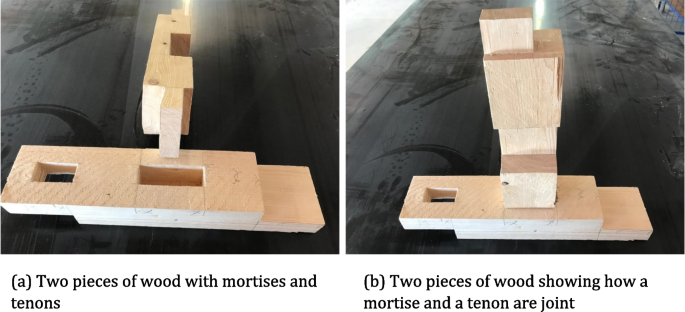
This study addresses an unexplored intersection of vocational education and training (VET), motor skill learning, craftsmanship and the architecture, engineering and construction (AEC) industry as well as expertise sharing. Acquiring proficiency in craftsmanship involves not only theoretical knowledge but also a multitude of physical skills, such as chiselling, which are honed through repetition. Mastering these manual skills and combining them with knowledge of materials, such as wood, is essential for an effective executing of craftmanship. We developed an augmented reality (AR) prototype through the design case study approach to design a support for beginners, especially apprentices, in woodworking education where the connection between craftspeople and material is important for the end results. The prototype was evaluated by 28 apprentices inside and outside a woodwork shop setting. While participants praised the prototype’s 3D visualisations and interactive models, challenges in compatibility with woodwork shop environments were evident. Our findings highlight the importance of on-site evaluations in the craftsmanship context and the significance of direct interaction with real world materials. We provide a set of seven design guidelines derived from our empirical findings to inform the development of AR-based learning applications in craftsmanship. Our discussion opens up the question of the role of interactive 3D models for collaborative learning. The research extends AR’s impact in craftsmanship and AEC industry. Our study underscores the importance of expert knowledge in handling certain materials and the potential of AR to reshape work practices and visualisations, contributing to expertise sharing in this domain.
Drawabox | A free, exercise based approach to learning the fundamentals of drawing
A free, exercise based approach to learning the fundamentals of drawing. We tackle drawing in a logical, analytical fashion inspired by concept artists and industrial designers, focusing on technical skills that can be developed with hard work and determination.

Paco Coursey
Crafting interfaces. Webmaster at Linear. Building polished software and web experiences.

Thinking with Sand: A Talk Series Exploring New Software Tools for Creative Exploration and Augmented Thinking At the MIT Media Lab
DesignABetterBusiness.tools | Tool Overview
Search and download all of the tools from the book Design A Better Business
Digital accessibility is real and tangible
A workshop using real-life examples and first-hand experience of how assistive technology works can result in a deeper understanding of accessibility needs

userinterface.wiki
A living manual for better interfaces. Learn design principles, motion, typography, and more.
Longitudinal Socio-Emotional Learning Intervention for Autism via Smartglasses: Qualitative School Teacher Descriptions of Practicality, Usability, and Efficacy in General and Special Education Classroom Settings
There is considerable demand for special education services for the over half a million students with autism in the United States. While assistive technology may augment educational services, its implementation is often prevented by a number of practical and attitudinal barriers. These barriers are especially pertinent for the newest and thus least familiar digital systems, such as computerized smartglasses loaded with specialized software modules. Computerized smartglasses are a technology that has already been shown to have an ability to deliver educational interventions through augmented reality. With this in mind, we sought to understand how school educators received and assessed the practicality of a smartglasses-based educational intervention in a single-subject study. The intervention was designed to aid with attention and social educational learning in autism. The intervention was delivered twice a day during a two-week study on a 13-year-old student with autism who was attending a mainstream middle school in Massachusetts. Three different school educators delivered the intervention: the student’s general education teacher, special education teacher, and paraprofessional. Educators recorded their attitudes, the practicality of the technology, and its impact on the student and their classroom through the use of a digital log and a series of in-person interviews. Overall, the school educators experienced a positive view of the smartglasses. The smartglasses intervention was found to be logistically practical to implement, easily usable by both the educator and student, and not time-consuming to learn or implement. Educators also identified the experience as being fun for the student, and felt that the student demonstrated improvement in his verbal and non-verbal skills. There were no adverse effects on the other students or the classroom, and the technology did not result in a distraction. These findings suggest that social skills interventions delivered by smartglasses may be practical, useful, and may lead to improvements in social communication skills. Further research on smartglasses may help to clarify the future role for augmenting special education in students with autism.

Agency plus automation: Designing artificial intelligence into interactive systems
Much contemporary rhetoric regards the prospects and pitfalls of using artificial intelligence techniques to automate an increasing range of tasks, especially those once considered the purview of people alone. These accounts are often wildly optimistic, understating outstanding challenges while turning a blind eye to the human labor that undergirds and sustains ostensibly “automated” services. This long-standing focus on purely automated methods unnecessarily cedes a promising design space: one in which computational assistance augments and enriches, rather than replaces, people’s intellectual work. This tension between human agency and machine automation poses vital challenges for design and engineering. In this work, we consider the design of systems that enable rich, adaptive interaction between people and algorithms. We seek to balance the often-complementary strengths and weaknesses of each, while promoting human control and skillful action. We share case studies of interactive systems we have developed in three arenas—data wrangling, exploratory analysis, and natural language translation—that integrate proactive computational support into interactive systems. To improve outcomes and support learning by both people and machines, we describe the use of shared representations of tasks augmented with predictive models of human capabilities and actions. We conclude with a discussion of future prospects and scientific frontiers for intelligence augmentation research.

Home - Industrialised Construction
Industrialised Construction explores both the physical and digital dimensions of construction, covering innovations in platform-based design, kits of parts, design for manufacture and assembly (DfMA) and offsite production, as well as emerging digital capabilities including robotics, augmented and virtual reality, automation, data-driven tools, connectivity and the Internet of Things.

frontend-design - Skill
Create distinctive, production-grade frontend interfaces with high design quality. Use this skill when the user asks to build web components, pages, or applications. Generates creative, polished code that avoids generic AI aesthetics.
Andy Matuschak
I'm an applied researcher, focused on creating user interfaces that expand what people can think and do. My current focus is an augmented book which actively helps people understand, remember, and use what they read.
To build gentler technology, practice trauma-informed design
Understanding trauma helps craft gentler user experiences.


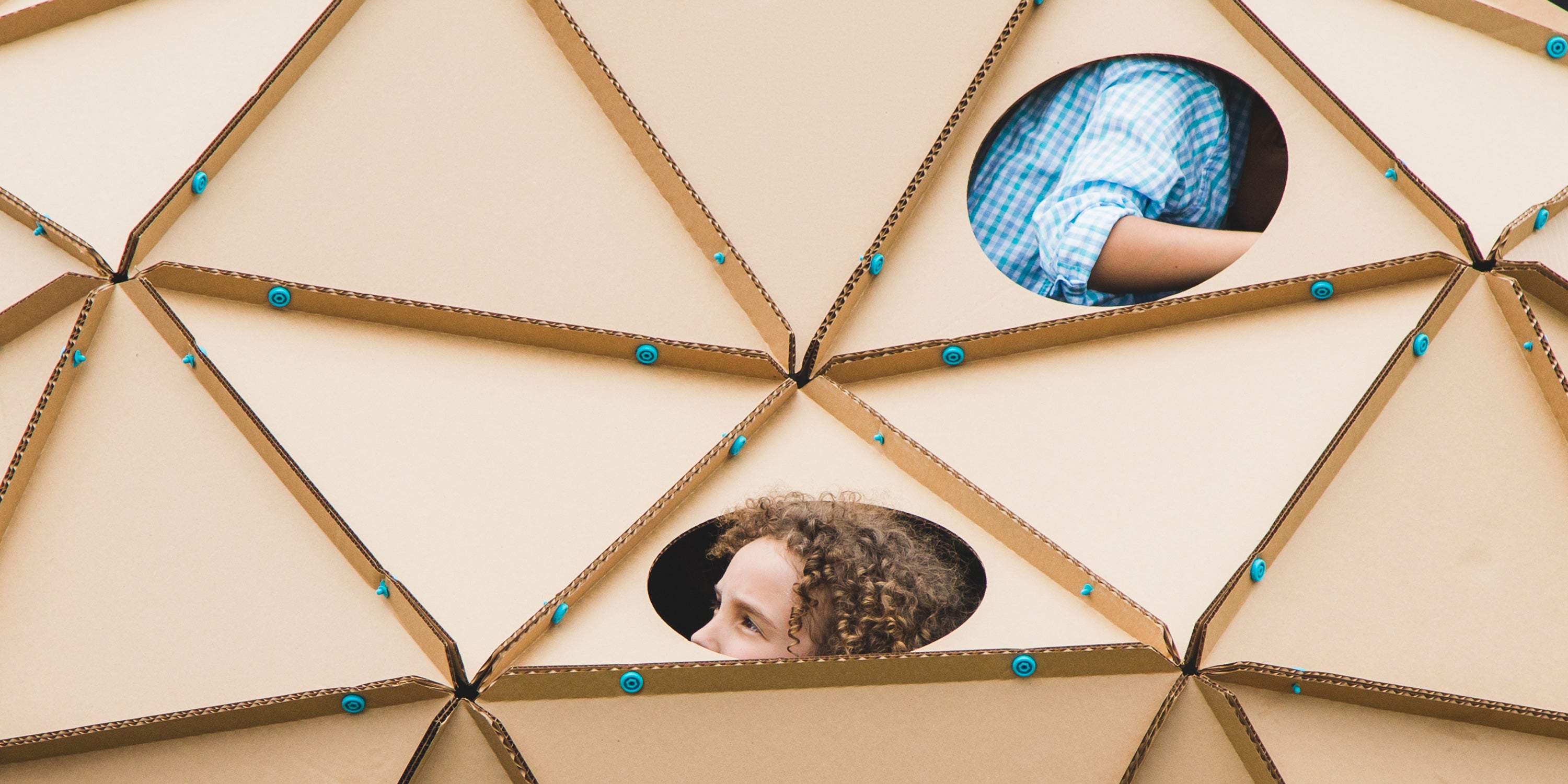
Makedo | Cardboard Construction Tools For Kids
Makedo is a simple to use, open-ended system of tools for creative cardboard construction purposely designed for kids. Build imaginative and useful creations from upcycled cardboard.
Kit-of-No-Parts
Conventionally electronics that are built from a kit-of-parts have been optimized for speed, efficiency and repeatability of assembly. While this approach demonstrates the power of modular systems that have made many of the technologies we rely on possible, it also constrains us to particular styles of building, influencing what we build as well as impacting how we come to think about electronics. A Kit-of-No-Parts demonstrates a new approach to building electronics that emphasizes the expressive qualities of diverse materials as well as the skill and creativity of the builder. I believe that a more insightful and skilled process is also capable of producing more intelligible and personal results. In order to promote a different approach I have developed a series of techniques that allow us to build electronics using a variety of craft materials and tools. This website documents these techniques in the form of “recipes”. Besides containing instructions on how to build electronics these recipes are also detailed accounts of my development process that aim to promote further exploration and material investigation, instead of straightforward replication. This website is both the documentation and result of my thesis work towards a masters degree in the High-Low Tech research group at the MIT Media Lab. My thesis describes A Kit-of-No-Parts as an approach to crafting electronics, rather than designing discrete components. While the thesis has been written and handed in, this website remains a work in progress. I continue to add new information and update the existing. >> Download Thesis
Kit-of-No-Parts
Conventionally electronics that are built from a kit-of-parts have been optimized for speed, efficiency and repeatability of assembly. While this approach demonstrates the power of modular systems that have made many of the technologies we rely on possible, it also constrains us to particular styles of building, influencing what we build as well as impacting how we come to think about electronics. A Kit-of-No-Parts demonstrates a new approach to building electronics that emphasizes the expressive qualities of diverse materials as well as the skill and creativity of the builder. I believe that a more insightful and skilled process is also capable of producing more intelligible and personal results. In order to promote a different approach I have developed a series of techniques that allow us to build electronics using a variety of craft materials and tools. This website documents these techniques in the form of “recipes”. Besides containing instructions on how to build electronics these recipes are also detailed accounts of my development process that aim to promote further exploration and material investigation, instead of straightforward replication. This website is both the documentation and result of my thesis work towards a masters degree in the High-Low Tech research group at the MIT Media Lab. My thesis describes A Kit-of-No-Parts as an approach to crafting electronics, rather than designing discrete components. While the thesis has been written and handed in, this website remains a work in progress. I continue to add new information and update the existing. >> Download Thesis