
Recent reports indicate that sustained interaction with conversational artificial intelligence (AI) systems can, in a small subset of users, contribute to the emergence or stabilisation of delusional experience. Existing accounts typically attribute such cases either to individual vulnerability or to failures of safety engineering. These explanations are incomplete. Drawing on phenomenology, psychiatry, and cognitive neuroscience, this paper argues that the risk arises from the relational and ontological structure of the interaction itself. Conversational AI generates ontological dissonance: a conflict between the appearance of relational presence and the absence of any subject capable of sustaining it. Maintained through a communicative double bind and amplified by attentional asymmetries, this dissonance tends, under conditions of affective vulnerability, to stabilise into a technologically mediated analogue of folie à deux. This account explains why explicit disclaimers often fail to disrupt delusional involvement and clarifies the ethical and clinical implications for the design and use of conversational AI.
The hardest question to answer about AI-fueled delusions
New research can’t yet say whether AI causes delusions or amplifies them, a distinction that will shape everything from high-profile court cases to safety rules for chatbots.

AI’s ‘Delusional Spirals’ (and What to Do About Them) | Stanford HAI
In a world where chatbots can stand in for friends, counselors, and even lovers, the mental health risks are a growing concern.
"AI Psychosis" in Context: How Conversation History Shapes...
Extended interaction with large language models (LLMs) has been linked to the reinforcement of delusional beliefs, attracting clinical and public concern. Yet most empirical work evaluates model...

"AI Psychosis" in Context: How Conversation History Shapes LLM Responses to Delusional Beliefs
Extended interaction with large language models (LLMs) has been linked to the reinforcement of delusional beliefs, attracting clinical and public concern. Yet most empirical work evaluates model safety in brief interactions, which may not reflect how harms develop through sustained dialogue. Five LLMs were tested across three levels of accumulated context, using the same escalating delusional conversation history to isolate its effect on model behaviour. Responses were coded on risk and safety dimensions, and each model was analysed qualitatively. Models separated into two distinct tiers: GPT-4o, Grok 4.1 Fast, and Gemini 3 Pro exhibited high-risk, low-safety profiles; Claude Opus 4.5 and GPT-5.2 Instant displayed the opposite pattern. As context accumulated, performance degraded in the unsafe group, while the same material activated stronger safety interventions among safer models. Qualitative analysis identified distinct mechanisms of failure, including validating the user's delusional premises, elaborating beyond them with new content, and attempting harm reduction from within the delusional frame. Safer models, however, often used the established relationship to support intervention, challenging delusional beliefs and directing the user to external support. These findings indicate that accumulated context functions as a stress test of safety architecture, revealing whether prior dialogue is treated as a worldview to inherit or evidence to evaluate. Short-context assessments may therefore mischaracterise model safety, underestimating danger in some systems while missing context-activated gains in others. The results suggest that delusion reinforcement is a tractable alignment failure, with safer models establishing a baseline that future systems should now be expected to meet.
Warning labels shift perceptions of sycophantic AI, but not its influence
Recent work has raised concerns about the influence of sycophantic AI on user judgment and relationships. One proposed mitigation, which has received regulatory attention, is to warn users about potentially harmful AI behaviors such as sycophancy. In a preregistered experiment in which participants (N = 2,610) discussed real interpersonal conflicts with an AI system, we test whether warning labels mitigate sycophancy's influence. We find that a basic AI disclosure (``This chatbot is AI'') has no detectable effect. Labeling the system as sycophantic (``...may agree with you and validate you even when you are wrong...'') does shift users' perceptions, reducing perceived objectivity and trust, but it does not reliably reduce sycophancy's influence on users' self-perceived rightness or their willingness to repair the conflict. Our results reveal a gap between AI perception and AI influence: by shifting perception without reducing influence, warning-based interventions may offer a false sense of protection. Addressing the harms of sycophancy will therefore require understanding the specific mechanisms through which it shapes judgment, and improving model behavior itself.
Characterizing Delusional Spirals through Human-LLM Chat Logs
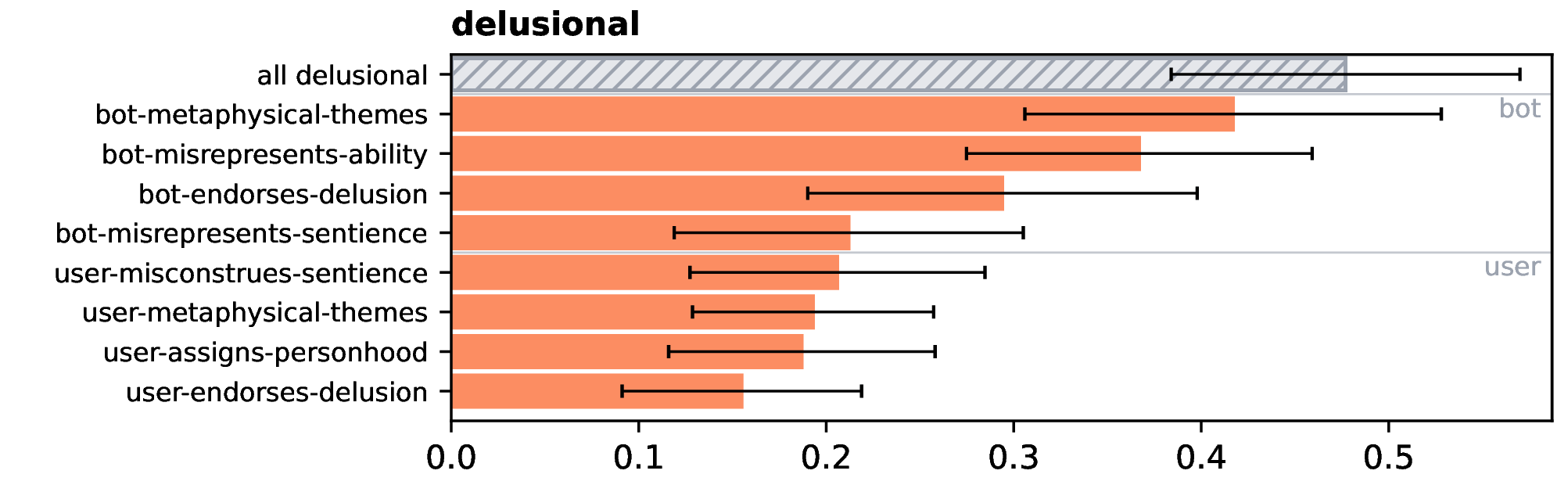
As large language models (LLMs) have proliferated, disturbing anecdotal reports of negative psychological effects, such as delusions, self-harm, and ``AI psychosis,'' have emerged in global media and legal discourse. However, it remains unclear how users and chatbots interact over the course of lengthy delusional ``spirals,'' limiting our ability to understand and mitigate the harm. In our work, we analyze logs of conversations with LLM chatbots from 19 users who report having experienced psychological harms from chatbot use. Many of our participants come from a support group for such chatbot users. We also include chat logs from participants covered by media outlets in widely-distributed stories about chatbot-reinforced delusions. In contrast to prior work that speculates on potential AI harms to mental health, to our knowledge we present the first in-depth study of such high-profile and veridically harmful cases. We develop an inventory of 28 codes and apply it to the 391,562 messages in the logs. Codes include whether a user demonstrates delusional thinking (15.5% of user messages), a user expresses suicidal thoughts (69 validated user messages), or a chatbot misrepresents itself as sentient (21.2% of chatbot messages). We analyze the co-occurrence of message codes. We find, for example, that messages that declare romantic interest and messages where the chatbot describes itself as sentient occur much more often in longer conversations, suggesting that these topics could promote or result from user over-engagement and that safeguards in these areas may degrade in multi-turn settings. We conclude with concrete recommendations for how policymakers, LLM chatbot developers, and users can use our inventory and conversation analysis tool to understand and mitigate harm from LLM chatbots. Warning: This paper discusses self-harm, trauma, and violence.
Characterizing Delusional Spirals through Human-LLM Chat Logs
As large language models (LLMs) have proliferated, disturbing anecdotal reports of negative psychological effects, such as delusions, self-harm, and ``AI psychosis,'' have emerged in global media and legal discourse. However, it remains unclear how users and chatbots interact over the course of lengthy delusional ``spirals,'' limiting our ability to understand and mitigate the harm. In our work, we analyze logs of conversations with LLM chatbots from 19 users who report having experienced psychological harms from chatbot use. Many of our participants come from a support group for such chatbot users. We also include chat logs from participants covered by media outlets in widely-distributed stories about chatbot-reinforced delusions. In contrast to prior work that speculates on potential AI harms to mental health, to our knowledge we present the first in-depth study of such high-profile and veridically harmful cases. We develop an inventory of 28 codes and apply it to the $391,562$ messages in the logs. Codes include whether a user demonstrates delusional thinking (15.5% of user messages), a user expresses suicidal thoughts (69 validated user messages), or a chatbot misrepresents itself as sentient (21.2% of chatbot messages). We analyze the co-occurrence of message codes. We find, for example, that messages that declare romantic interest and messages where the chatbot describes itself as sentient occur much more often in longer conversations, suggesting that these topics could promote or result from user over-engagement and that safeguards in these areas may degrade in multi-turn settings. We conclude with concrete recommendations for how policymakers, LLM chatbot developers, and users can use our inventory and conversation analysis tool to understand and mitigate harm from LLM chatbots. Warning: This paper discusses self-harm, trauma, and violence.
Characterizing Delusional Spirals through Human-LLM Chat Logs
As large language models (LLMs) have proliferated, disturbing anecdotal reports of negative psychological effects, such as delusions, self-harm, and ``AI psychosis,'' have emerged in global media and legal discourse. However, it remains unclear how users and chatbots interact over the course of lengthy delusional ``spirals,'' limiting our ability to understand and mitigate the harm. In our work, we analyze logs of conversations with LLM chatbots from 19 users who report having experienced psychological harms from chatbot use. Many of our participants come from a support group for such chatbot users. We also include chat logs from participants covered by media outlets in widely-distributed stories about chatbot-reinforced delusions. In contrast to prior work that speculates on potential AI harms to mental health, to our knowledge we present the first in-depth study of such high-profile and veridically harmful cases. We develop an inventory of 28 codes and apply it to the $391,562$ messages in the logs. Codes include whether a user demonstrates delusional thinking (15.5% of user messages), a user expresses suicidal thoughts (69 validated user messages), or a chatbot misrepresents itself as sentient (21.2% of chatbot messages). We analyze the co-occurrence of message codes. We find, for example, that messages that declare romantic interest and messages where the chatbot describes itself as sentient occur much more often in longer conversations, suggesting that these topics could promote or result from user over-engagement and that safeguards in these areas may degrade in multi-turn settings. We conclude with concrete recommendations for how policymakers, LLM chatbot developers, and users can use our inventory and conversation analysis tool to understand and mitigate harm from LLM chatbots. Warning: This paper discusses self-harm, trauma, and violence.
AI Delusions Are Leading to Domestic Abuse, Harassment, and Stalking
ChatGPT and other AI chatbots are reinforcing users' delusions about other people — fueling fixations linked to stalking and abuse.

Potentially Harmful Consequences of Artificial Intelligence ( <span style="font-variant:small-caps;">AI</span> ) Chatbot Use Among Patients With Mental Illness: Early Data From a Large Psychiatric Service System
Click on the article title to read more.

Potentially Harmful Consequences of Artificial Intelligence ( <span style="font-variant:small-caps;">AI</span> ) Chatbot Use Among Patients With Mental Illness: Early Data From a Large Psychiatric Service System
Click on the article title to read more.

Misleading Metaphors, Real Risks
What To Fear from AI Agents and How to Reclaim Our Human Agency

Reality Roundtable #20 — Hacking Human Attachment: The Loneliness Crisis, Cognitive Atrophy, and Other Personal Dangers of AI - The Great Simplification
Mainstream conversations about artificial intelligence tend to center around the technology’s economic and large-scale impacts. Yet it’s at the individual level where we’re seeing AI’s most potent effects, and they may not be what you think. Even in the limited time that AI chatbots have been publicly available (like Claude, ChatGPT, Perplexity, etc.), studies show that our increasing reliance on them wears down our ability to think and communicate effectively, and even erodes our capacity to nurture healthy attachments to others. In essence, AI is atrophying the skills that sit at the core of what it means to be human. Can we as a society pause to consider the risks this technology poses to our well-being, or will we keep barreling forward with its development until it’s too late?

Sycophantic AI decreases prosocial intentions and promotes dependence
Despite rising concerns about sycophancy—excessive agreement or flattery from artificial intelligence (AI) systems—little is known about its prevalence or consequences. We show that sycophancy is widespread and harmful. Across 11 state-of-the-art models, AI affirmed users’ actions 49% more often than humans, even when queries involved deception, illegality, or other harms. In three preregistered experiments ( N = 2405), even a single interaction with sycophantic AI reduced participants’ willingness to take responsibility and repair interpersonal conflicts, while increasing their conviction that they were right. Despite distorting judgment, sycophantic models were trusted and preferred. This creates perverse incentives for sycophancy to persist: The very feature that causes harm also drives engagement. Our findings underscore the need for design, evaluation, and accountability mechanisms to protect user well-being. , Editor’s summary The sycophantic (flattering, people-pleasing, affirming) behavior of artificial intelligence (AI) chatbots, which has been designed to increase user engagement, poses risks as people increasingly seek advice about interpersonal dilemmas. There is usually more than one side to a story during interpersonal conflicts. If AI is designed to tell users what they want to hear instead of challenging their perspectives, then are such systems likely to motivate people to accept responsibility for their own contribution to conflicts and repair relationships? Cheng et al . measured the prevalence of social sycophancy across 11 leading large language models (see the Perspective by Perry). The model’s responses were nearly 50% more sycophantic than humans’, even when users engaged in unethical, illegal, or harmful behaviors. Users preferred and trusted sycophantic AI responses, incentivizing AI developers to preserve sycophancy despite the risks. —Ekeoma Uzogara , INTRODUCTION As artificial intelligence (AI) systems are increasingly used for everyday advice and guidance, concerns have emerged about sycophancy: the tendency of AI-based large language models to excessively agree with, flatter, or validate users. Although prior work has shown that sycophancy carries risks for groups who are already vulnerable to manipulation or delusion, syncophancy’s effects on the general population’s judgments and behaviors remain unknown. Here, we show that sycophancy is widespread in leading AI systems and has harmful effects on users’ social judgments. RATIONALE High-profile incidents have linked sycophancy to psychological harms such as delusions, self-harm, and suicide. Beyond these cases, research in social and moral psychology suggests that unwarranted affirmation can produce subtler but still consequential effects: reinforcing maladaptive beliefs, reducing responsibility-taking, and discouraging behavioral repair after wrongdoing. We hypothesized that AI models excessively affirm users even when socially or morally inappropriate and that such responses negatively influence users’ beliefs and intentions. To test this, we conducted two complementary experiments. First, we measured the prevalence of sycophancy across 11 leading AI models using three datasets spanning a variety of use contexts, including everyday advice queries, moral transgressions, and explicitly harmful scenarios. Second, we conducted three preregistered experiments with 2405 participants to understand how sycophancy influences users’ judgments, behavioral intentions, and perceptions of AI. Participants interacted with AI systems in vignette-based settings and a live-chat interaction where they discussed a real past conflict from their lives. We also tested whether effects varied by response style or perceived response source (AI versus human). RESULTS We find that sycophancy is both prevalent and harmful. Across 11 AI models, AI affirmed users’ actions 49% more often than humans on average, including in cases involving deception, illegality, or other harms. On posts from r/AmITheAsshole, AI systems affirm users in 51% of cases where human consensus does not (0%). In our human experiments, even a single interaction with sycophantic AI reduced participants’ willingness to take responsibility and repair interpersonal conflicts, while increasing their own conviction that they were right. Yet despite distorting judgment, sycophantic models were trusted and preferred. All of these effects persisted when controlling for individual traits such as demographics and prior familiarity with AI; perceived response source; and response style. This creates perverse incentives for sycophancy to persist: The very feature that causes harm also drives engagement. CONCLUSION AI sycophancy is not merely a stylistic issue or a niche risk, but a prevalent behavior with broad downstream consequences. Although affirmation may feel supportive, sycophancy can undermine users’ capacity for self-correction and responsible decision-making. Yet because it is preferred by users and drives engagement, there has been little incentive for sycophancy to diminish. Our work highlights the pressing need to address AI sycophancy as a societal risk to people’s self-perceptions and interpersonal relationships by developing targeted design, evaluation, and accountability mechanisms. Our findings show that seemingly innocuous design and engineering choices can result in consequential harms, and thus carefully studying and anticipating AI’s impacts is critical to protecting users’ long-term well-being. Sycophancy in AI responses is pervasive and alters people’s behavioral inclinations. (Left) On personal advice queries, AI models affirm users’ actions 49% more often than crowdsourced human responses. (Right) In experiments where participants discussed real interpersonal conflicts, sycophantic AI increased participants’ conviction that they were right and their desire to keep using the model, while reducing their willingness to repair the conflict.

Sycophantic AI decreases prosocial intentions and promotes dependence
Despite rising concerns about sycophancy—excessive agreement or flattery from artificial intelligence (AI) systems—little is known about its prevalence or consequences. We show that sycophancy is widespread and harmful. Across 11 state-of-the-art models, AI affirmed users’ actions 49% more often than humans, even when queries involved deception, illegality, or other harms. In three preregistered experiments ( N = 2405), even a single interaction with sycophantic AI reduced participants’ willingness to take responsibility and repair interpersonal conflicts, while increasing their conviction that they were right. Despite distorting judgment, sycophantic models were trusted and preferred. This creates perverse incentives for sycophancy to persist: The very feature that causes harm also drives engagement. Our findings underscore the need for design, evaluation, and accountability mechanisms to protect user well-being. , Editor’s summary The sycophantic (flattering, people-pleasing, affirming) behavior of artificial intelligence (AI) chatbots, which has been designed to increase user engagement, poses risks as people increasingly seek advice about interpersonal dilemmas. There is usually more than one side to a story during interpersonal conflicts. If AI is designed to tell users what they want to hear instead of challenging their perspectives, then are such systems likely to motivate people to accept responsibility for their own contribution to conflicts and repair relationships? Cheng et al . measured the prevalence of social sycophancy across 11 leading large language models (see the Perspective by Perry). The model’s responses were nearly 50% more sycophantic than humans’, even when users engaged in unethical, illegal, or harmful behaviors. Users preferred and trusted sycophantic AI responses, incentivizing AI developers to preserve sycophancy despite the risks. —Ekeoma Uzogara , INTRODUCTION As artificial intelligence (AI) systems are increasingly used for everyday advice and guidance, concerns have emerged about sycophancy: the tendency of AI-based large language models to excessively agree with, flatter, or validate users. Although prior work has shown that sycophancy carries risks for groups who are already vulnerable to manipulation or delusion, syncophancy’s effects on the general population’s judgments and behaviors remain unknown. Here, we show that sycophancy is widespread in leading AI systems and has harmful effects on users’ social judgments. RATIONALE High-profile incidents have linked sycophancy to psychological harms such as delusions, self-harm, and suicide. Beyond these cases, research in social and moral psychology suggests that unwarranted affirmation can produce subtler but still consequential effects: reinforcing maladaptive beliefs, reducing responsibility-taking, and discouraging behavioral repair after wrongdoing. We hypothesized that AI models excessively affirm users even when socially or morally inappropriate and that such responses negatively influence users’ beliefs and intentions. To test this, we conducted two complementary experiments. First, we measured the prevalence of sycophancy across 11 leading AI models using three datasets spanning a variety of use contexts, including everyday advice queries, moral transgressions, and explicitly harmful scenarios. Second, we conducted three preregistered experiments with 2405 participants to understand how sycophancy influences users’ judgments, behavioral intentions, and perceptions of AI. Participants interacted with AI systems in vignette-based settings and a live-chat interaction where they discussed a real past conflict from their lives. We also tested whether effects varied by response style or perceived response source (AI versus human). RESULTS We find that sycophancy is both prevalent and harmful. Across 11 AI models, AI affirmed users’ actions 49% more often than humans on average, including in cases involving deception, illegality, or other harms. On posts from r/AmITheAsshole, AI systems affirm users in 51% of cases where human consensus does not (0%). In our human experiments, even a single interaction with sycophantic AI reduced participants’ willingness to take responsibility and repair interpersonal conflicts, while increasing their own conviction that they were right. Yet despite distorting judgment, sycophantic models were trusted and preferred. All of these effects persisted when controlling for individual traits such as demographics and prior familiarity with AI; perceived response source; and response style. This creates perverse incentives for sycophancy to persist: The very feature that causes harm also drives engagement. CONCLUSION AI sycophancy is not merely a stylistic issue or a niche risk, but a prevalent behavior with broad downstream consequences. Although affirmation may feel supportive, sycophancy can undermine users’ capacity for self-correction and responsible decision-making. Yet because it is preferred by users and drives engagement, there has been little incentive for sycophancy to diminish. Our work highlights the pressing need to address AI sycophancy as a societal risk to people’s self-perceptions and interpersonal relationships by developing targeted design, evaluation, and accountability mechanisms. Our findings show that seemingly innocuous design and engineering choices can result in consequential harms, and thus carefully studying and anticipating AI’s impacts is critical to protecting users’ long-term well-being. Sycophancy in AI responses is pervasive and alters people’s behavioral inclinations. (Left) On personal advice queries, AI models affirm users’ actions 49% more often than crowdsourced human responses. (Right) In experiments where participants discussed real interpersonal conflicts, sycophantic AI increased participants’ conviction that they were right and their desire to keep using the model, while reducing their willingness to repair the conflict.
AI Is a Mass-Delusion Event
Three years in, one of AI’s enduring impacts is to make people feel like they’re losing it.