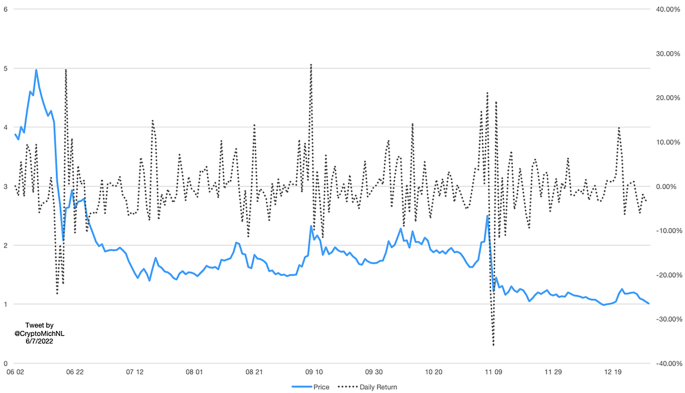
Merkley et al. (2023) examine how cryptocurrency influencers recommend digital coins on Twitter (X) and the associated price effects. They report that influencers may exploit market investors via potential pump and dump schemes. While plausible, researchers may develop a broader understanding of influencers’ incentives and their influence by considering how investors engage these markets for social identity needs that enhance utility. Social-psychological research indicates that someone’s social identity strongly influences their behavior, even making the behavior maladaptive. This paper discusses how crypto influencers create social identity resonance. It then discusses how influencers can leverage this resonance for potentially lucrative financial opportunities, which might manifest in different expected crypto price patterns. The paper concludes by recommending more research on influencers’ experience, networks, and communication choices; the effects of video relative to text communication; and implications of social identity cohorts that influence prices and undermine regulatory trust in traditional markets.
Opinion | A Viral Case Against Crypto, Explored (Published 2022)
The video essayist Dan Olson explains the dangers lurking in the culture and ideology that surround digital currency.


Status Traps: Learning from Web2 Social Networks - a16z crypto
Countering social networks’ tendency toward “social capital” inequality requires thinking like an economist and learning from the web2 days.

Social media promotion improves job market outcomes
Social media has transformed how academics disseminate research, but its effect on academic job outcomes remains unclear. Previous research has shown correlations between social media exposure and metrics like citation counts, but these relationships may be confounded by unobserved factors such as researcher quality or access to professional networks. We examine whether social media promotion causally affects job market outcomes in economics through a field experiment on Twitter (now X). We first collect tweets about job market papers from 519 candidates and post them from a dedicated account. We then randomize half of the posts to be quote-tweeted by established economists in the candidates’ fields, and measure the effects on both online visibility and hiring outcomes. We find that posts in the treatment group receive 441% more views and 303% more likes than those in the control group. Candidates whose posts were assigned to be quote-tweeted receive one additional flyout invitation compared to the control group average of 5.4 flyouts. Furthermore, women in the treatment group receive 0.9 more job offers than women in the control group, who receive 3 offers on average. Exploring mechanisms, we find that academic reputation drives these results, with stronger effects for quote-tweets from highly cited scholars and for candidates from top institutions. Our findings suggest social media promotion causally increases research visibility and improves academic job market outcomes.

Digital Social Norm Enforcement: Online Firestorms in Social Media
Actors of public interest today have to fear the adverse impact that stems from social media platforms. Any controversial behavior may promptly trigger temporal, but potentially devastating storms of emotional and aggressive outrage, so called online firestorms. Popular targets of online firestorms are companies, politicians, celebrities, media, academics and many more. This article introduces social norm theory to understand online aggression in a social-political online setting, challenging the popular assumption that online anonymity is one of the principle factors that promotes aggression. We underpin this social norm view by analyzing a major social media platform concerned with public affairs over a period of three years entailing 532,197 comments on 1,612 online petitions. Results show that in the context of online firestorms, non-anonymous individuals are more aggressive compared to anonymous individuals. This effect is reinforced if selective incentives are present and if aggressors are intrinsically motivated.
‘Unbelievable how accurate’: How paid influencers hype Polymarket’s odds
The company’s chief marketing officer, Matthew Modabber, used a personal PayPal account to send money to content creators, according to records reviewed by POLITICO.

Kara Swisher on Tech Founders' Flaws & Why Social Apps Are the New Cigarettes
Empowering Users, Not Overlords: Overcoming Digital Helplessness
Disclosure: I’m on the board of Bluesky, so feel free to take as many grains of salt as you want in reading it, though all of it applies equally to other decentralized social media ecosys…

The Social Network Doling Out Millions in Ephemeral Money | Backchannel
Steemit is a social network with the radical idea of paying users for their contributions. But in the crypto gold rush, it's unclear who stands to profit.

Persuasion: Empirical Evidence
We provide a selective survey of empirical evidence on the effects as well as the drivers of persuasive communication. We consider persuasion directed at consumers, voters, donors, and investors. We organize our review around four questions. First, to what extent does persuasion affect the behavior of each of these groups? Second, what models best capture the response to persuasive communication? Third, what are persuaders' incentives, and what limits their ability to distort communications? Finally, what evidence exists on the way persuasion affects equilibrium outcomes in economics and politics?

Social Media Is Now Parasocial Media
When practitioners used the term “social media” to describe the internet tools that emerged in the mid-aughts, they were giving a name to the kinds of platforms and protocols that allowed people to socialize with friends and communities of interest by using digital technologies. Twenty years later, users of social media are far more likely to scroll than post – and the content that they consume is often strategically produced and algorithmically curated. In this essay, I argue that the very essence of social media has changed. To more effectively interrogate what we are witnessing, we need to stop presuming that these tools are “social media” and begin recognizing that they are now “parasocial media.” Doing so raises new questions about digitally mediated sociality, not to mention the politics and governance of these platforms.

America’s News Influencers
This study explores the makeup of the social media news influencer universe, including who they are, what content they create and who their audiences are.

Brands using AI-generated influencers to promote products on social media
Investigation finds AI content that purports to show genuine customers, prompting calls for greater transparency

Who Makes Money From Social Media?
Investigate platforms' revenue redistribution schemes.
Introducing a network for thoughtful conversations
The quality of conversations on the Internet is terrible. Most platforms like Twitter, Facebook, Instagram, Reddit, etc. optimize for engagement as their key metric. This spawns and rewards behavior that leads to bragging of gameable metrics such as likes and followers, self-feeding thought bubbles, knee-jerk reactions, “if you’re not on our side, you’re on their side” mentality, and thought policing even by people who think they’re fighting for a good cause. Today’s Internet doesn’t incentiviz