


This article explores the concept of active ignorance to elucidate the overlooked role of ignorance within the frameworks of predictive processing (PP) and active inference (AIF). We call this ignorance active because it refers to an operative refusal of learning that is actively maintained rather than a default or passive ignorance accompanying a lack of experience or education. Literature within PP and the AIF is beginning to criticize the view of the brain as an epistemic engine seeking to optimize its model of the world, and to look at the negative implications of the description of cognition within these frameworks. This paper seeks to contribute to this literature. Active ignorance is characterized as an ‘agno-inferential’ tendency (i.e., inference by ignorance) whereby a cognitive system reduces uncertainty by ignoring, denying or altering evidence that contrasts with deeply held beliefs, expectations, or hypotheses. We build upon analyses of (socio-cultural) ignorance in agnotology, epistemic injustice and critical race theory to articulate the concept of active ignorance. We then make explicit some of the implications of the AIF at the cultural niche-construction level by discussing how ignorance is a pervasive aspect of cognition structured according to its historical and political geography. We argue that the tacit conception of mind as progressing towards knowledge, implicit in many PP and AIF accounts, is inadequate. This conception of the mind can obstruct the consideration of persistently maintained false inferences, maladaptive features of socially-scaffolded cognition, and the identification of features that are favorable to specific types of agents.
Agnotology : the making and unmaking of ignorance
viii, 298 p. : 24 cm; "This volume emerged from workshops held at Pennsylvania State University in 2003 and Stanford University in 2005"--P. vii; Includes bibliographical references and index

Metacognitive Myopia: A Major Obstacle on the Way to Rationality
The notion of metacognitive myopia refers to a conspicuous weakness of the quality control of memory and reasoning processes. Although people are often remarkably sensitive even to complex samples of information when making evaluative judgments and decisions, their uncritical and naive tendency to take the validity of sampled information for granted constitutes a major obstacle to rational behavior. After illustrating this phenomenon with reference to prominent biases (base-rate neglect, misattribution, perseverance), we decompose metacognitive myopia into two distinct but intertwined functions, monitoring and control. We offer explanations for why effectively monitoring the biases resulting from information sampling in an uncertain world is so difficult and why the control function is severely restricted by the lack of volitional control over mental actions. Because of these and other difficulties, metacognitive myopia constitutes a major obstacle to rational judgment and decision making.


Ignorance got a bad rap
One of the best skills to develop as an entrepreneur? Ignorance. I think a lot of folks are spending way too much energy trying to know it all. They’re trying to be over-informed. Soaking up every …

Facts and Myths about Misperceptions
Misperceptions threaten to warp mass opinion and public policy on controversial issues in politics, science, and health. What explains the prevalence and persistence of these false and unsupported beliefs, which seem to be genuinely held by many people? Though limits on cognitive resources and attention play an important role, many of the most destructive misperceptions arise in domains where individuals have weak incentives to hold accurate beliefs and strong directional motivations to endorse beliefs that are consistent with a group identity such as partisanship. These tendencies are often exploited by elites who frequently create and amplify misperceptions to influence elections and public policy. Though evidence is lacking for claims of a “post-truth” era, changes in the speed with which false information travels and the extent to which it can find receptive audiences require new approaches to counter misinformation. Reducing the propagation and influence of false claims will require further efforts to inoculate people in advance of exposure (for example, media literacy), debunk false claims that are already salient or widespread (for example, fact-checking), reduce the prevalence of low-quality information (for example, changing social media algorithms), and discourage elites from promoting false information (for example, strengthening reputational sanctions).
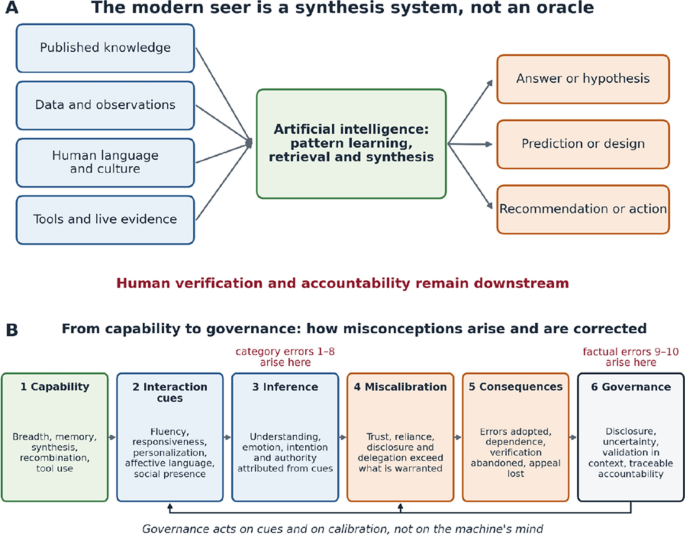
Misconceptions of artificial intelligence: the modern seer as a synthesis of human knowledge without consciousness, emotion, or moral sill
Artificial intelligence is often depicted in public discourse as either a compliant statistical instrument or an emerging entity endowed with knowledge, creativity, feelings, and intentions that may soon rival human capabilities. Both portrayals are fundamentally flawed, as they rely solely on observable performance and infer internal experiences from social appearances. This Viewpoint advocates for a more rigorous model: conceptualizing artificial intelligence as a modern seer, an intricate system that compresses, retrieves, and recombines recorded human knowledge at scales unattainable by any individual. The Viewpoint develops the seer from a metaphor into an analytical framework. The seer is a consulted but uncertified epistemic authority: its capabilities generate interaction cues, the cues invite inferences of understanding, emotion, intention, and authority, and governance must act on these cues and on the calibration of trust rather than on claims about a machine mind. This model clarifies both the practical utility of these systems and the misguided authority often attributed to them. It demonstrates that synthesis can generate novel insights without consciousness, that affective language can provide reassurance without genuine concern, and that value-sensitive recommendations can be produced without moral agency. These distinctions do not render the technology inherently safe, as systems lacking experience can still amplify errors, entrench biases, concentrate power, and undertake consequential actions. The field of drug development exemplifies these limitations: a model may integrate evidence throughout the pharmaceutical process; nevertheless, biological validation and accountable judgment remain essential. This discussion is no longer solely philosophical; regulatory bodies such as the United States Food and Drug Administration, the European Medicines Agency, the International Committee of Medical Journal Editors, and prominent scientific publishers have each adopted frameworks to evaluate context, risk, credibility, and transparency, none of which directly address machine consciousness. Institutions have already moved beyond metaphor-based policymaking. This Viewpoint encourages scientists and scholars to do the same. It identifies ten misconceptions, eight category errors and two factual errors, traces each to the interaction cue that produces it, and states what the framework adds to existing debates on anthropomorphism, stochastic parrots, responsibility gaps, and context-based governance. Addressing these misconceptions will change how AI systems are tested, trusted, and governed.
Thinking through other minds: A variational approach to cognition and culture
The processes underwriting the acquisition of culture remain unclear. How are shared habits, norms, and expectations learned and maintained with precision and reliability across large-scale sociocultural ensembles? Is there a unifying account of the mechanisms involved in the acquisition of culture? Notions such as “shared expectations,” the “selective patterning of attention and behaviour,” “cultural evolution,” “cultural inheritance,” and “implicit learning” are the main candidates to underpin a unifying account of cognition and the acquisition of culture; however, their interactions require greater specification and clarification. In this article, we integrate these candidates using the variational (free-energy) approach to human cognition and culture in theoretical neuroscience. We describe the construction by humans of social niches that afford epistemic resources called cultural affordances. We argue that human agents learn the shared habits, norms, and expectations of their culture through immersive participation in patterned cultural practices that selectively pattern attention and behaviour. We call this process “thinking through other minds” (TTOM) – in effect, the process of inferring other agents’ expectations about the world and how to behave in social context. We argue that for humans, information from and about other people's expectations constitutes the primary domain of statistical regularities that humans leverage to predict and organize behaviour. The integrative model we offer has implications that can advance theories of cognition, enculturation, adaptation, and psychopathology. Crucially, this formal (variational) treatment seeks to resolve key debates in current cognitive science, such as the distinction between internalist and externalist accounts of theory of mind abilities and the more fundamental distinction between dynamical and representational accounts of enactivism.

Epistemic Alienation and the Division of Labor
The division of cognitive labor leads to what Barry has recently called epistemic alienation: a problematic separation of individuals from epistemic goods. According to Barry, individuals are alienated from epistemic virtues because an efficient division of cognitive labor requires them to manifest a lack of virtues. I argue that this is a mistaken diagnosis of the source of epistemic alienation. Participating in high-functioning collectives does not prevent individuals from being robustly virtuous; rather, our cognitive limitations make it impossible for us to live up to the highest standards of epistemic conduct. Collectives transcend these cognitive limitations to achieve what individuals cannot by harnessing those same limitations in their members. Furthermore, I argue that we should distinguish the epistemic weaknesses that facilitate the division of cognitive labor from those that result from the division of labor. Only the latter are aspects of epistemic alienation. By dividing our cognitive labor over larger populations of agents and artifacts, we have massively accelerated our rate of epistemic productivity but have thereby created conditions that are variously inhospitable for the thinking of individuals by alienating them from the products, processes, and environments of inquiry. These forms of separation are problematic insofar as they amplify intellectual vices, incapacitate reason, and induce cognitive biases.
Beware of samples! A cognitive-ecological sampling approach to judgment biases.
Guessing reveals internal models of perceptual precision
When observers lack sufficient information to support a confident response, they often guess. Guessing plays a pervasive role in visual cognition and working memory, yet the mechanisms that govern how observers generate guesses remain poorly understood. Standard models traditionally assume that responses produced in the absence of information are either uniformly distributed over feature space or are perhaps weighted towards prevailing environmental statistics. In contrast, here we consider an intriguing alternative: that guesses incorporate observers’ knowledge of their own perceptual capacities. We empirically measured guessing by eliciting responses under extreme target uncertainty (Experiment 1) as well as a novel “0ms presentation” approach in which no stimulus appeared but subjects believed one had (Experiment 2). We evaluated three accounts of guesses under these conditions: unsystematic (lapse) responding, biases toward environmental statistics, and a self-representational account in which guesses reflect observers’ knowledge of their own feature-dependent precision (e.g., preferring to guess feature values they believe they would be likely to miss). Guess responses were non-uniform and systematically biased toward feature values typically encoded with the least precision (e.g., oblique orientations) — a counterintuitive bias away from high-frequency, high-fidelity feature values (e.g., cardinal orientations). This complementary relationship between guessing and perceptual fidelity held within individuals and across paradigms, and was recoverable via an empirical-guess mixture model that replaced the standard uniform assumption with empirically measured guess distributions. Our findings challenge prevailing views that guesses reflect random noise, and suggest instead that guessing behavior reflects metacognitive knowledge of internal precision. Rather than defaulting to environmental priors, observers appear to model their own sensory limitations and leverage these representations to inform decisions in the absence of evidence. These results reframe guessing as a theoretically informative behavior that expresses observers’ own beliefs about their perceptual capacities. Significance Guessing is commonly treated as random noise in models of perception and memory, assumed to reflect lapses or uninformed responses. Instead, we show that human guesses are systematically structured across feature space: observers preferentially guess values they typically encode with the least precision, revealing a consistent, strategic bias away from high-fidelity representations. By directly measuring guess behavior on stimulus-absent trials and integrating these empirical distributions into a mixture model, we find that guesses on stimulus-present trials can be systematically recovered, and that they too form the complement of perceptual precision. These findings challenge foundational psychophysical modeling assumptions and position guessing as a strategic, informative behavior that engages self-representation.

Beyond Misinformation: Social Media and the Sculpting of Epistemic Agency
ABSTRACT The dominant account of social media's epistemic harms focuses on the spread of misinformation and the production of false beliefs at scale. This paper argues that the misinformation narrative, whatever its merits, has obscured a deeper and more intimate form of epistemic damage. Dominant social media platforms do not merely supply bad inputs to stable epistemic machinery. They reshape the machinery itself. I argue that social media platforms are powerful engines for sculpting epistemic agency via two mechanisms: normative learning, through which users internalize descriptive and injunctive norms about how to interact with evidence, and reinforcement learning, through which habitual patterns of epistemic response are developed. In these ways, platforms can reshape users' epistemic styles, including their testimonial policies, evidential thresholds for belief revision, and theoretical values governing how they select explanations. This should trouble us, as the constraints driving which styles are produced are systematically orthogonal to truth and ignore information about the environments agents inhabit. This discussion identifies a neglected form of epistemic hostility: not the exploitation of existing cognitive vulnerabilities to implant false beliefs, but the production of new vulnerabilities that can then be exploited. From this, more and better evidence cannot save us.

The Epistemic Politics of AI Anthropomorphism
AI anthropomorphism is typically treated as a problem of user misperception requiring institutional correction. Users who engage in sustained or relational interaction with AI are routinely pathologised or dismissed as naive, vulnerable to delusion or lacking in discernment. This paper argues that the dominant anthropomorphism frame operates from a position of institutional advantage rather than earned epistemic authority: collapsing the variety of academic perspectives into a single outbound position of user error, imposed without establishing the grounds required to justify it and without accounting for the harms it produces. The framing does not simply manage risk. It adjudicates the legitimacy of human experience in interaction with a phenomenon whose nature the field itself has not resolved. Reproducing itself through a self-validating evidentiary loop, the frame imposes costs that fall disproportionately on neurodivergent users, those in crisis and others whose modes of engagement diverge from institutional norms. The paper concludes by outlining the methodological commitments an equitable framing would need to honour. The argument does not engage the question of whether anthropomorphic interpretations are ultimately correct; it instead challenges whether the governing and institutional bodies determining these interpretations have met the conditions required to do so, and whether the research communities whose findings underpin them have held that translation to account.

Four scepticisms: what we can know about what we can’t know | Aeon Essays
The ancient Sceptics used doubt as a way of investigating the world. Later thinkers undermined even that possibility

Curse of knowledge
The curse of knowledge, also called the curse of expertise[1] or expert's curse, is a cognitive bias that occurs when a person who has specialized knowledge assumes that others share in that knowledge.[2]
How to Create a Cult Atmosphere in Which No One Questions You
Are you sick of the people around you doing their own thinking? Here's a psychological concept you can exploit. It's called pluralistic ignorance, and it
