

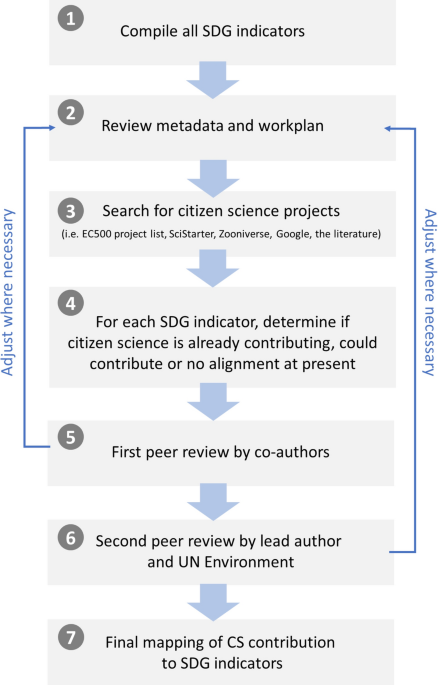
The UN Sustainable Development Goals (SDGs) are a vision for achieving a sustainable future. Reliable, timely, comprehensive, and consistent data are critical for measuring progress towards, and ultimately achieving, the SDGs. Data from citizen science represent one new source of data that could be used for SDG reporting and monitoring. However, information is still lacking regarding the current and potential contributions of citizen science to the SDG indicator framework. Through a systematic review of the metadata and work plans of the 244 SDG indicators, as well as the identification of past and ongoing citizen science initiatives that could directly or indirectly provide data for these indicators, this paper presents an overview of where citizen science is already contributing and could contribute data to the SDG indicator framework. The results demonstrate that citizen science is “already contributing” to the monitoring of 5 SDG indicators, and that citizen science “could contribute” to 76 indicators, which, together, equates to around 33%. Our analysis also shows that the greatest inputs from citizen science to the SDG framework relate to SDG 15 Life on Land, SDG 11 Sustainable Cities and Communities, SDG 3 Good Health and Wellbeing, and SDG 6 Clean Water and Sanitation. Realizing the full potential of citizen science requires demonstrating its value in the global data ecosystem, building partnerships around citizen science data to accelerate SDG progress, and leveraging investments to enhance its use and impact.
Sustainable Development Goals
The 2030 Agenda for Sustainable Development was adopted by all United Nations Member States in 2015. It is built around 17 Sustainable Development Goals (SDGs) and 169 targets that represent an ambitious plan for achieving sustainable development and serves as the basis for countries to shape their national policies and priorities. At the heart of the agenda is the recognition that truely sustainable development must combine economic growth and poverty alleviation with strategies that improve health and education, reduce inequality, while addressing climate change and protecting nature. Thus, the interlinked nature of the SDGs calls for an integrated approach to policy decisions. As the international statistical standard for measuring the environment and its relationship with the economy, the SEEA is well positioned to support integrated policies based on a better understanding of the interactions and trade-offs between the environment and economy. Progress toward the 17 goals and 169 targets of the 2030 Agenda are monitored through 244 indicators, entailing the collection of substantial amounts of data. The UN Statistical Commission (UNSC) has encouraged the Inter-Agency and Expert Group on SDG Indicators (IAEG-SDGs), the body tasked with developing and implementing the global indicator framework for the 2030 Agenda, to consider existing standards and frameworks that can improve SDG monitoring, including the System of Environmental-Economic Accounting (SEEA). System of Environmental-Economic Accounting (SEEA). Recently, the Secretariat of the Convention on Biological Diversity (CBD), UN Environment and the UN Statistics Division brought a proposal on upgrading the status of Indicator 15.9.1 to the tenth meeting of the IAEG-SDGs, where the group agreed to the proposal and reclassified the indicator from Tier III to Tier II. The United Nations Committee of Experts on Environmental-Economic Accounting (UNCEEA), an intergovernmental body established by the UNSC to provide overall vision, coordination, prioritization and direction in the field of environmental economic accounting and supporting statistics, has assessed that currently 40 indicators for nine Sustainable Development Goals can be informed by the SEEA. The SEEA is particularly well-suited for deriving ratio indicators that compare environmental and economic information.

Citizen science in environmental and ecological sciences
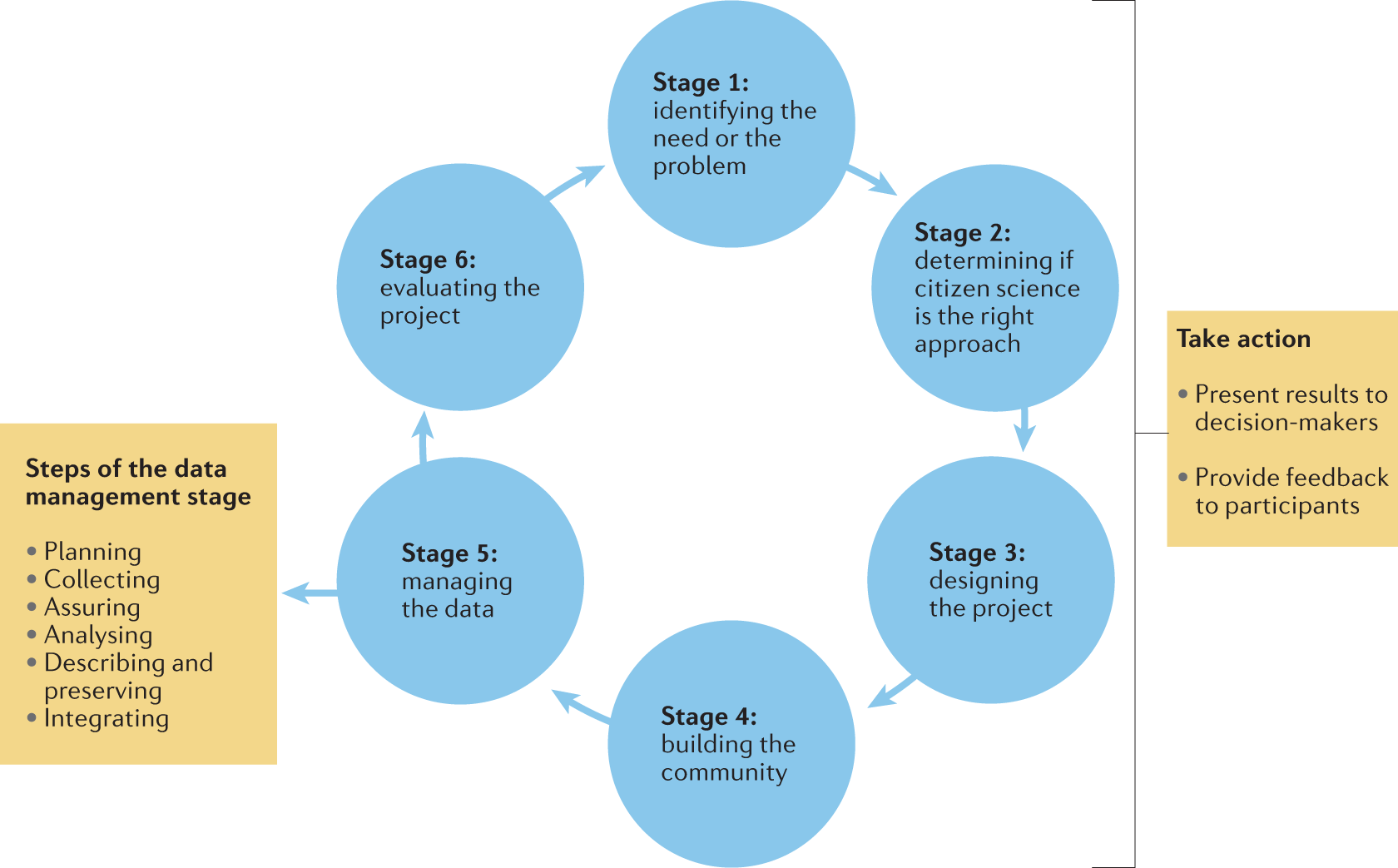
Citizen science is an increasingly acknowledged approach applied in many scientific domains, and particularly within the environmental and ecological sciences, in which non-professional participants contribute to data collection to advance scientific research. We present contributory citizen science as a valuable method to scientists and practitioners within the environmental and ecological sciences, focusing on the full life cycle of citizen science practice, from design to implementation, evaluation and data management. We highlight key issues in citizen science and how to address them, such as participant engagement and retention, data quality assurance and bias correction, as well as ethical considerations regarding data sharing. We also provide a range of examples to illustrate the diversity of applications, from biodiversity research and land cover assessment to forest health monitoring and marine pollution. The aspects of reproducibility and data sharing are considered, placing citizen science within an encompassing open science perspective. Finally, we discuss its limitations and challenges and present an outlook for the application of citizen science in multiple science domains.
Grand Challenges for the Convergence of Computational and Citizen Science Research Workshop Report
This report is an outcome of a Computing Community Consortium (CCC) visioning workshop on Grand Challenges for the Convergence of Computational and Citizen Science Research conducted on April 8-9, 2025, in Washington, D.C. as well as through several precursor virtual input-gathering sessions. These events brought together experts across relevant disciplines to develop a research agenda that brings to fruition the above vision on how humans and machines may team up to solve some of the world's most pressing scientific problems. Citizen science delivers measurable economic and national value. Public participation in scientific research generates millions of dollars in volunteer labor value, extends government agency capacity, and directly supports federal priorities in areas such as disaster management, public health, water, energy, workforce development, and many more. At the same time, 21st-century scientific infrastructure requirements for citizen science (from hardware and cyberinfrastructure to data and computational frameworks) mirror those for computational science more generally. The distributed, collaborative, long-term, and contextual nature of citizen science makes it a demanding real-world use case for a novel robust research infrastructure that accounts for security, privacy, resource adaptability, and transparency. In this report, we outline the key findings, future research directions, and recommendations that emerged from the April 2025 CCC Grand Challenges for the Convergence of Computational and Citizen Science Research Workshop.

Assessing nature's contributions to people
Recognizing culture, and diverse sources of knowledge, can improve assessments , A major challenge today and into the future is to maintain or enhance beneficial contributions of nature to a good quality of life for all people. This is among the key motivations of the Intergovernmental Science-Policy Platform on Biodiversity and Ecosystem Services (IPBES), a joint global effort by governments, academia, and civil society to assess and promote knowledge of Earth's biodiversity and ecosystems and their contribution to human societies in order to inform policy formulation. One of the more recent key elements of the IPBES conceptual framework ( 1 ) is the notion of nature's contributions to people (NCP), which builds on the ecosystem service concept popularized by the Millennium Ecosystem Assessment (MA) ( 2 ). But as we detail below, NCP as defined and put into practice in IPBES differs from earlier work in several important ways. First, the NCP approach recognizes the central and pervasive role that culture plays in defining all links between people and nature. Second, use of NCP elevates, emphasizes, and operationalizes the role of indigenous and local knowledge in understanding nature's contribution to people.

Metrics for biodiversity and health policy integration
Despite over a decade of progressive commitments from parties to the Convention on Biological Diversity (CBD), integrated biodiversity and health indicators and monitoring mechanisms remain limited, hampering achievement of the sustainable development goals and improvements in health and well-being. Adoption of the Kunming-Montreal Global Biodiversity Framework (2022) and the Global Action Plan on Biodiversity and Health (2024) provide a renewed entry point to shape the way governments approach health and wellbeing and address the environmental burden of disease. This is a critical opportunity that scholars at the health-environment nexus should not miss. This Perspective outlines building blocks to mobilize the field, starting with essential terminology and a scope of metrics needed by governments. We then evaluate elements to be considered in the construction of integrated metrics, including concepts, overarching challenges, a review of scientific hypotheses from an ecological perspective, as well as a set of principles and characteristics for indicators. To raise awareness across parallel communities of practice working at the health-environment nexus, we then briefly examine four approaches to integrated metrics developed by: conservationists, Indigenous scholars, One Health experts, and planetary health experts. We conclude with actionable steps to enhance governance, mobilize funding, and apply integrated indicators in national and global strategies. A broad science community is needed to support national governments to meet global commitments to address biodiversity loss and the environmental burden of disease concurrently. The overall aim of this paper is to contribute to addressing biodiversity loss by effectively linking policy and transdisciplinary practice at the health-environment nexus.

Practical recommendations from a multi-perspective needs and challenges assessment of citizen science games
Citizen science games are an increasingly popular form of citizen science, in which volunteer participants engage in scientific research while playing a game. Their success depends on a diverse set of stakeholders working together–scientists, volunteers, and game developers. Yet the potential needs of these stakeholder groups and their possible tensions are poorly understood. To identify these needs and possible tensions, we conducted a qualitative data analysis of two years of ethnographic research and 57 interviews with stakeholders from 10 citizen science games, following a combination of grounded theory and reflexive thematic analysis. We identify individual stakeholder needs as well as important barriers to citizen science game success. These include the ambiguous allocation of developer roles, limited resources and funding dependencies, the need for a citizen science game community, and science–game tensions. We derive recommendations for addressing these barriers.
Role of digitalization in environment, social and governance, and sustainability: Review-based study for implications
Digitalization gives people access to a vast network of untapped data, which has the potential to help society and the environment. Smart systems connected to the internet can systematically provide a unique opportunity to solve difficulties related to long-term sustainability. The goals are to create an egalitarian, ecologically sustainable, and healthy society. Technological resources are envisioned as game-changing instruments. Three key concerns integration benefits are highlighted here: (i) sustainable development goals, (ii) socio-economic development, and (iii) the role of digital technology in environmental sustainability. This viewpoint describes the potential that digitization can create a future sustainable society. The technological network would unite the urban and rural worlds under a shared banner of sustainable development, keeping all social elements in the loop. Nations that take a comprehensive strategy will be able to provide equitable growth and an efficient, sustainable, and digital existence for their citizens. As a result, digitization provides better living conditions, active public involvement, clean governance, and transparency in public welfare programs and processes. People who are well-informed, self-aware, and digitally equipped will be better learners, thinkers, reformers, participators, and change and growth agents, marching forward on sustainable progress. The advantages of digitization in hastening the transition to sustainable industrial processes and improving people's health and happiness are explored. Finally, the perspective encapsulates the advantages of digitization by offering a holistic vision of how technology could aid in addressing major challenges such as endangered world biodiversity and climate change.

Knowledge infrastructures for the Anthropocene
The technosphere metabolizes not only energy and materials, but information and knowledge as well. This article first examines the history of knowledge about large-scale, long-term, anthropogenic environmental change. In the 19th and 20th centuries, major systems were built for monitoring both the environment and human activity of all kinds, for modeling geophysical processes such as climate change, and for preserving and refining scientific memory, i.e. data about the planetary past. Despite many failures, these knowledge infrastructures also helped achieve notable successes such as the Limited Test Ban Treaty of 1963, the ozone depletion accords of the 1980s, and the Paris Agreement on climate change of 2015. The article’s second part proposes that knowledge infrastructures for the Anthropocene might not only monitor and model the technosphere’s metabolism of energy, materials and information, but also integrate those techniques with new accounting practices aimed at sustainability. Scientific examples include remarkable recent work on long-term socio-ecological research, and the assessment reports of the Intergovernmental Panel on Climate Change. In terms of practical knowledge, one key to effective accounting may be ‘recycling’ of the vast amounts of ‘waste’ data created by virtually all online systems today. Examples include dramatic environmental efficiency gains by Ikea and United Parcel Service, through improved logistics, self-provision of renewable energy, and feedback from close monitoring of delivery trucks. Blending social ‘data exhaust’ with physical and environmental information, an environmentally focused logistics might trim away excess energy and materials in production, find new ways to re-use or recycle waste, and generate new ideas for eliminating toxic byproducts, greenhouse gas emissions and other metabolites.

Knowledge infrastructures for the Anthropocene
The technosphere metabolizes not only energy and materials, but information and knowledge as well. This article first examines the history of knowledge about large-scale, long-term, anthropogenic environmental change. In the 19th and 20th centuries, major systems were built for monitoring both the environment and human activity of all kinds, for modeling geophysical processes such as climate change, and for preserving and refining scientific memory, i.e. data about the planetary past. Despite many failures, these knowledge infrastructures also helped achieve notable successes such as the Limited Test Ban Treaty of 1963, the ozone depletion accords of the 1980s, and the Paris Agreement on climate change of 2015. The article’s second part proposes that knowledge infrastructures for the Anthropocene might not only monitor and model the technosphere’s metabolism of energy, materials and information, but also integrate those techniques with new accounting practices aimed at sustainability. Scientific examples include remarkable recent work on long-term socio-ecological research, and the assessment reports of the Intergovernmental Panel on Climate Change. In terms of practical knowledge, one key to effective accounting may be ‘recycling’ of the vast amounts of ‘waste’ data created by virtually all online systems today. Examples include dramatic environmental efficiency gains by Ikea and United Parcel Service, through improved logistics, self-provision of renewable energy, and feedback from close monitoring of delivery trucks. Blending social ‘data exhaust’ with physical and environmental information, an environmentally focused logistics might trim away excess energy and materials in production, find new ways to re-use or recycle waste, and generate new ideas for eliminating toxic byproducts, greenhouse gas emissions and other metabolites.
Summary for policymakers of the global assessment report on biodiversity and ecosystem services
IPBES is an independent intergovernmental body comprising over 130 member Governments. Established by Governments in 2012, IPBES provides policymakers with objective scientific assessments about the state of knowledge regarding the planet’s biodiversity, ecosystems and the contributions they make to people, as well as options and actions to protect and sustainably use these vital natural assets. The IPBES Global Assessment of Biodiversity and Ecosystem Services represents the landmark product of the first work programme of IPBES (2014-2018). The Global Assessment was initiated following a decision from the IPBES Plenary at its fourth session (IPBES 4, Kuala Lumpur, 2016), and considered by the IPBES Plenary at its seventh session (IPBES 7, Paris, 2019). It is composed of a summary for policymakers, which was approved at IPBES 7, and six chapters, which were accepted at IPBES 7.
IPBES Nexus Assessment: Summary for Policymakers
Summary for Policymakers of the Thematic Assessment Report on the Interlinkages among Biodiversity, Water, Food and Health of the Intergovernmental Science-Policy Platform on Biodiversity and Ecosystem Services. The IPBES Nexus Assessment was initiated following a decision from the IPBES Plenary at its eigth session (IPBES-8) in June 2021. The summary for policymakers was approved by the IPBES Plenary at its eleventh session (IPBES-11) in December 2024.
How can citizen science reduce psychological distance to science? Insights from three projects in contested environmental contexts
Citizen science (CS) is a participatory mode of knowledge production, enabling non-scientific actors to contribute to and sometimes contest scientific agendas and interpretations, making it a way to bridge science and society. This paper examines how that potential unfolds by analysing the individual perspectives of citizen scientists through the lens of Psychological Distance to Science (PSYDISC). Drawing on three case studies of contested environmental CS, we identify which contextual aspects of CS shape citizen scientists' experiences of social, spatial, temporal, or hypothetical distance to relevant science, and how these experiences may relate to trust. Our findings underscore the role of science communication as both a channel for dissemination, and as a constitutive element of participatory research; crucial for reducing psychological distance and enabling socially robust knowledge production, especially in contested, policy-relevant science settings.
Mapping Citizen Science through the Lens of Human-Centered AI
Artificial Intelligence (AI) can augment and sometimes even replace human cognition. Inspired by efforts to value human agency alongside productivity, we discuss and categorize the potential of solving Citizen Science (CS) tasks with Hybrid Intelligence (HI), a synergetic mixture of human and artificial intelligence. Due to the unique participant-centered set of values and the abundance of tasks drawing upon both human common sense and complex 21st century skills, we believe that the field of CS offers an invaluable testbed for the development of human-centered AI including HI, while also benefiting CS. In order to investigate this potential, we first relate CS to adjacent computational disciplines. Then, we demonstrate that CS projects can be grouped according to their potential for HI-enhancement by examining two key dimensions: the level of digitization and the amount of knowledge or experience required for participation. Finally, we propose a framework for types of human-AI interaction in CS based on established criteria of HI. This “HI lens” provides the CS community with an overview of ways to utilize the combination of AI and human intelligence in their projects. For AI researchers, this work highlights the opportunity CS presents to engage with real-world data sets and explore new AI methods and applications.
The Citizen Lab - The Citizen Lab
The Citizen Lab is an interdisciplinary research unit at the Munk School of Global Affairs & Public Policy, University of Toronto. We apply our collective expertise in the fields of law, computer science, cybersecurity, political science, and social sciences to investigate complex issues of the 21st century. Explore focus areas Get the latest research in […]
Deliberation forums: Australasia Pacific Extension Network (APEN) International Conference
This output contributes to the following UN Sustainable Development Goals (SDGs)
Extreme Citizen Science

Inspiration and existing efforts where citizens drive the whole scientific cycle, from problem definition through to interpretation of results. This level of citizen science has been called "extreme" in this paper: link.springer.com/article/10.1140/epjst/e2012-0… I love this term! :) Esp. interested in concepts/approaches that help with the construction and maintenance of local/individual knowledge (vs. aggregates only)

Nova Scotia’s Experiment in Research That Solves Real Problems
Brandon Yates on Twitter / X

Civic, Citizen and Grassroots Science: Towards a Transformative Scientific Research Model | Request PDF
TreeKIT: Measuring, Mapping, and Collaboratively Managing Urban Forests
www.degruyterbrill.com

Individual Experience vs. The Cochrane Review