


Many frameworks exist across the sciences and science-policy interface, but it is not always clear how they are developed or can be applied. It is also often vague how new or existing frameworks are positioned in a theory of science to advance a specific theory or paradigm. This article examines these questions and positions the role of frameworks as integral but often vague scientific tools, highlighting benefits and critiques. While frameworks can be useful for synthesizing and communicating core concepts in a field, they often lack transparency in how they were developed and how they can be applied. Positioning frameworks within a theory of science can aid in knowing the purpose and value of framework use. This article provides a meta-framework for visualizing and engaging the four mediating processes for framework development and application: (1) empirical generalization, (2) theoretical fitting, (3) application, and (4) hypothesizing. Guiding points for scholars and policymakers using or developing frameworks in their research are provided in closing.
(PDF) Building a Conceptual Framework: Philosophy, Definitions, and Procedure
PDF | In this paper the author proposes a new qualitative method for building conceptual frameworks for phenomena that are linked to multidisciplinary... | Find, read and cite all the research you need on ResearchGate
Do Frameworks Matter Anymore?
I'm not trying to be facetious. I want to really want consider whether or not, in 2026, in the age of vibe coding, agentic programming, loop or graph or whatever diagrammatic metaphor-based engineering is most popular, does it matters what web framework you use? More importantly (to me and my particular interests), and at the risk of Betteridge-ing myself: should we make new frameworks?
Frameworks v0.2
FRAMEWORKS v0.2 Many of the thoughts in this document draw on and synthesize concepts from economics, math, physics, chemistry, biology, and psychology. Here are a handful of core concepts that are often relied on as inputs: Activation energy Behavioral economics Cognitive biases Darwinism En...

Thinking Frameworks | 2021
Sharing out the best meta-thinking tools I’ve learned this year

OSF Changes: A Note to Users
The Center for Open Science announced a significant change to the Open Science Framework (OSF). This post shares what led to the change, implications, and what's next.
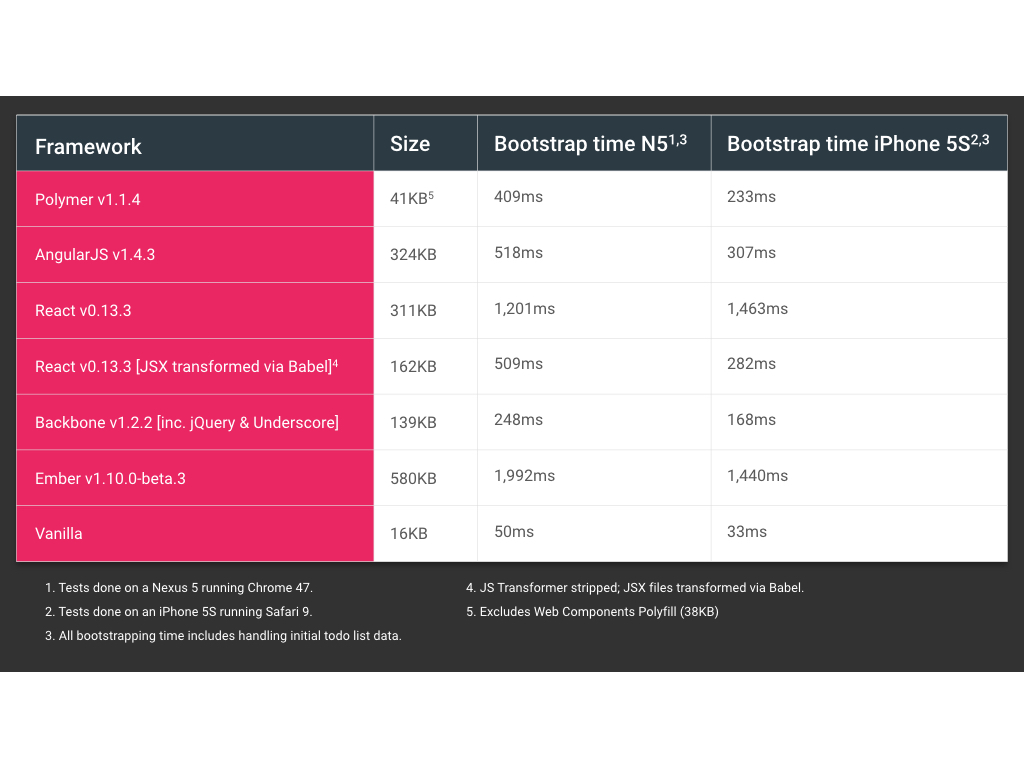
The Cost of Frameworks
I recently delivered a talk at FFConf in Brighton, called "You should use <insert library / framework here>, it's the bestestest!". I wanted to do a write-up of the presentation's content here, hopefully so it can start a broader conversation that I think we need to have, mainly around the cost of modern frameworks on mobile devices.
progression.fyi
A collection of open source frameworks for helping designers and engineers to grow at work

Continuous Science Foundation | Transform Science Together—Get Involved
Explore how the Continuous Science Foundation promotes open, continuous, and collaborative scientific research through innovative tools, standards, and community support.
Stop learning frameworks
We are developers. We need to stay up to date with technology. Every day, we learn programming languages, frameworks, and libraries. The more modern tools we know — the better. Keeping up to date with Angular, React, Vue, Riot, Ember, Knockout is fun. But we are wasting our time.
What Makes a Good Theory, and How Do We Make a Theory Good?
I present an ontology of criteria for evaluating theory to answer the titular question from the perspective of a scientist practitioner. Set inside a formal account of our adjudication over theories, a metatheoretical calculus, this ontology comprises the following: (a) metaphysical commitment, the need to highlight what parts of theory are not under investigation, but are assumed, asserted, or essential; (b) discursive survival, the ability to be understood by interested non-bad actors, to withstand scrutiny within the intended (sub)field(s), and to negotiate the dialectical landscape thereof; (c) empirical interface, the potential to explicate the relationship between theory and observation, i.e., how observations relate to, and affect, theory and vice versa; (d) minimising harm, the reckoning with how theory is forged in a fire of historical, if not ongoing, abuses—from past crimes against humanity, to current exploitation, turbocharged or hyped by machine learning, to historical and present internal academic marginalisation. This work hopes to serve as a possible beginning for scientists who want to examine the properties and characteristics of theories, to propose additional virtues and vices, and to engage in further dialogue. Finally, I appeal to practitioners to iterate frequently over such criteria, by building and sharing the metatheoretical calculi used to adjudicate over theories.
National Science Foundation Fostering Interdisciplinary Networks to Develop Emergent and Responsive Solutions Foundry (NSF FINDERS FOUNDRY)
To save a PDF of this solicitation, select Print to PDF in your browser's print options.
National Science Foundation Fostering Interdisciplinary Networks to Develop Emergent and Responsive Solutions Foundry (NSF FINDERS FOUNDRY)
To save a PDF of this solicitation, select Print to PDF in your browser's print options.
Structure and Interpretation of Test Cases • Kevlin Henney • GOTO 2022
Do you really want an SPA framework?
First, sell your soul to the framework maintainer…
Leiden Manifesto for Research Metrics
The Leiden Manifesto for Research Metrics (also known as the Leiden Manifesto) is a 22 April 2015 published comment in Nature that includes a list of "ten principles to guide research evaluation".[1] It was formulated by public policy professor Diana Hicks, scientometrics professor Paul Wouters, and their colleagues at the 19th International Conference on Science and Technology Indicators, held between 3–5 September 2014 in Leiden, The Netherlands.[2]
