

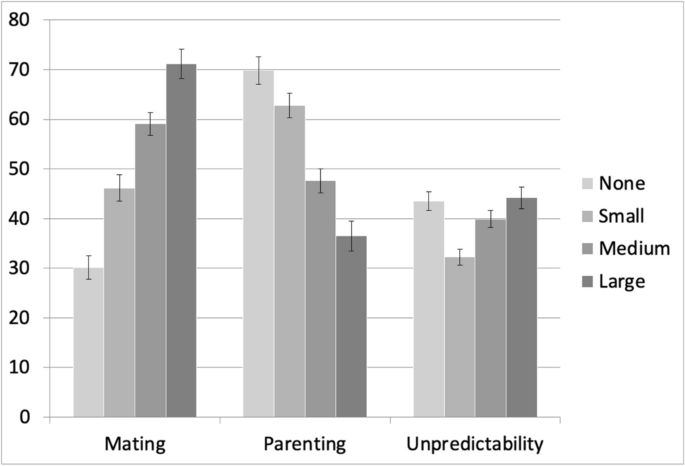
Two studies advance the understanding of phenotypic mimicry in consumer products. Product features mimicking more prominent male secondary sexual characteristics are associated with men’s behavioral strategies which are higher in mating effort and lower in paternal investment in offspring, in parallel with reproductive strategies across species and within the human population. The first study demonstrated a continuous relationship between the sizes of luxury brand logos and perceptions of the owners’ life histories. Two partial replications reproduced Study 1 results. Study 2 demonstrated that a manipulation of coloration, another fundamental dimension of variation in secondary sex characteristics, generates a similar pattern of results. In both studies, men owning shirts with more prominent sensory characteristics were believed to use authority and intimidation as strategies for advancing social status, whereas men owning shirts with less showy characteristics were believed to demonstrate useful abilities and foster cooperative alliances. Participants also recognized the strategic use of luxury display properties across social contexts.
Sizing chaos
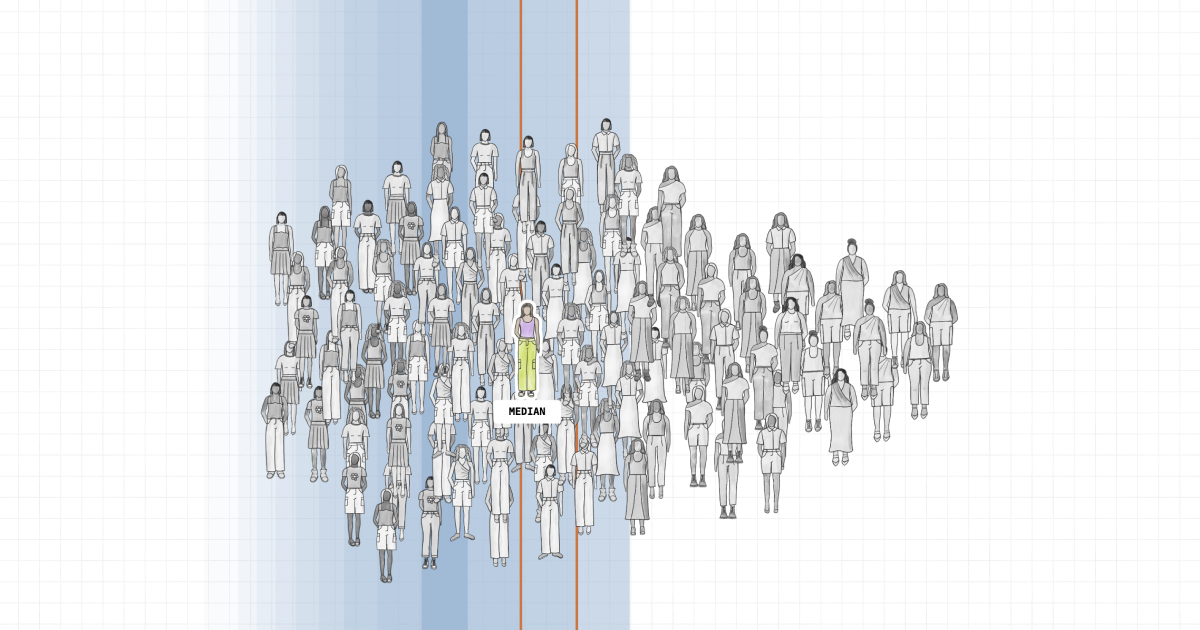
The inter-generational struggle to find clothes that fit more than a tiny portion of women
Evolution of Consumption: A Psychological Ownership Framework
Technological innovations are creating new products, services, and markets that satisfy enduring consumer needs. These technological innovations create value for consumers and firms in many ways, but they also disrupt psychological ownership––the feeling that a thing is “MINE.” The authors describe two key dimensions of this technology-driven evolution of consumption pertaining to psychological ownership: (1) replacing legal ownership of private goods with legal access rights to goods and services owned and used by others and (2) replacing “solid” material goods with “liquid” experiential goods. They propose that these consumption changes can have three effects on psychological ownership: they can threaten it, cause it to transfer to other targets, and create new opportunities to preserve it. These changes and their effects are organized in a framework and examined across three macro trends in marketing: (1) growth of the sharing economy, (2) digitization of goods and services, and (3) expansion of personal data. This psychological ownership framework generates future research opportunities and actionable marketing strategies for firms aiming to preserve the positive consequences of psychological ownership and navigate cases for which it is a liability.

Love Is a Many-Splendored Thing: Brand Love in a Consumer Culture
In a consumer culture, people make sense of their everyday existence based on meanings generated during the consumption process. These meanings feature in establishing human identities and communicating them to others. Brands fulfill a pivotal role in conveying the...

Appearances vs Experiences: What Really Makes Us Happy
In the search for happiness, we often confuse how something looks with how it’s likely to make us feel. This is especially true when it comes to our homes. If we want to maximize happiness, we need to prioritize experiences over appearances.
Restoring Consumer Sovereignty
For decades, there has been broad consensus within antitrust, intellectual property, and consumer law scholarship that consumers make decisions in their own best interests by consciously weighting the market’s relative prices, quantities, and qualities against each other. That consensus is unraveling in light of novel findings from cognitive and social psychology that explain how individuals’ concepts of what they prefer drive the global economy. At the same time, producers nowadays no longer merely satisfy consumers’ needs but also communicate their values, identities, and aspirations through the sale and marketing of products. As part of the growing interest in observations such as these, a wealth of psychological studies challenge the fundamental teaching of economics that the interplay of demand and supply of goods in a free market economy provides us with material wealth. This book provides a normative defense of that assumption and a theoretical framework for understanding its contradictions. It argues that the erosion of consumer sovereignty through the ability of product manufacturers and sellers to systematically take advantage of individuals’ psychological weaknesses demands a twenty-first-century reconceptualization of the consumer and a modern account of how the law should regulate the digital economy. Such an account is justified to ensure a diverse marketplace in which consumers can influence how our societies are structured and arranged. By examining the role that market manipulation plays, it offers ingredients for a realistic descriptive and normative market regulatory theory that is aware of its political economy, its behavioral suppositions, and its distributional consequences.
Survival of the Prettiest (Published 2017)
Darwin’s theory of aesthetics may be the sexiest, most dangerous idea in evolution.

The role of storytelling in the creation of brand love: the PANDORA case
The study of storytelling and brand love is justified by the need to understand the potential of storytelling as a tool that marketers have available to positively influence the love felt by the consumers toward a particular brand. In this case, we ...

Taking a look at looksmaxxing — and what parents should know
The trend among boys and young men of optimizing their physical appearance includes dangerous practices. Experts offer advice on how to talk to their sons about body image and healthy behaviors.

Behavioural economics, consumer behaviour and consumer policy: state of the art
Counter to the traditional assumption of neoclassical economics that individuals are rational Homo oeconomici that always seek to maximize their utility and follow their ‘true’ preferences, research in behavioural economics has demonstrated that people's judgements and decisions are often subject to systematic biases and heuristics, and are strongly dependent on the context of the decision. In this article, we briefly review the transition of research from neoclassical economics to behavioural economics, and discuss how the latter has influenced research in consumer behaviour and consumer policy. In particular, we discuss the impacts of key principles such as status quo bias, the endowment effect, mental accounting and the sunk-cost effect, other heuristics and biases related to availability, salience, the anchoring effect and simplicity rules, as well as the effects of other supposedly irrelevant factors such as music, temperature and physical markers on consumers’ decisions. These principles not only add significantly to research on consumer behaviour – they also offer readily available practical implications for consumer policy to nudge behaviour in beneficial directions in consumption domains including financial decision making, product choice, healthy eating and sustainable consumption.
So It Is, So It Shall Be: Group Regularities License Children's Prescriptive Judgments
Abstract When do descriptive regularities (what characteristics individuals have) become prescriptive norms (what characteristics individuals should have)? We examined children's (4–13 years) and adults' use of group regularities to make prescriptive judgments, employing novel groups (Hibbles and Glerks) that engaged in morally neutral behaviors (e.g., eating different kinds of berries). Participants were introduced to conforming or non‐conforming individuals (e.g., a Hibble who ate berries more typical of a Glerk). Children negatively evaluated non‐conformity, with negative evaluations declining with age (Study 1). These effects were replicable across competitive and cooperative intergroup contexts (Study 2) and stemmed from reasoning about group regularities rather than reasoning about individual regularities (Study 3). These data provide new insights into children's group concepts and have important implications for understanding the development of stereotyping and norm enforcement.

Can names shape facial appearance?
Our given name is a social tag associated with us early in life. This study investigates the possibility of a self-fulfilling prophecy effect wherein individuals’ facial appearance develops over time to resemble the social stereotypes associated with given names. Leveraging the face–name matching effect, which demonstrates an ability to match adults’ names to their faces, we hypothesized that individuals would resemble their social stereotype (name) in adulthood but not in childhood. To test this hypothesis, children and adults were asked to match faces and names of children and adults. Results revealed that both adults and children correctly matched adult faces to their corresponding names, significantly above the chance level. However, when it came to children’s faces and names, participants were unable to make accurate associations. Complementing our lab studies, we employed a machine-learning framework to process facial image data and found that facial representations of adults with the same name were more similar to each other than to those of adults with different names. This pattern of similarity was absent among the facial representations of children, thereby strengthening the case for the self-fulfilling prophecy hypothesis. Furthermore, the face–name matching effect was evident for adults but not for children’s faces that were artificially aged to resemble adults, supporting the conjectured role of social development in this effect. Together, these findings suggest that even our facial appearance can be influenced by a social factor such as our name, confirming the potent impact of social expectations.

Tightwads and spendthrifts: An interdisciplinary review
Consumers rely on a “pain of paying” to help deter their spending. While this is beneficial for some consumers, others experience levels of pain that create problems. “Tightwads” experience too much pain when considering spending and therefore spend less than they would ideally like to spend. By contrast, “spendthrifts” experience too little pain and therefore spend more than they would ideally like to spend. Neither are happy with how they handle money. In the decade since the tightwad‐spendthrift construct was introduced, much has been learned about what it is and is not (e.g., frugality, greed), what contextual factors are likely to reduce its importance, how it plays a role within romantic relationships, and when it might first emerge in childhood. This paper reviews the wide range of interdisciplinary research relevant to the tightwad‐spendthrift construct and proposes several directions for new research.

In pursuit of 'Instagram face,' are we losing the imperfections that make us human?
Plastic surgery is becoming so normalized and undetectable, it's changing our relationship to reality. The New Yorker staff writer Jia Tolentino considers how beauty standards have dovetailed with AI.

Elegant theories and the problems of social psychology
This perspective article provides a commentary on the current state of theories used in social psychology, with a particular emphasis on the importance of distinguishing between theoretical models ...
Relevant envy:

Mayor Zohran Kwame Mamdani
演出现场见! on.nyc.gov/broadway
Relevant envy:
Mayor Zohran Kwame Mamdani
演出现场见! on.nyc.gov/broadway
