Scientists seek to understand the causes of observed phenomena. Beliefs that they have succeeded are based on understanding that is rarely or possibly never complete, and varies in depth and quality. Most often scientists believe they understand more than they do, making their belief an illusion. This illusion then persists in explanations scientists provide in print, in talks, or in discussions. The illusion that a scientist has a valid and complete explanation tends to be magnified when the data are well described by mathematical and computer simulation models due to the precision of such models and their ability to predict well; prediction does not imply causality, but gives the illusion that it does. The first part of this essay supports the case for the universality of partial and incomplete levels of understanding by showing the difficulty of reaching a deep level of understanding for even a simple analysis and model that most scientists use and believe they understand: linear regression. The second part highlights some implications of the existence of many levels of understanding and explanation, and their use by scientists for design, testing, analysis, and theory development. It discusses the way that deduction and induction depend on the levels of understanding and the implications of the illusion that a scientist’s understanding is deep. It makes a case that the many incomplete levels of understanding affect, often unwittingly, the ways scientists design experiments, test theories, comprehend, communicate, and teach.
Understanding Artificial Neural Networks: Mysterianism about Known Mechanism is Mysticism
Mysterianism is the idea that human cognition, mind, cannot be understood. Taking this concept and applying it to known mechanism — such that claims are made that we do not know how engineered systems, such as artificial neural networks (ANNs), work, or that they constitute black boxes that we can only open with difficulty — is inappropriate at best and malicious at worst. We do know the mechanistic structure of such models because we designed and built them. We also do know their functional role (what they are for) as well as the mathematical function they are asked to approximate (map inputs to target outputs). Because mysterianist beliefs about known systems, such as ANNs, are often expressed, scientists need to sit up and take notice. We provide an error theory as to what is going on to help unpick this metatheoretical blunder. Ultimately, the problem is that 'understanding' is not a technical term in these cases: the word is co-opted for a specific narrative to sell 'artificial intelligence' through mystification. All computational systems, from pendulums to databases, will behave in ways we cannot predict or control — this is not a unique property of ANNs — and experts do indeed grasp the computational properties of these systems nonetheless.
Understanding Artificial Neural Networks: Mysterianism about Known Mechanism is Mysticism
Mysterianism is the idea that human cognition, mind, cannot be understood. Taking this concept and applying it to known mechanism — such that claims are made that we do not know how engineered systems, such as artificial neural networks (ANNs), work, or that they constitute black boxes that we can only open with difficulty — is inappropriate at best and malicious at worst. We do know the mechanistic structure of such models because we designed and built them. We also do know their functional role (what they are for) as well as the mathematical function they are asked to approximate (map inputs to target outputs). Because mysterianist beliefs about known systems, such as ANNs, are often expressed, scientists need to sit up and take notice. We provide an error theory as to what is going on to help unpick this metatheoretical blunder. Ultimately, the problem is that 'understanding' is not a technical term in these cases: the word is co-opted for a specific narrative to sell 'artificial intelligence' through mystification. All computational systems, from pendulums to databases, will behave in ways we cannot predict or control — this is not a unique property of ANNs — and experts do indeed grasp the computational properties of these systems nonetheless.
Artificial intelligence and illusions of understanding in scientific research
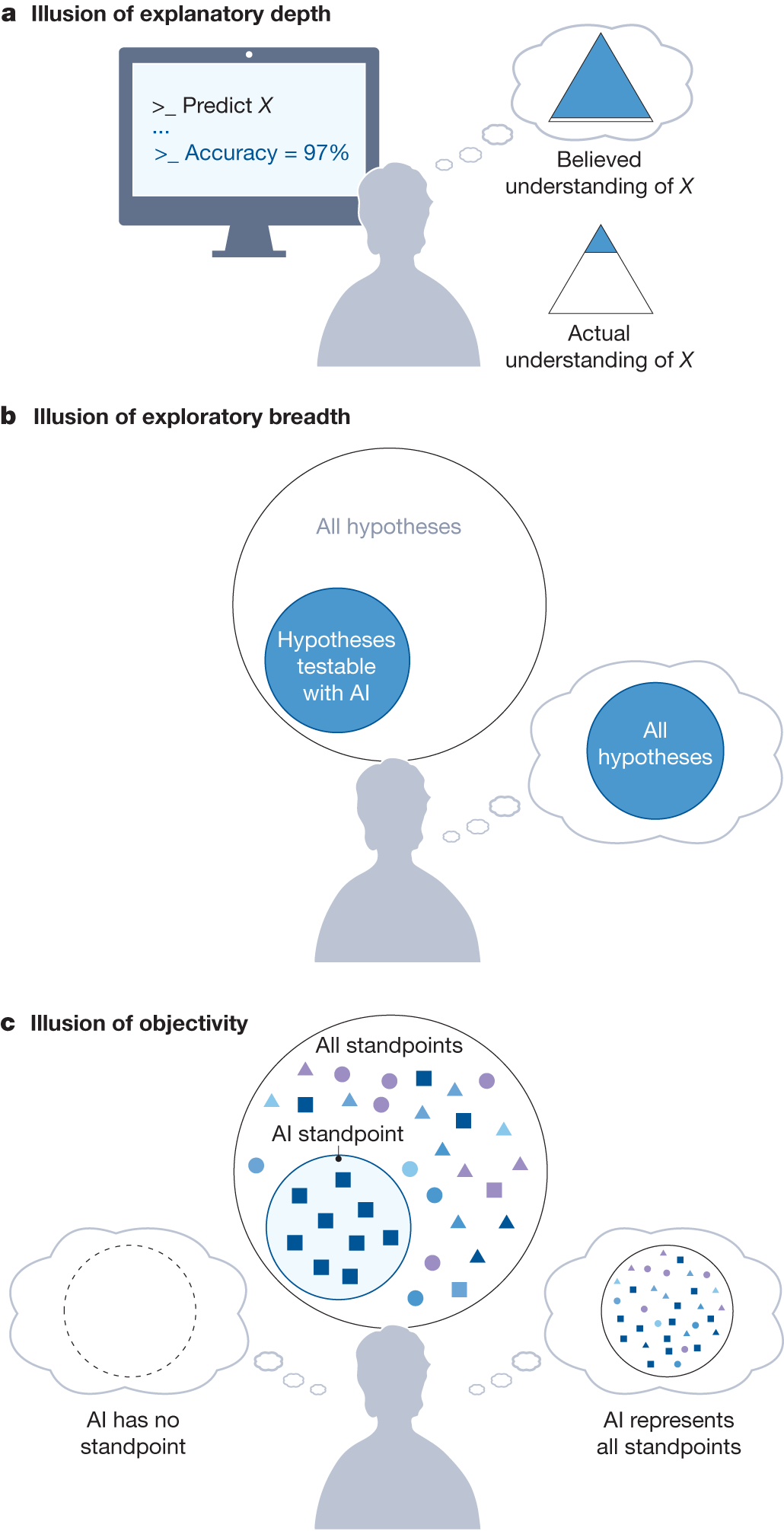
Scientists are enthusiastically imagining ways in which artificial intelligence (AI) tools might improve research. Why are AI tools so attractive and what are the risks of implementing them across the research pipeline? Here we develop a taxonomy of scientists’ visions for AI, observing that their appeal comes from promises to improve productivity and objectivity by overcoming human shortcomings. But proposed AI solutions can also exploit our cognitive limitations, making us vulnerable to illusions of understanding in which we believe we understand more about the world than we actually do. Such illusions obscure the scientific community’s ability to see the formation of scientific monocultures, in which some types of methods, questions and viewpoints come to dominate alternative approaches, making science less innovative and more vulnerable to errors. The proliferation of AI tools in science risks introducing a phase of scientific enquiry in which we produce more but understand less. By analysing the appeal of these tools, we provide a framework for advancing discussions of responsible knowledge production in the age of AI.
Many Minds: Science, AI, and illusions of understanding
AI will fundamentally transform science. It will supercharge the research process, making it faster and more efficient and broader in scope. It will make scientists themselves vastly more productive, more objective, maybe more creative. It will make many human participants—and probably some human scientists—obsolete… Or at least these are some of the claims we are hearing these days. There is no question that various AI tools could radically reshape how science is done, and how much science is done. What we stand to gain in all this is pretty clear. What we stand to lose is less obvious, but no less important. My guest today is . Molly is a Professor in the Department of Psychology and the University Center for Human Values at Princeton University. In a recent , Molly and the anthropologist presented a framework for thinking about the different roles that are being imagined for AI in science. And they argue that, when we adopt AI in these ways, we become vulnerable to certain illusions. Here, Molly and I talk about four visions of AI in science that are currently circulating: AI as an Oracle, as a Surrogate, as a Quant, and as an Arbiter. We talk about the very real problems in the scientific process that AI promises to help us solve. We consider the ethics and challenges of using Large Language Models as experimental subjects. We talk about three illusions of understanding the crop up when we uncritically adopt AI into the research pipeline—an illusion that we understand more than we actually do; an illusion that we're covering a larger swath of a research space than we actually are; and the illusion that AI makes our work more objective. We also talk about how ideas from Science and Technology Studies (or STS) can help us make sense of this AI-driven transformation that, like it or not, is already upon us. Along the way Molly and I touch on: AI therapists and AI tutors, anthropomorphism, the culture and ideology of Silicon Valley, Amazon's Mechanical Turk, fMRI, objectivity, quantification, Molly's mid-career crisis, monocultures, and the squishy parts of human experience. Without further ado, on to my conversation with Dr. Molly Crockett. Enjoy! A transcript of this episode is available . Notes and links 5:00 – For more on LLMs—and the question of whether we understand how they work—see our with Murray Shanahan. 9:00 – For the paper by Dr. Crockett and colleagues about the social/behavioral sciences and the COVID-19 pandemic, see . 11:30 – For Dr. Crockett and colleagues’ work on outrage on social media, see this . 18:00 – For a recent exchange on the prospects of using LLMs in scientific peer review, see . 20:30 – Donna Haraway’s essay, 'Situated Knowledges: The Science Question in Feminism and the Privilege of Partial Perspective’, is . See also Dr. Haraway's book, . 22:00 – For the recent essay by Henry Farrell and others on AI as a cultural technology, see . 23:00 – For a recent report on chatbots driving people to mental health crises, see . 25:30 – For the already-classic “stochastic parrots” article, see . 33:00 – For the study by Ryan Carlson and Dr. Crockett on using crowd-workers to study altruism, see . 34:00 – For more on the “illusion of explanatory depth,” see with Tania Lombrozo. 53:00 – For more about Ohio State’s plans to incorporate AI in the classroom, see . For a recent essay by Dr. Crockett on the idea of “techno-optimism,” see . Recommendations , by Adam Becker , by L. A. Paul , by Miranda Fricker Many Minds is a project of the , which is made possible by a generous grant from the John Templeton Foundation to Indiana University. The show is hosted and produced by , with help from Assistant Producer and with creative support from DISI Directors Erica Cartmill and Jacob Foster. Our artwork is by . Our transcripts are created by . Subscribe to Many Minds on Apple, Stitcher, Spotify, Pocket Casts, Google Play, or wherever you listen to podcasts. You can also now subscribe to the Many Minds newsletter ! We welcome your comments, questions, and suggestions. Feel free to email us at: manymindspodcast@gmail.com. For updates about the show, visit or follow us on Twitter () or Bluesky ().

Position: Don't Just "Fix it in Post": A Science of AI Must Study Training Dynamics
What would it mean to have a scientific understanding of AI? Models are not static objects: they are snapshots of time-evolving processes shaped by data, objectives, architectures, and optimization dynamics. Yet much of AI research treats models as fixed artifacts, analyzing behaviors after training rather than asking why they emerge. This position paper argues that a science of AI must move beyond post-hoc fixes and study the training dynamics that produce model behavior. Such a science should support progressively stronger forms of understanding: predicting outcomes from early training signals, intervening when trajectories go wrong, and ultimately designing training procedures that more reliably produce desired properties. Scaling laws have made prediction routine for loss; the challenge is extending this success to capabilities, biases, robustness, and safety-relevant behaviors. We articulate requirements for such theories grounded in the history and philosophy of science, examine progress in mechanistic interpretability, fairness, memorization, and simplicity bias, and identify concrete open problems.

The misunderstood limits of folk science: an illusion of explanatory depth
People feel they understand complex phenomena with far greater precision, coherence, and depth than they really do; they are subject to an illusion—an illusion of explanatory depth. The illusion is f...

Re-Engineering Wimsatt for Limited Beings
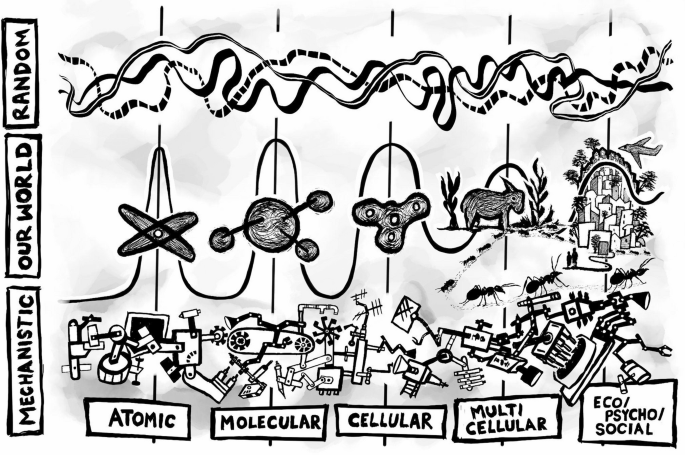
Science is the best way to produce facts about reality. The best, at least, that limited human beings have devised so far. Yet, not even scientists quite seem to understand how scientific knowledge is generated. This is not only a philosophical but also a practical problem, as our misunderstandings affect the quality of our research and limit the directions it can take. In light of this, it may be good if we reflected a bit more on how we do science — to become better researchers through philosophy. Here, I provide an accessible introduction to a philosophical approach that achieves precisely this: William Wimsatt’s multi-perspectival realism. It disabuses us of widespread but misleading myths and idealizations about science, such as the idea that everything in the world can be reduced to a fundamental level, or that we can approach a “view from nowhere” — complete and objectively detached knowledge of the world. Wismatt proposes an alternative view based on his thorough studies of actual research practice. It cuts deeply into the layered yet messy structure of reality, and the improvised but potent tools we have available, as limited and evolved beings, to explore it. Wimsatt reframes science as an irregular yet adaptive process rather than a cumulative repository of unalterable facts. His philosophy provides a workable and grounded middle way between radical skepticism and naïve belief in the objective truth of science. It explains how knowledge is conceptually constructed by humans, but still connects us to reality in a trustworthy way. We need such a new view of science, not only to improve our research practices and outcomes but, more generally, to gain a more realistic understanding of ourselves, the world, and our place and role within it.
Against theory-motivated experimentation: Can random experimental choice lead to better theories?
Scientists must choose which among many experiments to perform. We study the epistemic success of experimental choice strategies proposed by philosophers of science or executed by scientists themselves. We develop a multi-agent model of the scientific process that jointly formalizes its core aspects: active experimentation, theorizing, and social learning. We find that agents who choose new experiments at random develop the most informative and predictive theories of the world. The agents aiming to confirm, falsify theories, or resolve theoretical disagreements end up with an illusion of epistemic success: they develop promising accounts for the data they collected, while misrepresenting the ground truth that they intended to learn about. Agents experimenting in these theory-motivated ways acquire less diverse or less representative samples from the ground truth that also turn out to be easier to account for. Random data collection, on the other hand, combines virtues of diverse and representative sampling from a target scientific domain which enables cumulative development of the successful theoretical accounts of it. We suggest that randomization, already a gold standard within experiments, is also beneficial at the level of experiments themselves.

Why Most Published Research Findings Are False
Summary There is increasing concern that most current published research findings are false. The probability that a research claim is true may depend on study power and bias, the number of other studies on the same question, and, importantly, the ratio of true to no relationships among the relationships probed in each scientific field. In this framework, a research finding is less likely to be true when the studies conducted in a field are smaller; when effect sizes are smaller; when there is a greater number and lesser preselection of tested relationships; where there is greater flexibility in designs, definitions, outcomes, and analytical modes; when there is greater financial and other interest and prejudice; and when more teams are involved in a scientific field in chase of statistical significance. Simulations show that for most study designs and settings, it is more likely for a research claim to be false than true. Moreover, for many current scientific fields, claimed research findings may often be simply accurate measures of the prevailing bias. In this essay, I discuss the implications of these problems for the conduct and interpretation of research.
Sciences perceived as precise and consensual are more trusted
Research focused on the United States shows that people’s trust in science varies considerably between disciplines. Existing explanations of these trust gaps stress the role of ideology: when people perceive scientists of a particular discipline to be ideologically like-minded, they tend to trust them more. Here, we report two findings: first, trust gaps between disciplines also exist in France—a representative sample of the French population (N = 1012) trusted researchers in biology and physics more than researchers studying climate science, economics, or sociology. Second, the more precise and consensual participants perceive scientific findings to be, the more they tend to trust the scientists (across and within disciplines). While these findings are correlational, they align with a non-ideological explanation of trust in science: the rational impression account. This account proposes that people can come to trust scientists by relying on basic cognitive inference processes, which tend to be generally rational.
Machine understanding
What do artificial intelligence (AI) systems “understand”? This question arises not only in assessing a system’s intelligence but also in evaluation practices to ensure the safe and responsible deployment of AI. Drawing on scholarship from philosophy and cognitive science, and informed by current practices in AI, we develop a framework for asking more precise questions and making more precise claims about machine understanding. We conceptualize understanding as a relation between a system (S) and a target of understanding (T), and we discuss how to specify the relation, the system, and the target, offering a landscape of options in each case. Our goal is not to defend a particular account of understanding, but to provide conceptual tools for those working to assess or advance machine understanding.

Complexity Explorables
A collection of interactive explorable explanations of complex systems in biology, physics, mathematics, social sciences, epidemiology, ecology and other fields....
The Illusion of Clarity • Ness Labs
The illusion of clarity is the confident feeling that you understand something, when in reality your grasp is full of gaps you’ve never noticed.
Verification in the Age of AI Scientists
AI Scientists now operate at a scale that outpaces human capacity for manual review. Systems such as Sakana’s AI Scientist write entire workshop papers end-to-end. Lila Sciences runs autonomous ``AI Science Factories’’ that hypothesize, experiment, and iterate without human guidance. FutureHouse’s Kosmos and Robin generate thousands of candidate hypotheses in a single run, and Google’s Co-Scientist proposes testable experiments at a rate no laboratory can fully evaluate. Each of these systems emphasizes verified results, yet that standard ranges from near-perfect formal proof in mathematics to decade-long clinical trials in medicine, with no shared framework for judging sufficiency across domains. As outputs scale beyond what humans can manually inspect, the question of which results to trust becomes as hard as generating them. The bottleneck for AI for Science is no longer hypothesis generation, it is verification.
Deep Research, information vs. insight, and the nature of science
What AI will accelerate in the scientific process, what it cannot do, and how we can prepare for new manners of scientific investigation.
#predictingthefuture #newfutureofwork | Jaime Teevan
🌱 Prediction: Knowledge will outgrow publication. We’re already seeing academic publication start to buckle under AI, sometimes absurdly. I still publish research more or less the way Darwin did. I run a study, write it up, a few other scientists check it over, and the result gets filed away as a document with my name on the front. Faster than Darwin, with better figures, but the same basic shape. I predict that shape won’t last another decade. Academic authors are starting to slip hidden instructions into papers to flatter the AI that might review them. Reviewers are spending time checking whether citations exist or were hallucinated. Researchers asking AI to tell them about a paper instead of reading it directly. These are signs that the creation of new knowledge is outgrowing the articles that used to contain it. An academic paper serves many purposes at once. It makes an argument legible. It lets strangers check one's reasoning. It assigns credit and responsibility. It records who knew what and when. A paper was the only container we had for these different jobs, so it carried all of them together. With AI, they can be separated. My guess is that means the unit of publication will get smaller. Much of my research has focused on microproductivity, developing the idea that large accomplishments can be built from many small contributions. Publication will start to become a form of microproductivity. Instead of holding onto a result until it can be wrapped in a narrative large enough to justify a paper, researchers will publish it the moment it’s solid. Each finding, method, or negative result will be citable and carry its own provenance, so credit and reasoning travel with it. Reviewing will shrink to match, so claims get checked as they’re made instead of in one verdict at the end. But more than changing publication, the deeper change will be to how research itself is done. You may have heard the term “compound engineering,” where every bug fixed, evaluation written, workflow documented, or lesson learned becomes part of the system’s memory. I predict we’re about to see “compound science,” where every experiment, evaluation, insight, artifact, and learned capability becomes a reusable asset for future discovery. Findings will become evidence. Methods will become building blocks. Failed approaches will become constraints. For centuries, science has relied on humans to navigate an ever-growing body of knowledge. Soon that body of knowledge will help navigate itself. Scientists will spend less time searching for hypotheses and more time deciding which opportunities to pursue. AI systems will propose explanations, design experiments, run analyses, and explore many possibilities in parallel. Every discovery will become a part of the machinery that produces the next one. Papers ten years from now will look less like my current papers than my current papers look like Darwin’s. If they exist at all. #PredictingTheFuture #NewFutureOfWork