


Some illusions of understanding are an inevitable part of the research process, while others can be avoided or overcome by careful critical thinking and observation. We are facing an increased risk of avoidable illusions as more research activities are delegated to large language models (LMM). LLMs can be useful but they cannot think, and their use can undermine our thinking and understanding. Thinking for ourselves is hard and error prone but worthwhile - and there are no shortcuts to understanding.
Augmenting Research Ideation with Data: An Empirical Investigation...
Recent advancements in large language models (LLMs) demonstrate strong potential for generating novel research ideas, yet such ideas often struggle with feasibility and effectiveness. In this...

AI Large Language Model Training: The Potential Risks of Ideological Skewing — PSG Consulting
LLMs (AI Large Language Models) have become part of everyday life. Systems such as ChatGPT, Claude, Gemini, Meta AI (Llama) and X.ai's Grok handle billions of interactions daily. They increasingly shape what information people encounter and in what order, subtly deciding what's important and even what is true, sometimes without users realizing it. Because LLMs wield growing power over information exposure, it is vital to recognize the political and ideological structures at multiple stages of their design, and to identify manipulation risks.

The unintended consequences of large language models as a labor-augmenting technology in science
As a labor-augmenting technology, large language models (LLMs) have the potential to accelerate scientific activity across the research pipeline. But even if LLMs perform on par with human experts at selected tasks, their use will bring unintended consequences as they alter the balance of frictions and inducements that steer the allocation of research effort across projects. Here we develop a simple mathematical model to illustrate. In fields where LLMs are useful primarily as tools for discovering promising projects, researchers will become more selective about what they publish; where they facilitate the process of publishing existing data, researchers will become less selective. By allowing scientists to work more quickly, LLMs raise the opportunity cost of researcher time, creating incentives to refine papers less thoroughly before moving on. Enticing as it is to imagine that, by saving us time on mundane tasks, LLMs will provide us with more time to think deeply and develop projects completely, our results temper such hopes.
The unintended consequences of large language models as a labor-augmenting technology in science
As a labor-augmenting technology, large language models (LLMs) have the potential to accelerate scientific activity across the research pipeline. But even if LLMs perform on par with human experts at selected tasks, their use will bring unintended consequences as they alter the balance of frictions and inducements that steer the allocation of research effort across projects. Here we develop a simple mathematical model to illustrate. In fields where LLMs are useful primarily as tools for discovering promising projects, researchers will become more selective about what they publish; where they facilitate the process of publishing existing data, researchers will become less selective. By allowing scientists to work more quickly, LLMs raise the opportunity cost of researcher time, creating incentives to refine papers less thoroughly before moving on. Enticing as it is to imagine that, by saving us time on mundane tasks, LLMs will provide us with more time to think deeply and develop projects completely, our results temper such hopes.
There's Something Fundamentally Wrong With LLMs
LLMs aren't trained on the "vast majority of speech," experts warn, a major blind spot that could have sweeping consequences.

The AI Cognitive Trojan Horse: How Large Language Models May...
Large language model (LLM)-based conversational AI systems present a challenge to human cognition that current frameworks for understanding misinformation and persuasion do not adequately address....
Understanding Understanding: A Pragmatic Framework Motivated by...
Motivated by the rapid ascent of Large Language Models (LLMs) and debates about the extent to which they possess human-level qualities, we propose a framework for testing whether any agent (be it...
Large language models are not the problem
If a Large Language Model (LLM) can replicate your scientific contribution, the problem is not the LLM. What does it say about our field that so much of the anxiety about AI comes down to the fear that a machine could do what we do? Perhaps it says we should be doing something better.

The Cloister Web: Reshaping the Political Maidan
The advent of the "Cloister Web," a conceptual space where individuals leverage Large Language Models (LLMs) to cultivate novel ideas and commit them to a persistent public memory, heralds a profound shift in our intellectual and political landscapes.

What Happens, Exactly, When a Person Talks to an LLM?
A phenomenology of thinking with a model.

Mitigating Cross-Lingual Cultural Inconsistencies in LLMs via...
Despite their impressive capabilities, multilingual large language models (MLLMs) frequently exhibit inconsistent behaviour when the prompt's language changes. While such adaptation is generally...
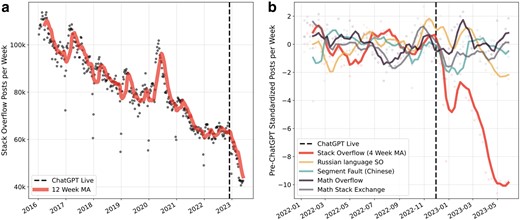
Large language models reduce public knowledge sharing on online Q&A platforms
Abstract. Large language models (LLMs) are a potential substitute for human-generated data and knowledge resources. This substitution, however, can present
Cognitive exponents and LLM leverage
I know a few people for whom LLMs have been a near-immediate multiplier of attention and effort. I know a lot for whom LLMs clearly make them worse at thinking and doing things. So: why?
Curated retrieval versus open web search in public AI information...
Public institutions increasingly use large language models (LLMs) to answer citizens' questions, often pairing a curated knowledge base with live web search, yet whether the sources behind these...
Artificial intelligences and human scientists exhibit...
We investigate the effectiveness of artificial intelligences (AI)-specifically large language models (LLMs)-relative to human scientists at high-level cognitive tasks in social science such as...
1/4 Do LLMs understand? "They understand in a way that’s very different from how humans understand," Dileep George, @dileeplearning.bsky.social, of Google DeepMind at the Simons Institute workshop on The Future of Language Models and Transformers. Video: simons.berkeley.edu/talks/dileep-george-google-de…
