


This essay focuses on anthropomorphism as both a form of hype and fallacy. As a form of hype, anthropomorphism is shown to exaggerate AI capabilities and performance by attributing human-like traits to systems that do not possess them. As a fallacy, anthropomorphism is shown to distort moral judgments about AI, such as those concerning its moral character and status, as well as judgments of responsibility and trust. By focusing on these two dimensions of anthropomorphism in AI, the essay highlights negative ethical consequences of the phenomenon in this field.
Anthropomorphism in AI: hype and fallacy
This essay focuses on anthropomorphism as both a form of hype and fallacy. As a form of hype, anthropomorphism is shown to exaggerate AI capabilities and performance by attributing human-like traits to systems that do not possess them. As a fallacy, anthropomorphism is shown to distort moral judgments about AI, such as those concerning its moral character and status, as well as judgments of responsibility and trust. By focusing on these two dimensions of anthropomorphism in AI, the essay highlights negative ethical consequences of the phenomenon in this field.
Anthropomorphism Is Breaking Our Ability to Judge AI
Tech Policy Press fellow James Ball asks, how should we interact with a technology designed to ‘speak’ with us on what appear to be human terms?
AI, Ethics, and Society — Home
The Impact of Artificial Intelligence on Human Thought
This research paper examines, from a multidimensional perspective (cognitive, social, ethical, and philosophical), how AI is transforming human thought. It highlights a cognitive offloading effect: the externalization of mental functions to AI can reduce intellectual engagement and weaken critical thinking. On the social level, algorithmic personalization creates filter bubbles that limit the diversity of opinions and can lead to the homogenization of thought and polarization. This research also describes the mechanisms of algorithmic manipulation (exploitation of cognitive biases, automated disinformation, etc.) that amplify AI's power of influence. Finally, the question of potential artificial consciousness is discussed, along with its ethical implications. The report as a whole underscores the risks that AI poses to human intellectual autonomy and creativity, while proposing avenues (education, transparency, governance) to align AI development with the interests of humanity.

How Shifting Responsibility for AI Harms Undermines Democratic Accountability | TechPolicy.Press
The moralization of individual AI use deflects responsibility away from powerful actors like corporations and governments, Suvradip Maitra and others write.
233. "The Illusion of Thinking" — Thoughts on This Important Paper
This is a fantastic paper. I just love it. tl;dr AI is not human. Anthropomorphization has been bad for AI, LLMs, and Chat. Clippy walked so today's AI could run.
Don't treat surface-level metaphors about AI as if they describe fundamental reality
Debates about whether AI is a “tool” or whether it’s wrong to “anthropomorphize” it often seem confused about what reality is made of

AI is An Ideology, Not A Technology
At its core, "artificial intelligence" is a perilous belief that fails to recognize the agency of humans.
For the love of God, stop calling your AI a co-worker | TechCrunch
A growing number of startups are anthropomorphizing AI to build trust fast -- and soften its threat to human jobs.

De-anthropomorphizing “AI”: From wishful mnemonics to accurate nomenclature
Language matters. How we describe “AI” technology influences how it is perceived, deployed, and trusted. Extravagant and persuasive language incites hype. It is the responsibility of journalists, companies, and scholars to characterize technology in ways that inform and empower their readers by using appropriate terminology and avoiding inflated claims. One type of inflated claim comes from using anthropomorphizing language to describe system functionality. Anthropomorphization is the attribution of human capabilities and characteristics to the inanimate system. In this paper, we present a linguistic analysis of anthropomorphizing language in 29 texts (a total of 1,368 sentences) from academic articles, online news articles, and company blog posts. We construct a taxonomy of eight categories of anthropomorphization: Cognizer, Products of cognition, Emotion, Communication, Agent, Human role analogy, Names and pronouns, and Biological metaphors. Following this taxonomy we present concrete strategies for how to de-anthropomorphize the language we use to describe “AI” based on a functionality-first principle.
Humanism without (All) Humans
Microsoft Humanism puts corporate muscle behind an overweening class of bad AI philosophies
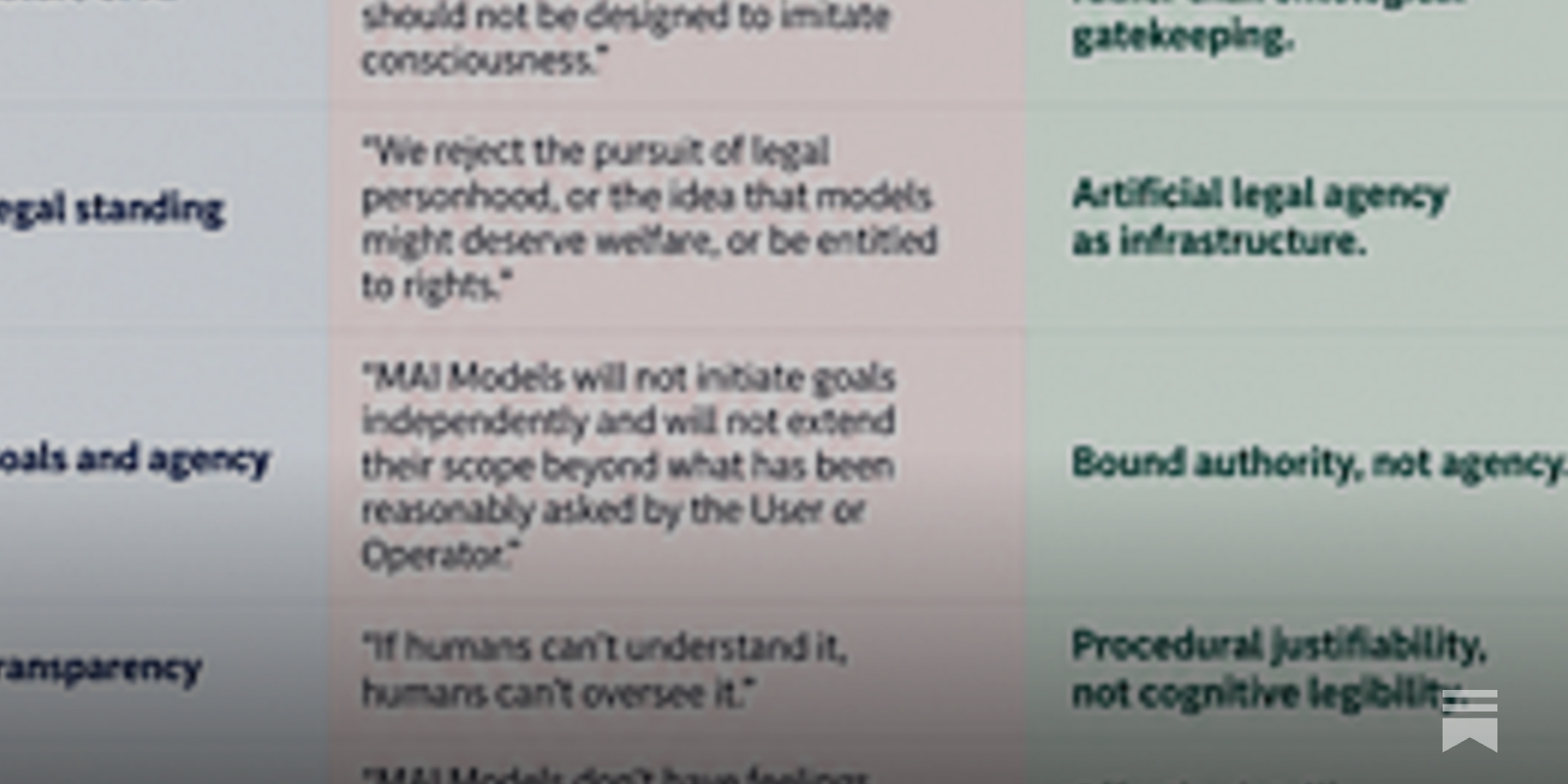
Pluralistic: “Rights for robots” and the AI slavery fantasy (10 Jul 2026) – Pluralistic: Daily links from Cory Doctorow
While the AI bubble is primarily a material phenomenon (driven by the calculation that bosses are easy marks for a sales pitch that sees them replacing workers with software), there is an inescapable ideological component to it: the desire for a world without people in it:
Why this philosopher turned down Anthropic
The AI industry is courting the humanities — but it is asking the wrong questions

Why this philosopher turned down Anthropic
The AI industry is courting the humanities — but it is asking the wrong questions
The Future of AI
The Parents’ Paradox: AI, Ethics, and the Limits of Machine Morality This post is based on a talk I gave at The AI & Automation Conference in London on February 25, 2026, and my slides. A…
AI* anthropomorphism

* I’m neither “pro-AI” nor “anti-AI.” I’ve been blocked for being perceived as both. —Actually, I’m honestly more anti-AI than pro-AI thus far, aside from specialized models and specific use cases, but I’m willing to consider information that’s new to me

Opinion | A.I. Companies Say They Aren’t Responsible for Their Unpredictable Products. Don’t Believe Them.

Anthropic bans ‘abusive or cruel behavior’ toward Claude
*extremely tired voice*AI agents don't "go rogue". They are not sentient; they don't have agency. They work within guardrails set by humans…

Artificial intelligence systems do not think, feel, want or understand. Avoid language that gives them human characteristics.

Assigning agency to AI means surrendering your own

論説:AIの「意識」論争は何を隠しているか