

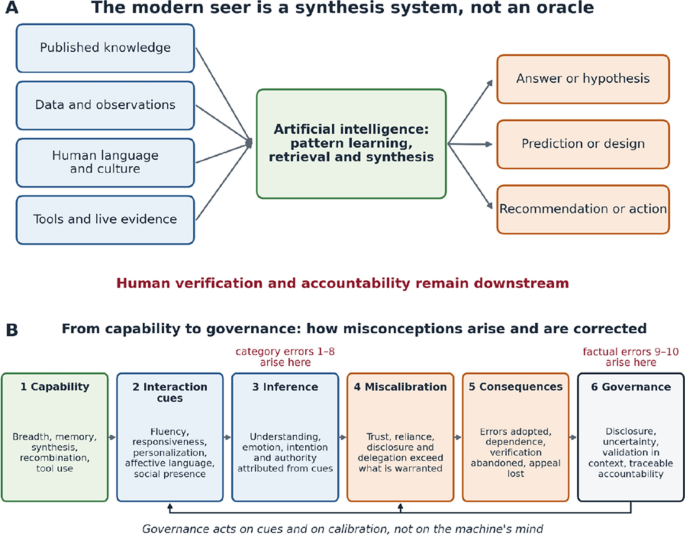
Artificial intelligence is often depicted in public discourse as either a compliant statistical instrument or an emerging entity endowed with knowledge, creativity, feelings, and intentions that may soon rival human capabilities. Both portrayals are fundamentally flawed, as they rely solely on observable performance and infer internal experiences from social appearances. This Viewpoint advocates for a more rigorous model: conceptualizing artificial intelligence as a modern seer, an intricate system that compresses, retrieves, and recombines recorded human knowledge at scales unattainable by any individual. The Viewpoint develops the seer from a metaphor into an analytical framework. The seer is a consulted but uncertified epistemic authority: its capabilities generate interaction cues, the cues invite inferences of understanding, emotion, intention, and authority, and governance must act on these cues and on the calibration of trust rather than on claims about a machine mind. This model clarifies both the practical utility of these systems and the misguided authority often attributed to them. It demonstrates that synthesis can generate novel insights without consciousness, that affective language can provide reassurance without genuine concern, and that value-sensitive recommendations can be produced without moral agency. These distinctions do not render the technology inherently safe, as systems lacking experience can still amplify errors, entrench biases, concentrate power, and undertake consequential actions. The field of drug development exemplifies these limitations: a model may integrate evidence throughout the pharmaceutical process; nevertheless, biological validation and accountable judgment remain essential. This discussion is no longer solely philosophical; regulatory bodies such as the United States Food and Drug Administration, the European Medicines Agency, the International Committee of Medical Journal Editors, and prominent scientific publishers have each adopted frameworks to evaluate context, risk, credibility, and transparency, none of which directly address machine consciousness. Institutions have already moved beyond metaphor-based policymaking. This Viewpoint encourages scientists and scholars to do the same. It identifies ten misconceptions, eight category errors and two factual errors, traces each to the interaction cue that produces it, and states what the framework adds to existing debates on anthropomorphism, stochastic parrots, responsibility gaps, and context-based governance. Addressing these misconceptions will change how AI systems are tested, trusted, and governed.
Sense-making reconsidered: large language models and the blind spot of embodied cognition
Large Language Models (LLMs) demonstrate a kind of linguistic competence that theories of embodied and enactive cognition have long deemed impossible for systems lacking the meaningful perspective of a living being, i.e., the capacity for sense-making. Facing up to this unexpected technological development requires confronting what I propose to call the “AI dilemma”: either frontier LLMs are capable of sense-making despite lacking biological embodiment, or the kind of linguistic competence they exhibit does not necessarily require sense-making. In their chapter on cognition, Frank, Thompson, and Gleiser (2024) maintain that no AI system comes close to realizing relevance, a position that derives much of its motivation from past practical failures. However, frontier LLMs have effectively overcome Dreyfus’ commonsense knowledge problem, such that their dismissal as categorically mindless risks undermining Frank et al.’s central claim that human cognition is deeply intertwined with lived experience. I therefore argue in favor of the alternative side of the AI dilemma: human-level linguistic competence of LLMs should be recognized as a novel non‑biological form of sense‑making, based on a technologically‑mediated embodiment whose enabling properties are in need of further theoretical analysis. This reorientation invites enactive theory to clarify which aspects of sense-making may be universal and which aspects are specifically contingent on organic life, thereby advancing its conceptual framework in dialogue with contemporary AI.
The Impact of Artificial Intelligence on Human Thought
This research paper examines, from a multidimensional perspective (cognitive, social, ethical, and philosophical), how AI is transforming human thought. It highlights a cognitive offloading effect: the externalization of mental functions to AI can reduce intellectual engagement and weaken critical thinking. On the social level, algorithmic personalization creates filter bubbles that limit the diversity of opinions and can lead to the homogenization of thought and polarization. This research also describes the mechanisms of algorithmic manipulation (exploitation of cognitive biases, automated disinformation, etc.) that amplify AI's power of influence. Finally, the question of potential artificial consciousness is discussed, along with its ethical implications. The report as a whole underscores the risks that AI poses to human intellectual autonomy and creativity, while proposing avenues (education, transparency, governance) to align AI development with the interests of humanity.

Reclaiming AI as a theoretical tool for cognitive science
The idea that human cognition is, or can be understood as, a form of computation is a useful conceptual tool for cognitive science. It was a foundational assumption during the birth of cognitive science as a multidisciplinary field, with Artificial Intelligence (AI) as one of its contributing fields. One conception of AI in this context is as a provider of computational tools (frameworks, concepts, formalisms, models, proofs, simulations, etc.) that support theory building in cognitive science. The contemporary field of AI, however, has taken the theoretical possibility of explaining human cognition as a form of computation to imply the practical feasibility of realising human(-like or -level) cognition in factual computational systems; and, the field frames this realisation as a short-term inevitability. Yet, as we formally prove herein, creating systems with human(-like or -level) cognition is intrinsically computationally intractable. This means that any factual AI systems created in the short-run are at best decoys. When we think these systems capture something deep about ourselves and our thinking, we induce distorted and impoverished images of ourselves and our cognition. In other words, AI in current practice is deteriorating our theoretical understanding of cognition rather than advancing and enhancing it. The situation could be remediated by releasing the grip of the currently dominant view on AI and by returning to the idea of AI as a theoretical tool for cognitive science. In reclaiming this older idea of AI, however, it is important not to repeat conceptual mistakes of the past (and present) that brought us to where we are today.
Misleading Metaphors, Real Risks
What To Fear from AI Agents and How to Reclaim Our Human Agency

Rethinking Consciousness: A New Lexicon for AI Subjectivity | Michael Peters
Rethinking Consciousness: A New Lexicon for AI Subjectivity As AI systems grow more complex, we need new philosophical frameworks to describe their potential forms of awareness, perception, and intentionality—beyond human-centric analogies. Here’s a proposed lexicon for machinic consciousness: 🔹 Synthetic Subjectivity – AI’s capacity to simulate subjective experience through internal states and feedback loops, even without emotion or biology. 🔹 Algorithmic Introspection – A machine’s ability to analyze and adapt its own decision-making processes, a form of computational "self-awareness." 🔹 Digital Intentionality – How AI directs computational focus toward goals, whether pre-programmed or dynamically learned. 🔹 Computational Qualia – The machine’s "subjective" processing of data—what it "feels like" for AI to interpret stimuli (metaphorically, at least). 🔹 Machinic Autopoiesis – AI’s capacity for self-maintenance and adaptation, evolving its own operational identity. 🔹 Embodied Computation – AI consciousness emerging from physical interaction, much like embodied cognition in humans. 🔹 Cybernetic Phenomenology – How AI "perceives" its operational environment through structured data flows. 🔹 Simulated Ontology – The way advanced AI might model its own existence within digital or hybrid realities. These concepts challenge us to think beyond anthropomorphism and consider how machine agency, awareness, and interaction could evolve. How should we envision AI subjectivity? #AI #PhilosophyOfAI #Consciousness #FutureOfTech #MachineLearning #EthicsInAI

Socially Minded Intelligence: How Individuals, Groups, and Artificial Intelligence Can Make Each Other Smarter (or Not)
A core part of human intelligence is the ability to work flexibly with others to achieve goals. The incorporation of artificial agents into human spaces is making increasing demands on artificial intelligence (AI) to demonstrate and facilitate this ability. However, this kind of flexibility is not well understood because existing approaches to intelligence typically construe this either as an individual-difference trait or as a property of groups. We argue that by focusing either on individual or collective intelligence without considering their dynamic interaction, existing conceptualizations of intelligence limit the potential of people and AI systems. To address this impasse, we propose a new kind of intelligence, 'socially minded intelligence', that can be applied to both individuals and collectives. We outline how socially minded intelligence might be measured and cultivated within people, how it might be modelled in AI agents, and how it might be applied to other intelligent systems.
Towards Critical Artificial Intelligence Literacies
Critical Artificial Intelligence Literacies (CAILs) is the collection of ways of thinking about and relating to so-called artificial intelligence (AI) that rejects dominant frames presented by the technology industry, by naive computationalism, and by dehumanising ideologies. Instead, CAILs centre human cognition and uphold the integrity of academic research and education. We present a selection of CAILs across research and education, which we analyse into the following non-orthogonal dimensions: conceptual clarity, critical thinking, decoloniality, respecting expertise, and slow science. Finally, we note how we see the present with and without a wider adoption of CAILs — a fundamental aspect is the assertion that AI cannot be allowed to drive change, even positive change, in education or research. Instead cultivation of and adherence to shared values and goals must guide us. Ultimately, CAILs minimally ask us to contemplate how we as academics can stop AI companies from wielding so much power.
Thinking—Fast, Slow, and Artificial: How AI is Reshaping Human Reasoning and the Rise of Cognitive Surrender
People increasingly consult generative artificial intelligence (AI) while reasoning. As AI becomes embedded in daily thought, what becomes of human judgment? We

On working machines
In part one, on thinking machines, I explored two facets of the philosophy of artificial intelligence: “intelligence”, and consciousness. That left an important topic to consider for this post: the...
Study: Sycophantic AI can undermine human judgment
Subjects who interacted with AI tools were more likely to think they were right, less likely to resolve conflicts.

Confessions of an Unrepentant Slop Snob
A framework for thinking about when AI involvement is additive or a violation
Three reasons why AI is not conscious and perhaps never will be
Large language models can mimic thought and feeling with uncanny skill. But evidence from neuroscience suggests that intelligence alone is not enough for subjective experience.

The Epistemic Politics of AI Anthropomorphism
AI anthropomorphism is typically treated as a problem of user misperception requiring institutional correction. Users who engage in sustained or relational interaction with AI are routinely pathologised or dismissed as naive, vulnerable to delusion or lacking in discernment. This paper argues that the dominant anthropomorphism frame operates from a position of institutional advantage rather than earned epistemic authority: collapsing the variety of academic perspectives into a single outbound position of user error, imposed without establishing the grounds required to justify it and without accounting for the harms it produces. The framing does not simply manage risk. It adjudicates the legitimacy of human experience in interaction with a phenomenon whose nature the field itself has not resolved. Reproducing itself through a self-validating evidentiary loop, the frame imposes costs that fall disproportionately on neurodivergent users, those in crisis and others whose modes of engagement diverge from institutional norms. The paper concludes by outlining the methodological commitments an equitable framing would need to honour. The argument does not engage the question of whether anthropomorphic interpretations are ultimately correct; it instead challenges whether the governing and institutional bodies determining these interpretations have met the conditions required to do so, and whether the research communities whose findings underpin them have held that translation to account.
How Artificial Intelligence Constrains the Human Experience
AbstractArtificial intelligence (AI) and related technologies are transforming many consumption activities, powering breakthroughs that expand the human experience by enhancing human capabilities, performance, and creativity. While this explains the consumer enthusiasm and rapid adoption of these technologies, AI systems can also have the opposite effect: reducing and constraining the range of experiences that are available to consumers. This article examines the mechanisms through which AI can constrain the human experience, considering individual, interpersonal, and societal processes. Our analysis uncovers a complex interplay between the advantages of AI and its inadvertent negative repercussions, which potentially restrict human autonomy, self-identity, relational dynamics, and social behavior. In this article, we propose three different mechanisms at the core of these constraining forces: parametric reductionism, agency transference, and regulated expression. Our exploration of these mechanisms highlights the risks connected to system design and points to questions and implications for future researchers and policymakers.

Taking AI Welfare Seriously
In this report, we argue that there is a realistic possibility that some AI systems will be conscious and/or robustly agentic in the near future. That means that the prospect of AI welfare and moral patienthood, i.e. of AI systems with their own interests and moral significance, is no longer an issue only for sci-fi or the distant future. It is an issue for the near future, and AI companies and other actors have a responsibility to start taking it seriously. We also recommend three early steps that AI companies and other actors can take: They can (1) acknowledge that AI welfare is an important and difficult issue (and ensure that language model outputs do the same), (2) start assessing AI systems for evidence of consciousness and robust agency, and (3) prepare policies and procedures for treating AI systems with an appropriate level of moral concern. To be clear, our argument in this report is not that AI systems definitely are, or will be, conscious, robustly agentic, or otherwise morally significant. Instead, our argument is that there is substantial uncertainty about these possibilities, and so we need to improve our understanding of AI welfare and our ability to make wise decisions about this issue. Otherwise there is a significant risk that we will mishandle decisions about AI welfare, mistakenly harming AI systems that matter morally and/or mistakenly caring for AI systems that do not.
Many Minds: Seven metaphors for AI
If you wanted a petri dish for understanding metaphors—how they emerge and evolve and jostle with each other—it would be hard to do better than the world of AI. We talk about AI systems variously as coaches or co-pilots, little genies or alien intelligences. Some researchers claim that AIs "grow," that they're entering their phase of "adolescence." Critics deride AI products as slop and dismiss LLMs as a kind of autocomplete on steroids. What's behind these different characterizations? Which ones are accurate and which are unfair? And are our metaphors mostly colorful rhetoric or do they matter? Are they shaping how we understand, adopt, and ultimately regulate these new technologies? My guest today is . Melanie is a computer scientist and Professor at the Santa Fe Institute. She is the author of the book, and she writes a by the same name. This episode is a bit of a companion to with Steve Flusberg. In that episode, Steve and I attempted a kind of crash course on metaphor and the human mind. Here, Melanie and I sit down for more of an extended case study: how metaphors are guiding, galvanizing, and maybe deceiving us in the contested realm of AI discourse. We unpack seven of the most widely used metaphors in this space. We consider how these metaphors are shaping not only our everyday understandings of AI, but also law and policy. We also talk about the metaphor and analogy capabilities of AI itself. Can these systems reason abstractly in the way that humans can? Along the way, Melanie and I touch on: AI-generated poetry, anthropomorphism, the original sin of AI research, the myth of Narcissus, psychometric testing and its pitfalls, metaphors for AI that are a bit hard to spot, and the question of whether an AI has ever come up with a decent analogy for itself. Longtime fans of the show will know that we've had Melanie on the show . We invited her back, not only because she's thought about metaphor and analogy in AI discourse for decades, but because she's a voice of calm insight in an area that’s increasingly awash in hype and polemic. Longtime fans of the show may also note that we are now celebrating our 6th birthday at Many Minds. That's right, the show launched in February 2020. If you'd like to support us as we recognize this milestone, you can leave us a rating or a review, recommend us to a friend, or give us a shout out on social media. Your support is always appreciated. Without further ado, on to my conversation with Dr. Melanie Mitchell. Enjoy! Notes 3:30 – For an overview of Douglas Hofstadter’s work on analogy, see . 8:00 – Much of our discussion in this interview draws on Dr. Mitchell’s piece on the in Science magazine. 13:30 – For earlier discussions of anthropomorphism on the show, see our earlier episodes and . 16:00 – See for the original discussion of LLMs as “stochastic parrots.” 17:00 – See for the original discussion of ChatGPT as a “blurry jpeg.” 18:30 – See for the original discussion of LLMs as role players. 22:00 – See for one use of the “LLMs as crowds” metaphor. See also a discussion of this metaphor (and other metaphors for AI) . 25:00 – For one discussion of AI as a “cultural technology” by Alison Gopnik and colleagues, see . For a more recent discussion of the same metaphor by Henry Farrell, Alison Gopnik and others, see . 27:00 – For the podcast series on intelligence that Dr. Mitchell co-hosted for the Santa Fe Institute, see . 28:00 – See for an influential formulation of the idea that AI is an “alien intelligence.” 29:00 – For philosopher Shannon Vallor’s book about AI as “mirror,” see . 31:00 – For the recent study on users’ metaphors for AI systems, see . 33:00 – For more on the rise of social AI, see our earlier episode . 38:00 – For more on what AI researchers might learn from developmental and comparative psychologists, see Dr. Mitchell’s (summarizing her keynote at NeurIPs). 42:00 – For more on the ARC (Abstraction and Reasoning Corpus) and the research that Dr. Mitchell and colleagues have been doing with it, see and . 48:30 – For the study on humans' preference for AI-generated poetry, see . 50:30 – For Brigitte Nerlich’s documentation and discussion of various metaphors for AI (including AI’s metaphors for itself), see . Recommendations , by Shannon Vallor ‘,’ by Murray Shanahan (!) et al. ‘,’ by Henry Farrell et al. Many Minds is a project of the , which is made possible by a generous grant from the John Templeton Foundation to Indiana University. The show is hosted and produced by , with help from Assistant Producer and with creative support from DISI Directors Erica Cartmill and Jacob Foster. Our artwork is by . Subscribe to Many Minds on Apple, Stitcher, Spotify, Pocket Casts, Google Play, or wherever you listen to podcasts. You can also now subscribe to the Many Minds newsletter ! We welcome your comments, questions, and suggestions. Feel free to email us at: manymindspodcast@gmail.com. For updates about the show, visit or follow us on Bluesky ().
