

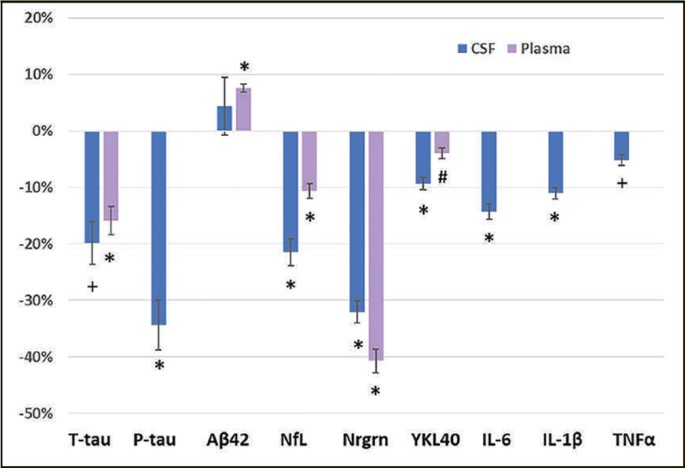
The most common dementia worldwide, Alzheimer’s disease is often diagnosed via biomarkers in cerebrospinal fluid, including reduced levels of Aβ1-42, and increases in total tau and phosphorylated tau-181. Here we describe results of a Phase 2a study of a promising new drug candidate that significantly reversed all measured biomarkers of Alzheimer’s disease, neurodegeneration and neuroinflammation. PTI-125 is an oral small molecule drug candidate that binds and reverses an altered conformation of the scaffolding protein filamin A found in Alzheimer’s disease brain. Altered filamin A links to the α7-nicotinic acetylcholine receptor to allow Aβ42’s toxic signaling through this receptor to hyperphosphorylate tau. Altered filamin A also links to toll-like receptor 4 to enable Aβ-induced persistent activation of this receptor and inflammatory cytokine release. Restoring the native shape of filamin A prevents or reverses filamin A’s linkages to the α7-nicotinic acetylcholine receptor and tolllike receptor 4, thereby blocking Aβ42’s activation of these receptors. The result is reduced tau hyperphosphorylation and neuroinflammation, with multiple functional improvements demonstrated in transgenic mice and postmortem Alzheimer’s disease brain.
Reducing Amyloid-Related Alzheimer's Disease Pathogenesis by a Small Molecule Targeting Filamin A
PTI-125 is a novel compound demonstrating a promising new approach to treating Alzheimer's disease (AD), characterized by neurodegeneration and amyloid plaque and neurofibrillary pathologies. We show that the toxic signaling of amyloid-β42 (Aβ42) by the α7-nicotinic acetylcholine receptor (α7nAChR), which results in tau phosphorylation and formation of neurofibrillary tangles, requires the recruitment of the scaffolding protein filamin A (FLNA). By binding FLNA with high affinity, PTI-125 prevents Aβ42's toxic cascade, decreasing phospho-tau and Aβ aggregates and reducing the dysfunction of α7nAChRs, NMDARs, and insulin receptors. PTI-125 prevents Aβ42 signaling by drastically reducing its affinity for α7nAChRs and can even dissociate existing Aβ42–α7nAChR complexes. Additionally, PTI-125 prevents Aβ-induced inflammatory cytokine release by blocking FLNA recruitment to toll-like receptor 4, illustrating an anti-inflammatory effect. PTI-125's broad spectrum of beneficial effects is demonstrated here in an intracerebroventricular Aβ42 infusion mouse model of AD and in human postmortem AD brain tissue.

Single-cell multiregion dissection of Alzheimer’s disease
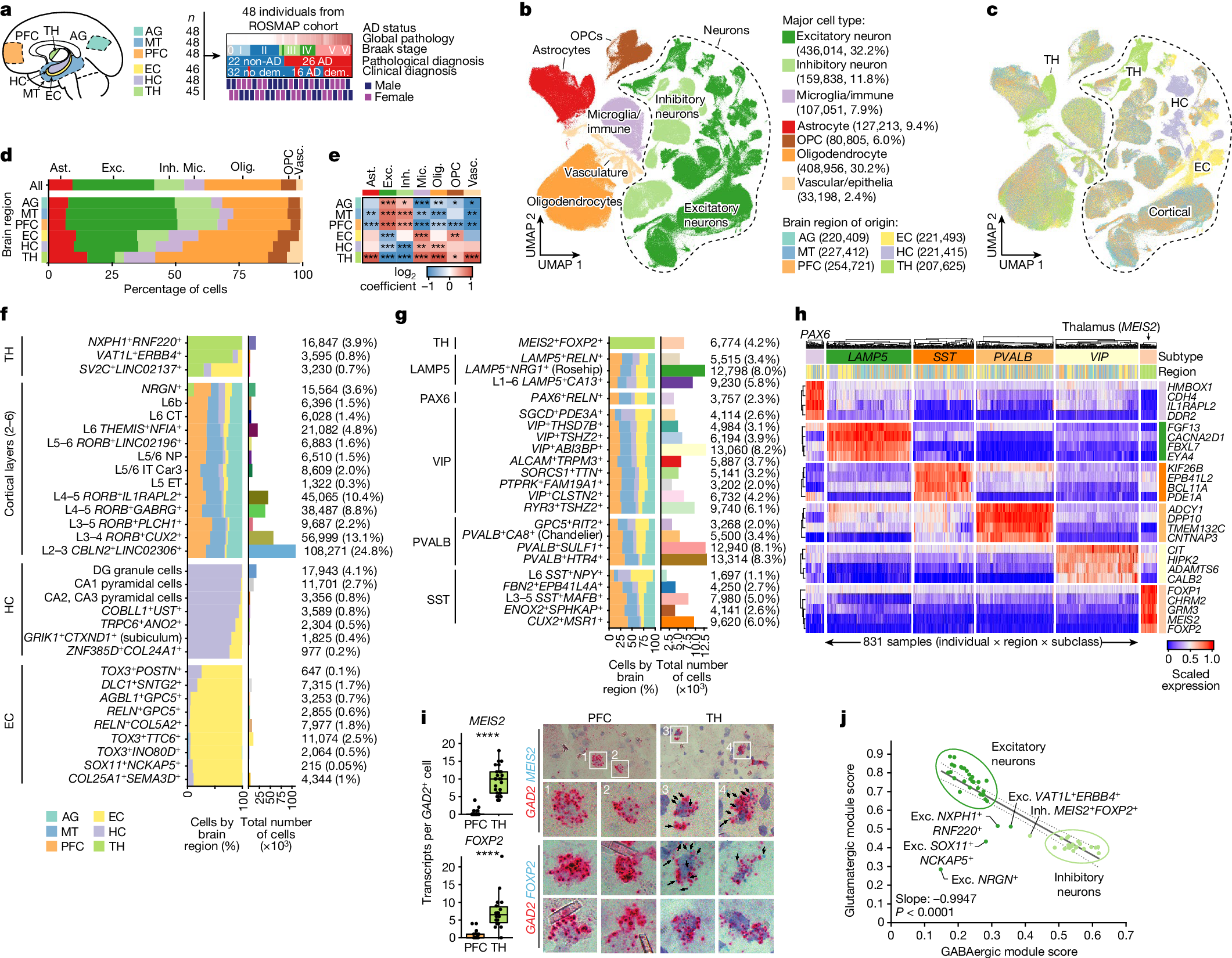
Alzheimer’s disease is the leading cause of dementia worldwide, but the cellular pathways that underlie its pathological progression across brain regions remain poorly understood1–3. Here we report a single-cell transcriptomic atlas of six different brain regions in the aged human brain, covering 1.3 million cells from 283 post-mortem human brain samples across 48 individuals with and without Alzheimer’s disease. We identify 76 cell types, including region-specific subtypes of astrocytes and excitatory neurons and an inhibitory interneuron population unique to the thalamus and distinct from canonical inhibitory subclasses. We identify vulnerable populations of excitatory and inhibitory neurons that are depleted in specific brain regions in Alzheimer’s disease, and provide evidence that the Reelin signalling pathway is involved in modulating the vulnerability of these neurons. We develop a scalable method for discovering gene modules, which we use to identify cell-type-specific and region-specific modules that are altered in Alzheimer’s disease and to annotate transcriptomic differences associated with diverse pathological variables. We identify an astrocyte program that is associated with cognitive resilience to Alzheimer’s disease pathology, tying choline metabolism and polyamine biosynthesis in astrocytes to preserved cognitive function late in life. Together, our study develops a regional atlas of the ageing human brain and provides insights into cellular vulnerability, response and resilience to Alzheimer’s disease pathology.
Species-Specific Unbound Fraction Differences in Highly Bound PFAS: A Comparative Study across Human, Rat, and Mouse Plasma and Albumin
Per- and polyfluoroalkyl substances (PFAS) are a diverse group of fluorinated compounds which have yet to undergo comprehensive investigation regarding potential adverse health effects and bioaccumulative properties. With long half-lives and accumulative properties, PFAS have been linked to several toxic effects in both non-clinical species such as rat and mouse as well as human. Although biological impacts and specific protein binding of PFAS have been examined, there is no study focusing on the species-specific fraction unbound (fu) in plasma and related toxicokinetics. Herein, a presaturation equilibrium dialysis method was used to measure and validate the binding of 14 individual PFAS with carbon chains containing 4 to 12 perfluorinated carbon atoms and several functional head-groups to albumin and plasma of mouse (C57BL/6 and CD-1), rat, and human. Equivalence testing between each species-matrix combination showed positive correlation between rat and human when comparing fu in plasma and binding to albumin. Similar trends in binding were also observed for mouse plasma and albumin. Relatively high Spearman correlations for all combinations indicate high concordance of PFAS binding regardless of matrix. Physiochemical properties of PFAS such as molecular weight, chain length, and lipophilicity were found to have important roles in plasma protein binding of PFAS.

UCLA discovers first stroke rehabilitation drug to repair brain damage
A new study by UCLA Health has discovered what researchers say is the first drug to fully reproduce the effects of physical stroke rehabilitation in model mice.
Precision Medicine in Neuroscience: Tools, Translation, and Implementation: A Workshop
Precision medicine approaches are rapidly transforming neuroscience, driven by advances in genetics, neuroimaging, biomarkers, and data science. These tools enable more refined disease classification, improved diagnosis, and treatments tailored to individual patients across neurological and psychiatric disorders. However, challenges remain in translating these advances into routine research and clinical practice. On March 4–5, the National Academies’ Forum on Neuroscience and Nervous System Disorders, in collaboration with the Forum on Drug Discovery, Development, and Translation and the Roundtable on Genomics and Precision Health, will host a workshop exploring opportunities, challenges, and strategies for integrating precision medicine into neuroscience research and care.

We Are Entering the Age of Alzheimer's
We will all be touched by the disease. How are we going to get through this?

Learning What Substance Is Suspected of Causing Alzheimer’s May Throw You Into an Existential Crisis
A surprisingly common substance was found to have a causal relationship with the kind of brain damage associated with Alzheimer's disease.

Time-resolved fluorescent proteins expand fluorescent microscopy in temporal and spectral domains
A family of rationally designed time-resolved fluorescent proteins with controllable lifetimes across the visible spectrum enables simultaneous multiplexed live imaging, super-resolution microscopy, and protein stoichiometry quantification, offering a transformative toolset for advancing biological research with enhanced complexity and quantitative precision.

Differences in Krox20-Dependent Regulation of Hoxa2 and Hoxb2 during Hindbrain Development
During hindbrain development, segmental regulation of the paralogous Hoxa2 and Hoxb2 genes in rhombomeres (r) 3 and 5 involves Krox20-dependent enhancers that have been conserved during the duplication of the vertebrate Hox clusters from a common ancestor. Examining these evolutionarily related control regions could provide important insight into the degree to which the basic Krox20-dependent mechanisms, cis-regulatory components, and their organization have been conserved. Toward this goal we have performed a detailed functional analysis of a mouse Hoxa2 enhancer capable of directing reporter expression in r3 and r5. The combined activities of five separate cis-regions, in addition to the conserved Krox20 binding sites, are involved in mediating enhancer function. A CTTT (BoxA) motif adjacent to the Krox20 binding sites is important for r3/r5 activity. The BoxA motif is similar to one (Box1) found in the Hoxb2 enhancer and indicates that the close proximity of these Box motifs to Krox20 sites is a common feature of Krox20 targets in vivo. Two other rhombomeric elements (RE1 and RE3) are essential for r3/r5 activity and share common TCT motifs, indicating that they interact with a similar cofactor(s). TCT motifs are also found in the Hoxb2 enhancer, suggesting that they may be another common feature of Krox20-dependent control regions. The two remaining Hoxa2 cis-elements, RE2 and RE4, are not conserved in the Hoxb2 enhancer and define differences in some of components that can contribute to the Krox20-dependent activities of these enhancers. Furthermore, analysis of regulatory activities of these enhancers in a Krox20 mutant background has uncovered differences in their degree of dependence upon Krox20 for segmental expression. Together, this work has revealed a surprising degree of complexity in the number of cis-elements and regulatory components that contribute to segmental expression mediated by Krox20 and sheds light on the diversity and evolution of Krox20 target sites and Hox regulatory elements in vertebrates.
Binding of Per- and Polyfluoroalkyl Substances (PFAS) to Serum Proteins: Implications for Toxicokinetics in Humans
Abstract. Per- and polyfluoroalkyl substances (PFAS) are a diverse class of highly persistent anthropogenic chemicals that are detectable in the serum of m

Cease-fire at the leading edge: new perspectives on actin filament branching, debranching and cross-linking
Membrane protrusion at the leading edge of migrating cells is driven by the polymerization of actin. Recent studies using advanced imaging techniques raised a lively controversy about the morphology of these filaments; however, common ground between ...

Google figures out how to watermark AI-designed proteins
Intended to help with biosecurity, it works with a popular AI protein design tool.
Dysregulated adult hippocampal neurogenesis in major depressive disorder
Major depressive disorder (MDD) is associated with reduced hippocampal volume, altered connectivity and negative memory bias, suggesting disrupted hippocampal plasticity. Dysregulated adult hippocampal neurogenesis is a potential contributor, but its relevance in humans and role in MDD remain unclear. Here we investigated the molecular basis of hippocampal dysfunction in nonmedicated individuals with MDD by integrating analyses of neurogenic trajectories, cell-type- and subfield-specific gene expression, chromatin accessibility and protein expression. We identify a neurogenic lineage in the adult human hippocampal subgranular zone and provide evidence for a stalled neurogenic process in MDD, associated with transcriptional regulation, stress-related reprogramming and interferon signaling across developmental stages. Excitatory and inhibitory neurons show dysregulation of transcription factor networks affecting cell states. Cellular stress, excitatory–inhibitory imbalance, impaired synaptic plasticity, reduced metabolic capacity and immune activation, underlie impaired neurogenesis and reduced hippocampus circuit plasticity. Findings indicate genetic and epigenetic regulation of gene expression in MDD, and overlapping pathogenetic mechanisms with autoimmune, neurodevelopmental and neurodegenerative diseases. This work provides a new understanding of the pathogenesis of hippocampus-dependent cognitive symptoms in MDD and suggests potential therapeutic targets.
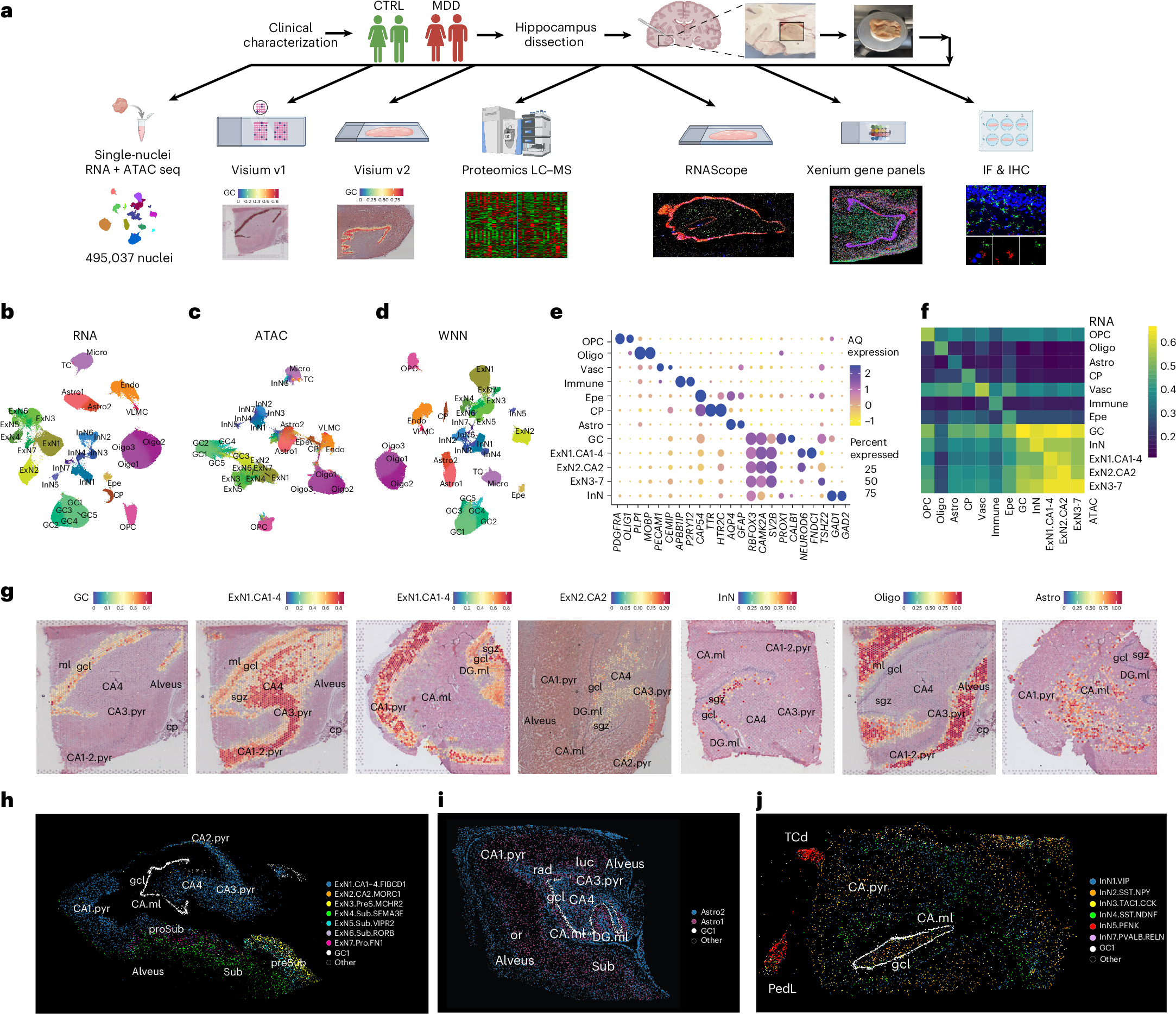
Dysregulated adult hippocampal neurogenesis in major depressive disorder
Major depressive disorder (MDD) is associated with reduced hippocampal volume, altered connectivity and negative memory bias, suggesting disrupted hippocampal plasticity. Dysregulated adult hippocampal neurogenesis is a potential contributor, but its relevance in humans and role in MDD remain unclear. Here we investigated the molecular basis of hippocampal dysfunction in nonmedicated individuals with MDD by integrating analyses of neurogenic trajectories, cell-type- and subfield-specific gene expression, chromatin accessibility and protein expression. We identify a neurogenic lineage in the adult human hippocampal subgranular zone and provide evidence for a stalled neurogenic process in MDD, associated with transcriptional regulation, stress-related reprogramming and interferon signaling across developmental stages. Excitatory and inhibitory neurons show dysregulation of transcription factor networks affecting cell states. Cellular stress, excitatory–inhibitory imbalance, impaired synaptic plasticity, reduced metabolic capacity and immune activation, underlie impaired neurogenesis and reduced hippocampus circuit plasticity. Findings indicate genetic and epigenetic regulation of gene expression in MDD, and overlapping pathogenetic mechanisms with autoimmune, neurodevelopmental and neurodegenerative diseases. This work provides a new understanding of the pathogenesis of hippocampus-dependent cognitive symptoms in MDD and suggests potential therapeutic targets.
Spatial Reorganization of Chromatin Architecture Shapes the Expression Phenotype of Therapy‐Induced Senescent Cells
In the course of TIS, cells undergo a profound epigenomic reorganization that underlies the development of a senescence-associated phenotype and formation of an inflammatory microenvironment.

Severe osteopetrosis, defective interleukin‐1 signalling and lymph node organogenesis in <i>TRAF6</i> ‐deficient mice
Background TRAF6, a member of the tumour necrosis factor receptor‐associated factor family, was first identified as a transducer of CD40 and interleukin‐1 receptor (IL‐1R) signals based on the interaction of TRAF6 with the cytoplasmic tail of CD40 and with the IL‐1R associated kinase in vitro . However, the functions of TRAF6 in vivo remain unidentified. Results We show that TRAF6 −/− mice exhibit severe osteopetrosis and are defective in osteoclast formation. In vitro culture experiments revealed that osteoclast precursor cells derived from TRAF6 −/− mice are unable to differentiate to functional osteoclasts in response to osteoclast differentiation factor (ODF). In bone marrow of TRAF6 −/− mice, the number of sIgM + B220 + immature B cells is markedly reduced while the ratio of proB to preB cells is not affected. In contrast, development of thymocytes is not affected. Furthermore, TRAF6 −/− mice are defective in lymph node organogenesis and IL‐1 signalling in thymocytes. Conclusions The results identify TRAF6 as an essential component of ODF signalling pathway, and also show that TRAF6 plays pivotal roles in immune and inflammatory systems in vivo .
