


The ability to cheaply train text classifiers is critical to their use in information retrieval, content analysis, natural language processing, and other tasks involving data which is partly or fully textual. An algorithm for sequential sampling during machine learning of statistical classifiers was developed and tested on a newswire text categorization task. This method, which we call uncertainty sampling, reduced by as much as 500-fold the amount of training data that would have to be manually classified to achieve a given level of effectiveness.
Technical Report on the Pangram AI-Generated Text Classifier
We present Pangram Text, a transformer-based neural network trained to distinguish text written by large language models from text written by humans. Pangram Text outperforms zero-shot methods...

Artificial Writing and Automated Detection
Artificial intelligence (AI) tools are increasingly used for written deliverables. This has created demand for distinguishing human-generated text from AI-generated text at scale, e.g., ensuring assignments were completed by students, product reviews written by actual customers, etc. A decision-maker aiming to implement a detector in practice must consider two key statistics: the False Negative Rate (FNR), which corresponds to the proportion of AI-generated text that is falsely classified as human, and the False Positive Rate (FPR), which corresponds to the proportion of human-written text that is falsely classified as AI-generated. We evaluate three leading commercial detectors—Pangram, OriginalityAI, GPTZero—and an open-source one —RoBERTa—on their performance in minimizing these statistics using a large corpus spanning genres, lengths, and models. Commercial detectors outperform open-source, with Pangram achieving near-zero FNR and FPR rates that remain robust across models, threshold rules, ultra-short passages, "stubs" (≤ 50 words) and ’humanizer’ tools. A decision-maker may weight one type of error (Type I vs. Type II) as more important than the other. To account for such a preference, we introduce a framework where the decision-maker sets a policy cap—a detector-independent metric reflecting tolerance for false positives or negatives. We show that Pangram is the only tool to satisfy a strict cap (FPR ≤ 0.005) without sacrificing accuracy. This framework is especially relevant given the uncertainty surrounding how AI may be used at different stages of writing, where certain uses may be encouraged (e.g., grammar correction) but may be difficult to separate from other uses.

Technical Report on the Pangram AI-Generated Text Classifier
We present Pangram Text, a transformer-based neural network trained to distinguish text written by large language models from text written by humans. Pangram Text outperforms zero-shot methods such as DetectGPT as well as leading commercial AI detection tools with over 38 times lower error rates on a comprehensive benchmark comprised of 10 text domains (student writing, creative writing, scientific writing, books, encyclopedias, news, email, scientific papers, short-form Q&A) and 8 open- and closed-source large language models. We propose a training algorithm, hard negative mining with synthetic mirrors, that enables our classifier to achieve orders of magnitude lower false positive rates on high-data domains such as reviews. Finally, we show that Pangram Text is not biased against nonnative English speakers and generalizes to domains and models unseen during training.
The Famine of Forte: Few Search Problems Greatly Favor Your Algorithm
Casting machine learning as a type of search, we demonstrate that the proportion of problems that are favorable for a fixed algorithm is strictly bounded, such that no single algorithm can perform well over a large fraction of them. Our results explain why we must either continue to develop new learning methods year after year or move towards highly parameterized models that are both flexible and sensitive to their hyperparameters. We further give an upper bound on the expected performance for a search algorithm as a function of the mutual information between the target and the information resource (e.g., training dataset), proving the importance of certain types of dependence for machine learning. Lastly, we show that the expected per-query probability of success for an algorithm is mathematically equivalent to a single-query probability of success under a distribution (called a search strategy), and prove that the proportion of favorable strategies is also strictly bounded. Thus, whether one holds fixed the search algorithm and considers all possible problems or one fixes the search problem and looks at all possible search strategies, favorable matches are exceedingly rare. The forte (strength) of any algorithm is quantifiably restricted.
The Famine of Forte: Few Search Problems Greatly Favor Your Algorithm
Casting machine learning as a type of search, we demonstrate that the proportion of problems that are favorable for a fixed algorithm is strictly bounded, such that no single algorithm can perform well over a large fraction of them. Our results explain why we must either continue to develop new learning methods year after year or move towards highly parameterized models that are both flexible and sensitive to their hyperparameters. We further give an upper bound on the expected performance for a search algorithm as a function of the mutual information between the target and the information resource (e.g., training dataset), proving the importance of certain types of dependence for machine learning. Lastly, we show that the expected per-query probability of success for an algorithm is mathematically equivalent to a single-query probability of success under a distribution (called a search strategy), and prove that the proportion of favorable strategies is also strictly bounded. Thus, whether one holds fixed the search algorithm and considers all possible problems or one fixes the search problem and looks at all possible search strategies, favorable matches are exceedingly rare. The forte (strength) of any algorithm is quantifiably restricted.
Optimized Pre-Processing for Discrimination Prevention
Non-discrimination is a recognized objective in algorithmic decision making. In this paper, we introduce a novel probabilistic formulation of data pre-processing for reducing discrimination. We propose a convex optimization for learning a data transformation with three goals: controlling discrimination, limiting distortion in individual data samples, and preserving utility. We characterize the impact of limited sample size in accomplishing this objective. Two instances of the proposed optimization are applied to datasets, including one on real-world criminal recidivism. Results show that discrimination can be greatly reduced at a small cost in classification accuracy.
Artificial Artificial Artificial Intelligence: Crowd Workers Widely Use Large Language Models for Text Production Tasks
Large language models (LLMs) are remarkable data annotators. They can be used to generate high-fidelity supervised training data, as well as survey and experimental data. With the widespread adoption of LLMs, human gold--standard annotations are key to understanding the capabilities of LLMs and the validity of their results. However, crowdsourcing, an important, inexpensive way to obtain human annotations, may itself be impacted by LLMs, as crowd workers have financial incentives to use LLMs to increase their productivity and income. To investigate this concern, we conducted a case study on the prevalence of LLM usage by crowd workers. We reran an abstract summarization task from the literature on Amazon Mechanical Turk and, through a combination of keystroke detection and synthetic text classification, estimate that 33-46% of crowd workers used LLMs when completing the task. Although generalization to other, less LLM-friendly tasks is unclear, our results call for platforms, researchers, and crowd workers to find new ways to ensure that human data remain human, perhaps using the methodology proposed here as a stepping stone. Code/data: https://github.com/epfl-dlab/GPTurk
Exploring the Limits of Transfer Learning with a Unified Text-to-Text Transformer
Transfer learning, where a model is first pre-trained on a data-rich task before being fine-tuned on a downstream task, has emerged as a powerful technique in natural language processing (NLP). The effectiveness of transfer learning has given rise to a diversity of approaches, methodology, and practice. In this paper, we explore the landscape of transfer learning techniques for NLP by introducing a unified framework that converts all text-based language problems into a text-to-text format. Our systematic study compares pre-training objectives, architectures, unlabeled data sets, transfer approaches, and other factors on dozens of language understanding tasks. By combining the insights from our exploration with scale and our new “Colossal Clean Crawled Corpus”, we achieve state-of-the-art results on many benchmarks covering summarization, question answering, text classification, and more. To facilitate future work on transfer learning for NLP, we release our data set, pre-trained models, and code.
Sparse Autoencoders for Hypothesis Generation
We describe HypotheSAEs, a general method to hypothesize interpretable relationships between text data (e.g., headlines) and a target variable (e.g., clicks). HypotheSAEs has three steps: (1) train a sparse autoencoder on text embeddings to produce interpretable features describing the data distribution, (2) select features that predict the target variable, and (3) generate a natural language interpretation of each feature (e.g., "mentions being surprised or shocked") using an LLM. Each interpretation serves as a hypothesis about what predicts the target variable. Compared to baselines, our method better identifies reference hypotheses on synthetic datasets (at least +0.06 in F1) and produces more predictive hypotheses on real datasets (~twice as many significant findings), despite requiring 1-2 orders of magnitude less compute than recent LLM-based methods. HypotheSAEs also produces novel discoveries on two well-studied tasks: explaining partisan differences in Congressional speeches and identifying drivers of engagement with online headlines.
On the Way to LLM Personalization: Learning to Remember User Conversations
Large Language Models (LLMs) have quickly become an invaluable assistant for a variety of tasks. However, their effectiveness is constrained by their ability to tailor responses to human preferences and behaviors via personalization. Prior work in LLM personalization has largely focused on style transfer or incorporating small factoids about the user, as knowledge injection remains an open challenge. In this paper, we explore injecting knowledge of prior conversations into LLMs to enable future work on less redundant, personalized conversations. We identify two real-world constraints: (1) conversations are sequential in time and must be treated as such during training, and (2) per-user personalization is only viable in parameter-efficient settings. To this aim, we propose PLUM, a pipeline performing data augmentation for up-sampling conversations as question-answer pairs, that are then used to finetune a low-rank adaptation adapter with a weighted cross entropy loss. Even in this first exploration of the problem, we perform competitively with baselines such as RAG, attaining an accuracy of 81.5% across 100 conversations.
WSJ Artificial Intelligence Tools - WSJ
The Wall Street Journal and Dow Jones Newswires use artificial-intelligence tools in a variety of ways in our journalism. For example, we use AI and machine learning in complex data-driven investigations, to summarize articles, to translate some content into local languages and to power website features such as audio versions of our articles. We are also using generative AI to write alt text descriptions of visuals to improve accessibility.
Documenting Large Webtext Corpora: A Case Study on the Colossal Clean Crawled Corpus
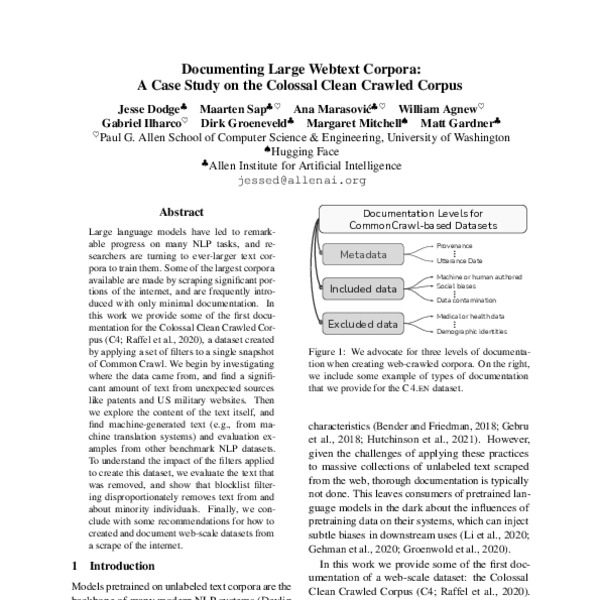
Large language models have led to remarkable progress on many NLP tasks, and researchers are turning to ever-larger text corpora to train them. Some of the largest corpora available are made by scraping significant portions of the internet, and are frequently introduced with only minimal documentation. In this work we provide some of the first documentation for the Colossal Clean Crawled Corpus (C4; Raffel et al., 2020), a dataset created by applying a set of filters to a single snapshot of Common Crawl. We begin by investigating where the data came from, and find a significant amount of text from unexpected sources like patents and US military websites. Then we explore the content of the text itself, and find machine-generated text (e.g., from machine translation systems) and evaluation examples from other benchmark NLP datasets. To understand the impact of the filters applied to create this dataset, we evaluate the text that was removed, and show that blocklist filtering disproportionately removes text from and about minority individuals. Finally, we conclude with some recommendations for how to created and document web-scale datasets from a scrape of the internet.
EXPRESS: Evaluating Novel Unstructured Treatments with Generative AI: A Causal Prediction Framework
Modern marketing increasingly requires managers to deploy new content at scale, often with limited opportunity for prior testing. As a result, decisions about what to launch become strategic managerial choices under uncertainty rather than purely creative exercises. While generative AI makes the creation of new content fast and highly scalable, it simultaneously expands the set of options managers must evaluate, making reliable content selection increasingly difficult. We develop a framework for causal prediction that enables managers to evaluate and deploy novel marketing content generated by AI. The framework uses pretrained large language models to represent previously deployed content and learn how its features causally relate to outcomes. Using a rejection-sampling procedure, the framework screens new content proposed by generative AI to avoid extrapolation beyond what historical data can reliably support. In a large-scale email marketing application (3.3 million observations across 34 campaigns), the framework improves out-of-sample prediction and real-world deployment performance relative to standard approaches, enabling outcome-guided generation of higher-performing AI-generated content. The framework establishes a threshold based on how closely new content resembles past campaigns, separating cases where causal prediction is reliable from cases where direct experimentation is warranted. The framework has important implications for marketing decision making in a rapidly evolving environment where generative AI is transforming content creation and deployment.

Data-OOB: Out-of-bag Estimate as a Simple and Efficient Data Value
Data valuation is a powerful framework for providing statistical insights into which data are beneficial or detrimental to model training. Many Shapley-based data valuation methods have shown promising results in various downstream tasks, however, they are well known to be computationally challenging as it requires training a large number of models. As a result, it has been recognized as infeasible to apply to large datasets. To address this issue, we propose Data-OOB, a new data valuation method for a bagging model that utilizes the out-of-bag estimate. The proposed method is computationally efficient and can scale to millions of data by reusing trained weak learners. Specifically, Data-OOB takes less than $2.25$ hours on a single CPU processor when there are $10^6$ samples to evaluate and the input dimension is $100$. Furthermore, Data-OOB has solid theoretical interpretations in that it identifies the same important data point as the infinitesimal jackknife influence function when two different points are compared. We conduct comprehensive experiments using 12 classification datasets, each with thousands of sample sizes. We demonstrate that the proposed method significantly outperforms existing state-of-the-art data valuation methods in identifying mislabeled data and finding a set of helpful (or harmful) data points, highlighting the potential for applying data values in real-world applications.
I'm creating a series of short form videos about how language models work technically. The goal is to be something in between "you know it's next token prediction" and "now you've taken a machine learning class." I'd love your thoughts so here are the first few! 🧵 youtube.com/shorts/VZB8XCcyllE

How does ChatGPT work? Or rather, language models in general- Part 1 attempting a lay explanation.
www.youtube.com