


Within the area of bioinformatics, Deep Learning (DL) models have shown exceptional results in applications in which histological images, scans and tomographies are used. However, when gene expression data is under analysis, the performance is often limited, further hampered by the complexity of these models that require several instances, in the order of thousands, to provide good results. Due to the difficulty and the costs involved in the collection of medical data, the application of Data Augmentation (DA) techniques to alleviate the lack of samples is a topic of great relevance. State-of-the-art models based on Conditional Generative Adversarial Networks (CGAN) and some introduced modifications are used in this work to investigate the effect of DA for prediction of the vital status of patients from RNA-Seq gene expression data. Experimental results on several real-world data sets demonstrate the effectiveness and efficiency of the proposed models. The application of DA methods significantly increase prediction accuracy, leading by 12% with respect to benchmark data sets and 3.15% with respect to data processed with feature selection. Results based on CGAN models outperform in most cases, alternative methods like the SMOTE or noise injection techniques.
Realistic in silico generation and augmentation of single-cell RNA-seq data using generative adversarial networks
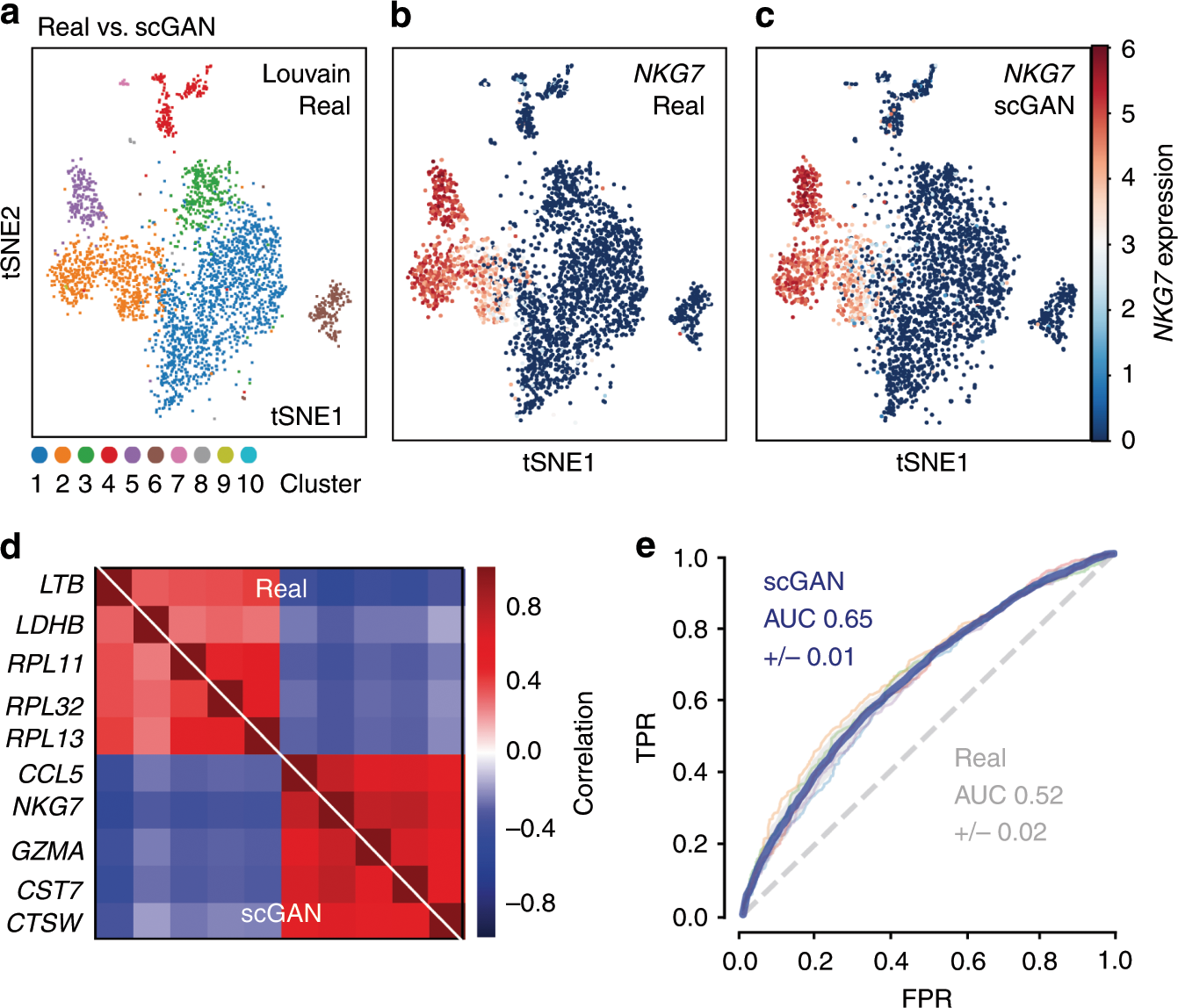
A fundamental problem in biomedical research is the low number of observations available, mostly due to a lack of available biosamples, prohibitive costs, or ethical reasons. Augmenting few real observations with generated in silico samples could lead to more robust analysis results and a higher reproducibility rate. Here, we propose the use of conditional single-cell generative adversarial neural networks (cscGAN) for the realistic generation of single-cell RNA-seq data. cscGAN learns non-linear gene–gene dependencies from complex, multiple cell type samples and uses this information to generate realistic cells of defined types. Augmenting sparse cell populations with cscGAN generated cells improves downstream analyses such as the detection of marker genes, the robustness and reliability of classifiers, the assessment of novel analysis algorithms, and might reduce the number of animal experiments and costs in consequence. cscGAN outperforms existing methods for single-cell RNA-seq data generation in quality and hold great promise for the realistic generation and augmentation of other biomedical data types.
Realistic in silico generation and augmentation of single cell RNA-seq data using Generative Adversarial Neural Networks
A fundamental problem in biomedical research is the low number of observations available, mostly due to a lack of available biosamples, prohibitive costs, or ethical reasons. Augmenting few real observations with generated in silico samples could lead to more robust analysis results and a higher reproducibility rate. Here we propose the use of conditional single cell Generative Adversarial Neural Networks (cscGANs) for the realistic generation of single cell RNA-seq data. cscGANs learn non-linear gene-gene dependencies from complex, multi cell type samples and use this information to generate realistic cells of defined types. Augmenting sparse cell populations with cscGAN generated cells improves downstream analyses such as the detection of marker genes, the robustness and reliability of classifiers, the assessment of novel analysis algorithms, and might reduce the number of animal experiments and costs in consequence. cscGANs outperform existing methods for single cell RNA-seq data generation in quality and hold great promise for the realistic generation and augmentation of other biomedical data types. *

An atlas-scale generative model for unified representation learning of bulk RNA-seq data
Public bulk RNA-seq repositories contain hundreds of thousands of samples, creating opportunities for large-scale representation learning, but integration across studies remains challenging because of heterogeneous annotations, experimental protocols, and technical variation. While pre-trained foundation models are now widely available for single-cell RNA-seq, comparable resources for bulk RNA-seq remain scarce, motivating a model that learns a unified, tissue-aware representation directly from bulk data. We trained a supervised variational autoencoder (VAE) on a compendium of 118,263 bulk RNA-seq samples that we assembled from TCGA, GTEx, and ARCHS4 and mapped to 42 tissue categories. The model classifies tissue of origin at 94.9% balanced accuracy (weighted F1 96.2%) and compresses 16,115 genes into a 121-dimensional latent space. Tissue identity is the primary organizing axis of the latent space, while source effects remain secondary. To assess the impact of data volume, we constructed training sets at three different scales (38K, 75K, and 118K samples). Our results demonstrated that reconstruction fidelity improved incrementally with each expansion of the dataset, but with diminishing returns. We validated the model on an independent cohort of 734 paediatric tumour samples from TARGET, achieving 84.6% agreement with the expected tissue of origin. The trained model and code are available at GitHub ([https://github.com/BIMSBbioinfo/flexynesis\_tissue\_vae_manuscript][1]) with an interactive web application. ### Competing Interest Statement The authors have declared no competing interest. [1]: https://github.com/BIMSBbioinfo/flexynesis_tissue_vae_manuscript
Synthetic data at scale: a development model to efficiently leverage machine learning in agriculture
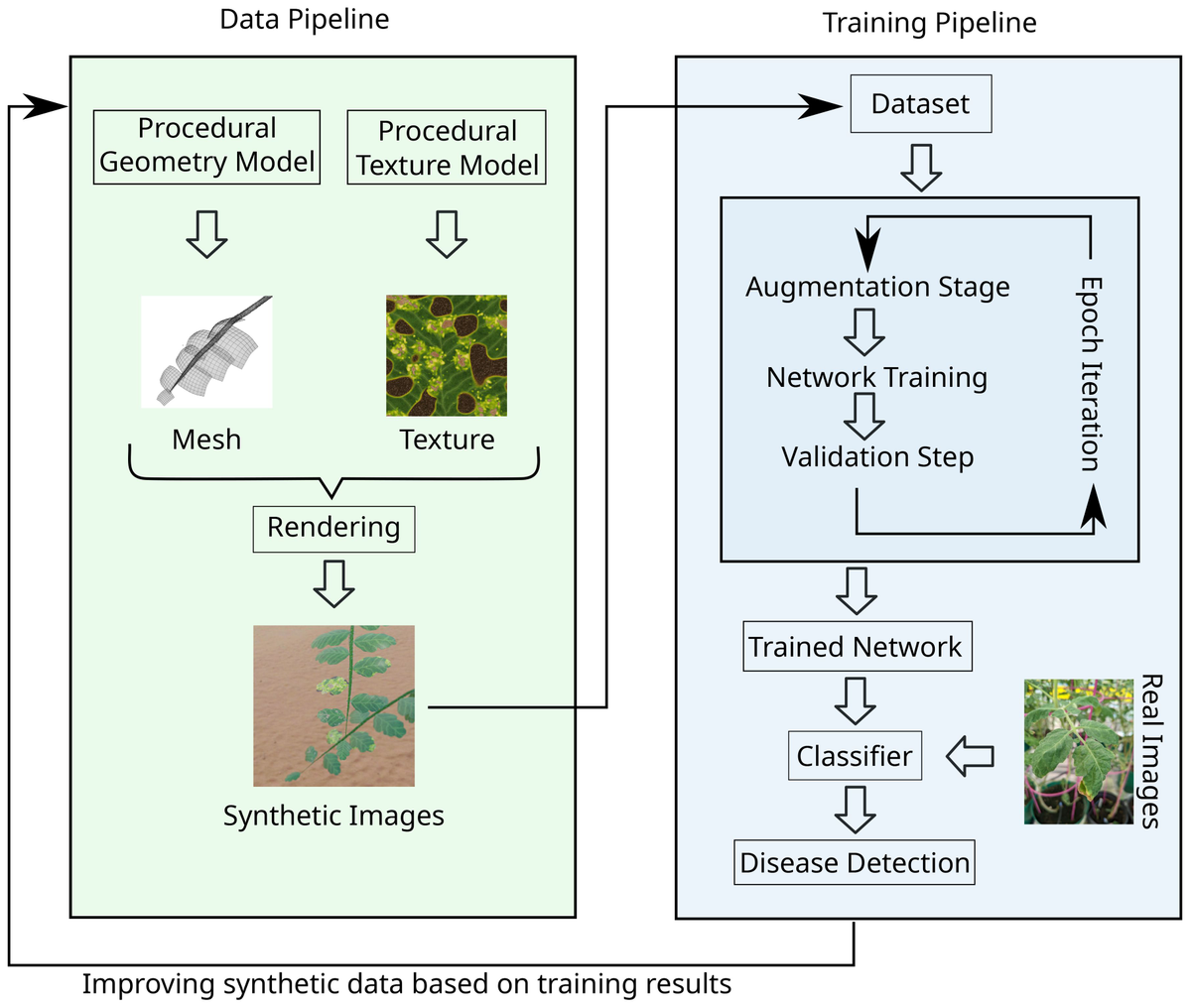
The rise of artificial intelligence (AI) and in particular modern machine learning (ML) algorithms during the last decade has been met with great interest in the agricultural industry. While undisputedly powerful, their main drawback remains the need for sufficient and diverse training data. The collection of real datasets and their annotation are the main cost drivers of ML developments, and while promising results on synthetically generated training data have been shown, their generation is not without difficulties on their own. In this paper, we present a development model for the iterative, cost-efficient generation of synthetic training data. Its application is demonstrated by developing a low-cost early disease detector for tomato plants (Solanum lycopersicum) using synthetic training data. A neural classifier is trained by exclusively using synthetic images, whose generation process is iteratively refined to obtain optimal performance. In contrast to other approaches that rely on a human assessment of similarity between real and synthetic data, we instead introduce a structured, quantitative approach. Our evaluation shows superior generalization results when compared to using non-task-specific real training data and a higher cost efficiency of development compared to traditional synthetic training data.
Dataset Condensation with Distribution Matching
Computational cost to train state-of-the-art deep models in many learning problems is rapidly increasing due to more sophisticated models and larger datasets. A recent promising direction to reduce training time is dataset condensation that aims to replace the original large training set with a significantly smaller learned synthetic set while preserving its information. While training deep models on the small set of condensed images can be extremely fast, their synthesis remains computationally expensive due to the complex bi-level optimization and second-order derivative computation. In this work, we propose a simple yet effective dataset condensation technique that requires significantly lower training cost with comparable performance by matching feature distributions of the synthetic and original training images in sampled embedding spaces. Thanks to its efficiency, we apply our method to more realistic and larger datasets with sophisticated neural architectures and achieve a significant performance boost while using larger synthetic training set. We also show various practical benefits of our method in continual learning and neural architecture search.
Benchmarking gene expression reconstruction from single-cell latent representations
Single-cell transcriptomics is typically modeled in low-dimensional latent representations that improve the signal-to-noise ratio of the data. Such representations underpin data integration, cell state discovery, and perturbation prediction, with applications ranging from large-scale organ atlases to latent trajectory modeling. Recent virtual cell approaches further leverage these representations to predict cellular responses as distributional shifts in latent space. Each of these applications ultimately requires faithful gene expression reconstruction from latent spaces for biological interpretation, enabling gene-level analysis of predicted perturbed or batch-corrected cells. Yet representation choice is typically treated as an implementation detail rather than a primary modeling decision, with no systematic evaluation of how well latent representations support gene expression reconstruction. Here, we introduce ReconEval, a benchmark for evaluating gene expression reconstruction from single-cell latent spaces. We benchmark two classes of latent representations: end-to-end trained models such as PCA, autoencoders, and variational autoencoders, and pretrained single-cell foundation model embeddings coupled to newly trained decoders. Reconstruction is evaluated both directly and after latent-space perturbation prediction. Across perturbational and observational datasets totaling over 100 million cells, our metric suite quantifies statistical fidelity; biological signal preservation, including differential expression, coexpression, cell-cycle structure, cytokine response and pathway activity; and perturbation-specific effects. We find that autoencoders achieve the strongest stand-alone reconstruction at low dimensionality, while variational regularization does not improve generalization in reconstruction. Frozen foundation model embeddings retain recoverable gene-level information, with reconstruction quality depending strongly on decoder architecture and pretraining objective. In latent perturbation modeling, high-dimensional PCA matches foundation model embeddings, while low-dimensional AE embeddings are optimal for flow-based generative models. Overall, reconstruction depends critically on the interplay between representation and downstream model, and simpler representations can outperform complex alternatives given appropriate capacity. Our benchmark establishes reconstruction as a critical evaluation axis for single-cell foundation models. We envision it improving the biological interpretability of latent-space modeling, a prerequisite for future virtual cell models to be validated by domain experts and grounded in biology. ### Competing Interest Statement F.J.T. consults for Immunai, CytoReason, Valinor Industries, Bioturing and Phylo Inc., and has ownership interest in RN.AI Therapeutics, Dermagnostix, and Cellarity. The remaining authors declare no competing interests.
Self-Consuming Generative Models Go MAD
Seismic advances in generative AI algorithms for imagery, text, and other data types has led to the temptation to use synthetic data to train next-generation models. Repeating this process creates an autophagous (self-consuming) loop whose properties are poorly understood. We conduct a thorough analytical and empirical analysis using state-of-the-art generative image models of three families of autophagous loops that differ in how fixed or fresh real training data is available through the generations of training and in whether the samples from previous generation models have been biased to trade off data quality versus diversity. Our primary conclusion across all scenarios is that without enough fresh real data in each generation of an autophagous loop, future generative models are doomed to have their quality (precision) or diversity (recall) progressively decrease. We term this condition Model Autophagy Disorder (MAD), making analogy to mad cow disease.

Datamodels: Predicting Predictions from Training Data
We present a conceptual framework, datamodeling, for analyzing the behavior of a model class in terms of the training data. For any fixed "target" example $x$, training set $S$, and learning algorithm, a datamodel is a parameterized function $2^S \to \mathbb{R}$ that for any subset of $S' \subset S$ -- using only information about which examples of $S$ are contained in $S'$ -- predicts the outcome of training a model on $S'$ and evaluating on $x$. Despite the potential complexity of the underlying process being approximated (e.g., end-to-end training and evaluation of deep neural networks), we show that even simple linear datamodels can successfully predict model outputs. We then demonstrate that datamodels give rise to a variety of applications, such as: accurately predicting the effect of dataset counterfactuals; identifying brittle predictions; finding semantically similar examples; quantifying train-test leakage; and embedding data into a well-behaved and feature-rich representation space. Data for this paper (including pre-computed datamodels as well as raw predictions from four million trained deep neural networks) is available at https://github.com/MadryLab/datamodels-data .
mixup: Beyond Empirical Risk Minimization
Large deep neural networks are powerful, but exhibit undesirable behaviors such as memorization and sensitivity to adversarial examples. In this work, we propose mixup, a simple learning principle to alleviate these issues. In essence, mixup trains a neural network on convex combinations of pairs of examples and their labels. By doing so, mixup regularizes the neural network to favor simple linear behavior in-between training examples. Our experiments on the ImageNet-2012, CIFAR-10, CIFAR-100, Google commands and UCI datasets show that mixup improves the generalization of state-of-the-art neural network architectures. We also find that mixup reduces the memorization of corrupt labels, increases the robustness to adversarial examples, and stabilizes the training of generative adversarial networks.
Dataset Condensation with Gradient Matching
As the state-of-the-art machine learning methods in many fields rely on larger datasets, storing datasets and training models on them become significantly more expensive. This paper proposes a training set synthesis technique for data-efficient learning, called Dataset Condensation, that learns to condense large dataset into a small set of informative synthetic samples for training deep neural networks from scratch. We formulate this goal as a gradient matching problem between the gradients of deep neural network weights that are trained on the original and our synthetic data. We rigorously evaluate its performance in several computer vision benchmarks and demonstrate that it significantly outperforms the state-of-the-art methods. Finally we explore the use of our method in continual learning and neural architecture search and report promising gains when limited memory and computations are available.
DataInf: Efficiently Estimating Data Influence in LoRA-tuned LLMs and Diffusion Models
Quantifying the impact of training data points is crucial for understanding the outputs of machine learning models and for improving the transparency of the AI pipeline. The influence function is a principled and popular data attribution method, but its computational cost often makes it challenging to use. This issue becomes more pronounced in the setting of large language models and text-to-image models. In this work, we propose DataInf, an efficient influence approximation method that is practical for large-scale generative AI models. Leveraging an easy-to-compute closed-form expression, DataInf outperforms existing influence computation algorithms in terms of computational and memory efficiency. Our theoretical analysis shows that DataInf is particularly well-suited for parameter-efficient fine-tuning techniques such as LoRA. Through systematic empirical evaluations, we show that DataInf accurately approximates influence scores and is orders of magnitude faster than existing methods. In applications to RoBERTa-large, Llama-2-13B-chat, and stable-diffusion-v1.5 models, DataInf effectively identifies the most influential fine-tuning examples better than other approximate influence scores. Moreover, it can help to identify which data points are mislabeled.
DAVINZ: Data Valuation using Deep Neural Networks at Initialization
Recent years have witnessed a surge of interest in developing trustworthy methods to evaluate the value of data in many real-world applications (e.g., collaborative machine learning, data marketplaces). Existing data valuation methods typically valuate data using the generalization performance of converged machine learning models after their long-term model training, hence making data valuation on large complex deep neural networks (DNNs) unaffordable. To this end, we theoretically derive a domain-aware generalization bound to estimate the generalization performance of DNNs without model training. We then exploit this theoretically derived generalization bound to develop a novel training-free data valuation method named data valuation at initialization (DAVINZ) on DNNs, which consistently achieves remarkable effectiveness and efficiency in practice. Moreover, our training-free DAVINZ, surprisingly, can even theoretically and empirically enjoy the desirable properties that training-based data valuation methods usually attain, thus making it more trustworthy in practice.
Meta-Weight-Net: Learning an Explicit Mapping For Sample Weighting
Current deep neural networks(DNNs) can easily overfit to biased training data with corrupted labels or class imbalance. Sample re-weighting strategy is commonly used to alleviate this issue by designing a weighting function mapping from training loss to sample weight, and then iterating between weight recalculating and classifier updating. Current approaches, however, need manually pre-specify the weighting function as well as its additional hyper-parameters. It makes them fairly hard to be generally applied in practice due to the significant variation of proper weighting schemes relying on the investigated problem and training data. To address this issue, we propose a method capable of adaptively learning an explicit weighting function directly from data. The weighting function is an MLP with one hidden layer, constituting a universal approximator to almost any continuous functions, making the method able to fit a wide range of weighting function forms including those assumed in conventional research. Guided by a small amount of unbiased meta-data, the parameters of the weighting function can be finely updated simultaneously with the learning process of the classifiers. Synthetic and real experiments substantiate the capability of our method for achieving proper weighting functions in class imbalance and noisy label cases, fully complying with the common settings in traditional methods, and more complicated scenarios beyond conventional cases. This naturally leads to its better accuracy than other state-of-the-art methods.
Data Valuation Without Training of a Model
Many recent works on understanding deep learning try to quantify how much individual data instances influence the optimization and generalization of a model. Such attempts reveal characteristics and importance of individual instances, which may provide useful information in diagnosing and improving deep learning. However, most of the existing works on data valuation require actual training of a model, which often demands high-computational cost. In this paper, we provide a training-free data valuation score, called complexity-gap score, which is a data-centric score to quantify the influence of individual instances in generalization of two-layer overparameterized neural networks. The proposed score can quantify irregularity of the instances and measure how much each data instance contributes in the total movement of the network parameters during training. We theoretically analyze and empirically demonstrate the effectiveness of the complexity-gap score in finding `irregular or mislabeled' data instances, and also provide applications of the score in analyzing datasets and diagnosing training dynamics. Our code is publicly available at https://github.com/JJchy/CG_score.
Distilling Dataset into Neural Field
Utilizing a large-scale dataset is essential for training high-performance deep learning models, but it also comes with substantial computation and storage costs. To overcome these challenges, dataset distillation has emerged as a promising solution by compressing the large-scale dataset into a smaller synthetic dataset that retains the essential information needed for training. This paper proposes a novel parameterization framework for dataset distillation, coined Distilling Dataset into Neural Field (DDiF), which leverages the neural field to store the necessary information of the large-scale dataset. Due to the unique nature of the neural field, which takes coordinates as input and output quantity, DDiF effectively preserves the information and easily generates various shapes of data. We theoretically confirm that DDiF exhibits greater expressiveness than some previous literature when the utilized budget for a single synthetic instance is the same. Through extensive experiments, we demonstrate that DDiF achieves superior performance on several benchmark datasets, extending beyond the image domain to include video, audio, and 3D voxel. We release the code at \url{https://github.com/aailab-kaist/DDiF}.
Distributionally Robust Data Valuation
Data valuation quantifies the contribution of each data point to the performance of a machine learning model. Existing works typically define the value of data by its improvement of the validation performance of the trained model. However, this approach can be impractical to apply in collaborative machine learning and data marketplace since it is difficult for the parties/buyers to agree on a common validation dataset or determine the exact validation distribution a priori. To address this, we propose a distributionally robust data valuation approach to perform data valuation without known/fixed validation distributions. Our approach defines the value of data by its improvement of the distributionally robust generalization error (DRGE), thus providing a worst-case performance guarantee without a known/fixed validation distribution. However, since computing DRGE directly is infeasible, we propose using model deviation as a proxy for the marginal improvement of DRGE (for kernel regression and neural networks) to compute data values. Furthermore, we identify a notion of uniqueness where low uniqueness characterizes low-value data. We empirically demonstrate that our approach outperforms existing data valuation approaches in data selection and data removal tasks on real-world datasets (e.g., housing price prediction, diabetes hospitalization prediction).