


Interpersonal trust between any two people in social networks is hard to gauge, and even harder to infer, given that these two people are not connected by an immediate social link, such as friendship or acquaintanceship. In order to be able to make accurate inferences for an arbitrary tuple of people in a given social environment, we present an approach, named Appleseed, that is based on mechanics taken from neuropsychology, known as spreading activation models. Compelling in its simplicity, we relate the concept to trust propagation and evaluation in an intuitive fashion. While Appleseed works very well when paths between two arbitrary people in the network can be established, no inference of trust is possible when this is not the case. To this end, we present several algorithms for inferring trust that go beyond network structure and demonstrate their accuracy in real social networks. We also show how these algorithms can be augmented with additional data that may be available in some contexts.
The Majority Illusion in Social Networks
Social behaviors are often contagious, spreading through a population as individuals imitate the decisions and choices of others. A variety of global phenomena, from innovation adoption to the emergence of social norms and political movements, arise as a result of people following a simple local rule, such as copy what others are doing. However, individuals often lack global knowledge of the behaviors of others and must estimate them from the observations of their friends' behaviors. In some cases, the structure of the underlying social network can dramatically skew an individual's local observations, making a behavior appear far more common locally than it is globally. We trace the origins of this phenomenon, which we call "the majority illusion," to the friendship paradox in social networks. As a result of this paradox, a behavior that is globally rare may be systematically overrepresented in the local neighborhoods of many people, i.e., among their friends. Thus, the "majority illusion" may facilitate the spread of social contagions in networks and also explain why systematic biases in social perceptions, for example, of risky behavior, arise. Using synthetic and real-world networks, we explore how the "majority illusion" depends on network structure and develop a statistical model to calculate its magnitude in a network.

The "Majority Illusion" in Social Networks
Individual’s decisions, from what product to buy to whether to engage in risky behavior, often depend on the choices, behaviors, or states of other people. People, however, rarely have global knowledge of the states of others, but must estimate them from the local observations of their social contacts. Network structure can significantly distort individual’s local observations. Under some conditions, a state that is globally rare in a network may be dramatically over-represented in the local neighborhoods of many individuals. This effect, which we call the “majority illusion,” leads individuals to systematically overestimate the prevalence of that state, which may accelerate the spread of social contagions. We develop a statistical model that quantifies this effect and validate it with measurements in synthetic and real-world networks. We show that the illusion is exacerbated in networks with a heterogeneous degree distribution and disassortative structure.
The "Majority Illusion" in Social Networks
Individual’s decisions, from what product to buy to whether to engage in risky behavior, often depend on the choices, behaviors, or states of other people. People, however, rarely have global knowledge of the states of others, but must estimate them from the local observations of their social contacts. Network structure can significantly distort individual’s local observations. Under some conditions, a state that is globally rare in a network may be dramatically over-represented in the local neighborhoods of many individuals. This effect, which we call the “majority illusion,” leads individuals to systematically overestimate the prevalence of that state, which may accelerate the spread of social contagions. We develop a statistical model that quantifies this effect and validate it with measurements in synthetic and real-world networks. We show that the illusion is exacerbated in networks with a heterogeneous degree distribution and disassortative structure.
Modelling Opinion Dynamics in the Age of Algorithmic Personalisation
Modern technology has drastically changed the way we interact and consume information. For example, online social platforms allow for seamless communication exchanges at an unprecedented scale. However, we are still bounded by cognitive and temporal constraints. Our attention is limited and extremely valuable. Algorithmic personalisation has become a standard approach to tackle the information overload problem. As result, the exposure to our friends' opinions and our perception about important issues might be distorted. However, the effects of algorithmic gatekeeping on our hyper-connected society are poorly understood. Here, we devise an opinion dynamics model where individuals are connected through a social network and adopt opinions as function of the view points they are exposed to. We apply various filtering algorithms that select the opinions shown to users i) at random ii) considering time ordering or iii) their current beliefs. Furthermore, we investigate the interplay between such mechanisms and crucial features of real networks. We found that algorithmic filtering might influence opinions' share and distributions, especially in case information is biased towards the current opinion of each user. These effects are reinforced in networks featuring topological and spatial correlations where echo chambers and polarisation emerge. Conversely, heterogeneity in connectivity patterns reduces such tendency. We consider also a scenario where one opinion, through nudging, is centrally pushed to all users. Interestingly, even minimal nudging is able to change the status quo moving it towards the desired view point. Our findings suggest that simple filtering algorithms might be powerful tools to regulate opinion dynamics taking place on social networks
Ranking Strategies on Farcaster | OpenRank
Profile reputation scoring to address trustworthiness in social networks

An analysis of social network-based Sybil defenses
Recently, there has been much excitement in the research community over using social networks to mitigate multiple identity, or Sybil, attacks. A number of schemes have been proposed, but they differ greatly in the algorithms they use and in the ...

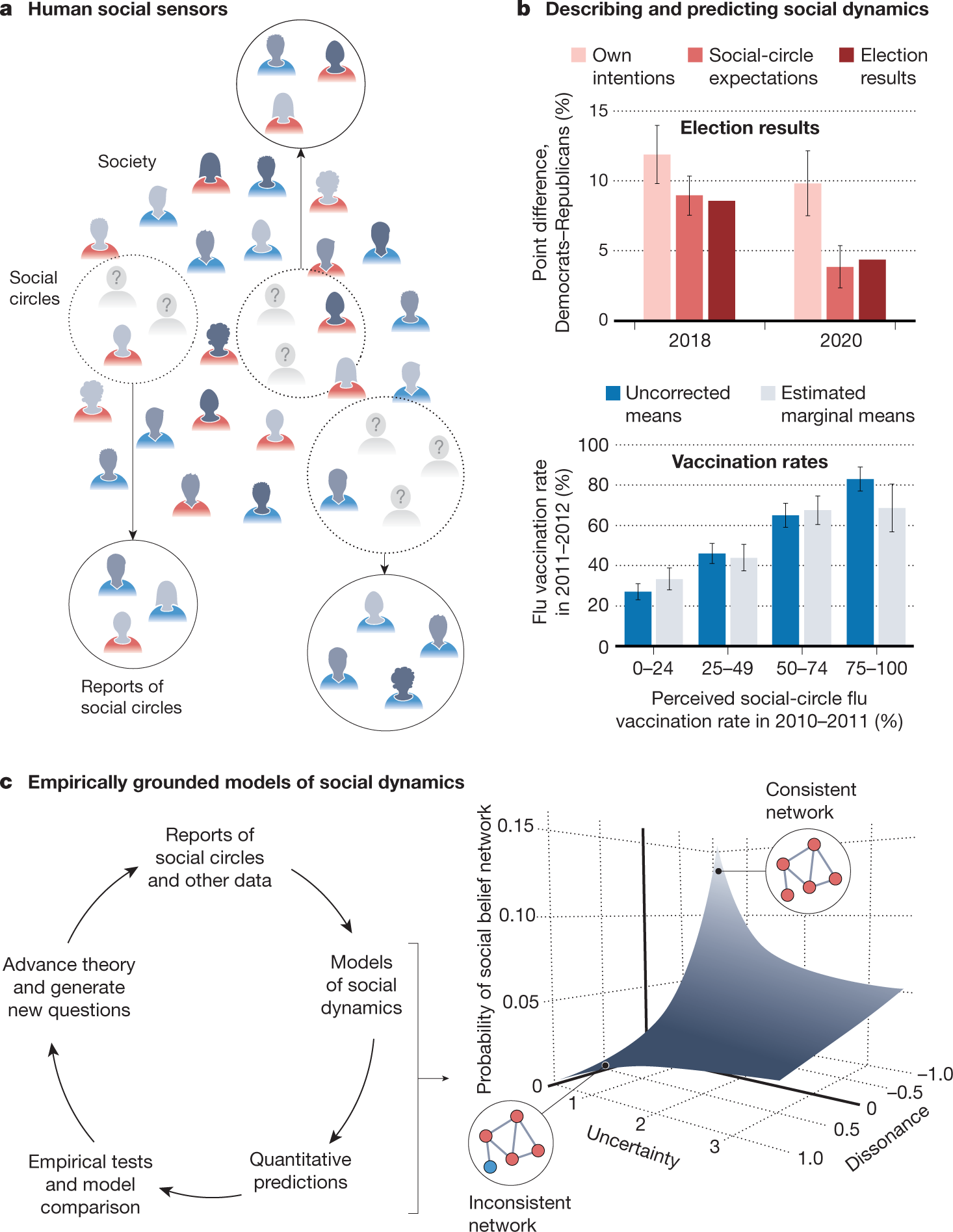
Human social sensing is an untapped resource for computational social science
The ability to ‘sense’ the social environment and thereby to understand the thoughts and actions of others allows humans to fit into their social worlds, communicate and cooperate, and learn from others’ experiences. Here we argue that, through the lens of computational social science, this ability can be used to advance research into human sociality. When strategically selected to represent a specific population of interest, human social sensors can help to describe and predict societal trends. In addition, their reports of how they experience their social worlds can help to build models of social dynamics that are constrained by the empirical reality of human social systems.
OpenCola
Build trust networks that give you control of your personal data and the flow of information around you.

Sybil Detection using Graph Neural Networks
Online social networks have become a central part of modern digital life, connecting billions of users worldwide. However, their open nature and vast scale make them vulnerable to various security threats, with Sybil attacks being a prevalent and challenging attack to detect. In Sybil attacks, malicious entities create fake accounts to manipulate the network, spread misinformation, or gain undue influence. Thus, detecting Sybil accounts is crucial for maintaining the integrity and trustworthiness of social networks. Effective Sybil detection can prevent the spread of fake news, protect users from scams, and ensure a fair distribution of resources and influence within the network. However, as attackers become more sophisticated, traditional detection methods increasingly fail to perform their task.
A Robust Decentralized Infrastructure for Trust-Aware Open Knowledge Sharing [DRAFT]
Semantic technologies and models have matured and become very powerful tools to increase the power and accuracy of recent AI approaches. However, we currently lack channels where semantically structured knowledge can be reliably published and queried, both by humans as well as AI agents. Here we show how this gap can be filled by a global ecosystem that aligns with the original Semantic Web vision with respect to openness, decentralization, and formal semantics, but also targets trust and redundancy. Our approach is based on the concept and technology of nanopublications with content-addressed identifiers and a layered peer-to-peer network of publishing services, query services, and user applications. It applies a trust algorithm from links that are published as nanopublications themselves. We present a novel trust propagation algorithm IDEBT and prove its properties of being robust, efficient to compute, and reproducible. We evaluate the ecosystem on a multi-node test deployment running a synthetic publish/query workload under two coverage configurations, complemented by a descriptive analysis of the live deployed trust network. Our positive results show that a such a decentralized network of services based on nanopublications has the capacity and potential to serve as a universal and globally integrated knowledge sharing platform.
A New Social
Our mission is to liberate people's networks from their platforms, enabling The Last Network Effect and leveling the playing field across the open social web.
A New Social
Our mission is to liberate people's networks from their platforms, enabling The Last Network Effect and leveling the playing field across the open social web.
Inverting the physics of trust
Common Fabric is a social computing lab building a medium for software that revolves around people, not apps.

Jesse Ruderman » The Advogato trust metric is not attack-resistant
The project for the graduate algorithms class I took in Fall was to compare two algorithms for a problem of our choice. I chose to compare two trust metrics, the Advogato trust metric and Google's PageRank. Trust metrics attempt to solve the following problem: "Given a directed graph where an edge from A to B means 'A trusts B', whom should I trust?".
Bayesian Inference of Social Norms as Shared Constraints on Behavior
People act upon their desires, but often, also act in adherence to implicit social norms. How do people infer these unstated social norms from others' behavior, especially in novel social contexts? We propose that laypeople have intuitive theories of social norms as behavioral constraints shared across different agents in the same social context. We formalize inference of norms using a Bayesian Theory of Mind approach, and show that this computational approach provides excellent predictions of how people infer norms in two scenarios. Our results suggest that people separate the influence of norms and individual desires on others' actions, and have implications for modelling generalizations of hidden causes of behavior.
Resampling reduces bias amplification in experimental social networks
Large-scale social networks are thought to contribute to polarization by amplifying people’s biases. However, the complexity of these technologies makes it difficult to identify the mechanisms responsible and evaluate mitigation strategies. Here we show under controlled laboratory conditions that transmission through social networks amplifies motivational biases on a simple artificial decision-making task. Participants in a large behavioural experiment showed increased rates of biased decision-making when part of a social network relative to asocial participants in 40 independently evolving populations. Drawing on ideas from Bayesian statistics, we identify a simple adjustment to content-selection algorithms that is predicted to mitigate bias amplification by generating samples of perspectives from within an individual’s network that are more representative of the wider population. In two large experiments, this strategy was effective at reducing bias amplification while maintaining the benefits of information sharing. Simulations show that this algorithm can also be effective in more complex networks.
