


Far-reaching changes to the structure and function of the Earth's natural systems represent a growing threat to human health. And yet, global health has mainly improved as these changes have gathered pace. What is the explanation? As a Commission, we are deeply concerned that the explanation is straightforward and sobering: we have been mortgaging the health of future generations to realise economic and development gains in the present. By unsustainably exploiting nature's resources, human civilisation has flourished but now risks substantial health effects from the degradation of nature's life support systems in the future.
The shock of the anthropocene: the earth, history and us
Dissecting the new theoretical buzzword of the "Anthrop…

The “Anthropocene”
Human activities are exerting increasing impacts on the environment on all scales, in many ways outcompeting natural processes. This includes the manufacturing of hazardous chemical compounds which are not produced by nature, such as for instance the...

Metrics for biodiversity and health policy integration
Despite over a decade of progressive commitments from parties to the Convention on Biological Diversity (CBD), integrated biodiversity and health indicators and monitoring mechanisms remain limited, hampering achievement of the sustainable development goals and improvements in health and well-being. Adoption of the Kunming-Montreal Global Biodiversity Framework (2022) and the Global Action Plan on Biodiversity and Health (2024) provide a renewed entry point to shape the way governments approach health and wellbeing and address the environmental burden of disease. This is a critical opportunity that scholars at the health-environment nexus should not miss. This Perspective outlines building blocks to mobilize the field, starting with essential terminology and a scope of metrics needed by governments. We then evaluate elements to be considered in the construction of integrated metrics, including concepts, overarching challenges, a review of scientific hypotheses from an ecological perspective, as well as a set of principles and characteristics for indicators. To raise awareness across parallel communities of practice working at the health-environment nexus, we then briefly examine four approaches to integrated metrics developed by: conservationists, Indigenous scholars, One Health experts, and planetary health experts. We conclude with actionable steps to enhance governance, mobilize funding, and apply integrated indicators in national and global strategies. A broad science community is needed to support national governments to meet global commitments to address biodiversity loss and the environmental burden of disease concurrently. The overall aim of this paper is to contribute to addressing biodiversity loss by effectively linking policy and transdisciplinary practice at the health-environment nexus.
How May the ‘Anthropocene’ Enable and Constrain Cybersystemic Governance? The ‘Anthropocene Problematique’
A growing awareness of the need for cybernetics and systems thinking (cybersystemic) in praxes of governance to improve human-biosphere relationships in the Anthropocene has become apparent. Nonetheless, mainstream governance informed by linear-causality seems to perpetuate an increasingly inadequate paradigm of dominant first-order/systematic thinking in governing complex interactions between humans and their natural environments. This conundrum is explored through the second-order lens of a systemic inquiry, using an integrative literature review. We discuss limitations of the Anthropocene metaphor and make the case for a reframing of our situation (humans’ co-evolutionary dynamic with the biosphere) as the ‘Anthropocene problematique’. This reframing as a systemic-duality offers more conducive affordances for trajectory-shifting cybersystemic governance to emerge. Aligning with a body of literature evidencing the influence of language on human cognition, we argue that by joining up the strengths of both ideas, ‘Anthropocene problematique’ may form a conceptual device amenable to changing worldviews and guiding practical action in governing human-biosphere relationships. We suggest a conceptual framework for practitioners to design and enact purposeful systems of cybersystemic governance with potential to improve situated Anthropocene problematiques. This framing and theoretical proposal are motivated by a need for shifts towards a social purpose of healing human-biosphere relationships in current governance systems in the Anthropocene-world.

Daniel Christian Wahl: “Bioregional Futures: Reconnecting to Place for Planetary Health” - The Great Simplification
In the past century of abundant energy surplus, humanity’s globalized, large-scale approach to problem-solving

The ultrasocial origin of the Anthropocene
The current geological epoch has been dubbed the Anthropocene—the age of humans. We argue that the roots of the Anthropocene lie in the agricultural revolution that began some 8000years ago. Unique human psychological and cultural characteristics were present in our distant hunter–gatherer past, but in terms of the biophysical impact of our species, agricultural represented an unequivocal and decisive evolutionary break. With the transition to agriculture human society began to function as a superorganism functioning as a single unit designed by social natural selection to produce economic surplus. Where environmental conditions were permitted, early human agricultural societies followed the same pattern as a few social insects and exhibited explosive population growth, complex and detailed division of labor, intensive resource exploitation, territorial expansion, and a social organization favoring the survival and growth of the supergroup over the well-being of individuals within the group. Similar economic forces lie behind ultrasociality in social insects and humans—increased productivity from the division of labor, increasing returns to scale, and the exploitation of stocks of productive resources. Exploring the evolutionary mechanisms behind ultrasociality offers insights into the growth imperative that threatens the stability of the earth's life support systems.
Biodiversity and global healthâhubris, humility and the unknown
Biodiversity and global healthâhubris, humility and the unknown, Stephens, Carolyn
Emerging contaminants: A One Health perspective
Environmental pollution is escalating due to rapid global development that often prioritizes human needs over planetary health. Despite global efforts to mitigate legacy pollutants, the continuous introduction of new substances remains a major threat to both people and the planet. In response, global initiatives are focusing on risk assessment and regulation of emerging contaminants, as demonstrated by the ongoing efforts to establish the UN’s Intergovernmental Science-Policy Panel on Chemicals, Waste, and Pollution Prevention.

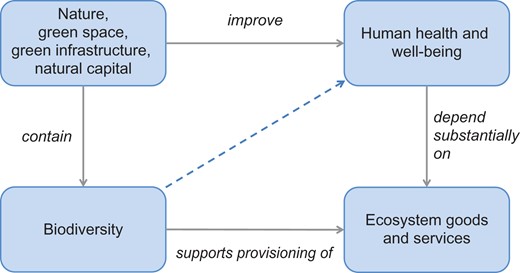
Biodiversity and human health: mechanisms and evidence of the positive health effects of diversity in nature and green spaces
AbstractIntroduction. Natural environments and green spaces provide ecosystem services that enhance human health and well-being. They improve mental health
BBC Earth | Environment, Climate Change, AI, Food, Health, Social, & Technology
As we face the world’s greatest environmental challenges, BBC Earth brings you solutions in psychology, food, climate change, health, social trends, and technology that can make the world a more sustainable place.
BBC Earth | Environment, Climate Change, AI, Food, Health, Social, & Technology
As we face the world’s greatest environmental challenges, BBC Earth brings you solutions in psychology, food, climate change, health, social trends, and technology that can make the world a more sustainable place.
BBC Earth | Environment, Climate Change, AI, Food, Health, Social, & Technology
As we face the world’s greatest environmental challenges, BBC Earth brings you solutions in psychology, food, climate change, health, social trends, and technology that can make the world a more sustainable place.
From The Anthropocene To The Microbiocene | NOEMA
The novel coronavirus compels us to rethink the modern concept of the political.

Avoidable mortality, risk factors and policies for tackling noncommunicable diseases – leveraging data for impact: monitoring commitments in the WHO European Region ahead of the Fourth United Nations High-Level Meeting
The report notes that, in order to tackle NCDs and address the commercial, social, environmental and digital determinants of health, there is a need for accelerated multisectoral whole-of-government and whole-of-society action, integrated policies, enhanced preventive measures and strengthened health systems.

Human Health and Ocean Pollution
Background: Pollution – unwanted waste released to air, water, and land by human activity – is the largest environmental cause of disease in the world today. It is responsible for an estimated nine million premature deaths per year, enormous economic losses, erosion of human capital, and degradation of ecosystems. Ocean pollution is an important, but insufficiently recognized and inadequately controlled component of global pollution. It poses serious threats to human health and well-being. The nature and magnitude of these impacts are only beginning to be understood.Goals: (1) Broadly examine the known and potential impacts of ocean pollution on human health. (2) Inform policy makers, government leaders, international organizations, civil society, and the global public of these threats. (3) Propose priorities for interventions to control and prevent pollution of the seas and safeguard human health.Methods: Topic-focused reviews that examine the effects of ocean pollution on human health, identify gaps in knowledge, project future trends, and offer evidence-based guidance for effective intervention.Environmental Findings: Pollution of the oceans is widespread, worsening, and in most countries poorly controlled. It is a complex mixture of toxic metals, plastics, manufactured chemicals, petroleum, urban and industrial wastes, pesticides, fertilizers, pharmaceutical chemicals, agricultural runoff, and sewage. More than 80% arises from land-based sources. It reaches the oceans through rivers, runoff, atmospheric deposition and direct discharges. It is often heaviest near the coasts and most highly concentrated along the coasts of low- and middle-income countries. Plastic is a rapidly increasing and highly visible component of ocean pollution, and an estimated 10 million metric tons of plastic waste enter the seas each year. Mercury is the metal pollutant of greatest concern in the oceans; it is released from two main sources – coal combustion and small-scale gold mining. Global spread of industrialized agriculture with increasing use of chemical fertilizer leads to extension of Harmful Algal Blooms (HABs) to previously unaffected regions. Chemical pollutants are ubiquitous and contaminate seas and marine organisms from the high Arctic to the abyssal depths.Ecosystem Findings: Ocean pollution has multiple negative impacts on marine ecosystems, and these impacts are exacerbated by global climate change. Petroleum-based pollutants reduce photosynthesis in marine microorganisms that generate oxygen. Increasing absorption of carbon dioxide into the seas causes ocean acidification, which destroys coral reefs, impairs shellfish development, dissolves calcium-containing microorganisms at the base of the marine food web, and increases the toxicity of some pollutants. Plastic pollution threatens marine mammals, fish, and seabirds and accumulates in large mid-ocean gyres. It breaks down into microplastic and nanoplastic particles containing multiple manufactured chemicals that can enter the tissues of marine organisms, including species consumed by humans. Industrial releases, runoff, and sewage increase frequency and severity of HABs, bacterial pollution, and anti-microbial resistance. Pollution and sea surface warming are triggering poleward migration of dangerous pathogens such as the Vibrio species. Industrial discharges, pharmaceutical wastes, pesticides, and sewage contribute to global declines in fish stocks.Human Health Findings: Methylmercury and PCBs are the ocean pollutants whose human health effects are best understood. Exposures of infants in utero to these pollutants through maternal consumption of contaminated seafood can damage developing brains, reduce IQ and increase children’s risks for autism, ADHD and learning disorders. Adult exposures to methylmercury increase risks for cardiovascular disease and dementia. Manufactured chemicals – phthalates, bisphenol A, flame retardants, and perfluorinated chemicals, many of them released into the seas from plastic waste – can disrupt endocrine signaling, reduce male fertility, damage the nervous system, and increase risk of cancer. HABs produce potent toxins that accumulate in fish and shellfish. When ingested, these toxins can cause severe neurological impairment and rapid death. HAB toxins can also become airborne and cause respiratory disease. Pathogenic marine bacteria cause gastrointestinal diseases and deep wound infections. With climate change and increasing pollution, risk is high that Vibrio infections, including cholera, will increase in frequency and extend to new areas. All of the health impacts of ocean pollution fall disproportionately on vulnerable populations in the Global South – environmental injustice on a planetary scale.Conclusions: Ocean pollution is a global problem. It arises from multiple sources and crosses national boundaries. It is the consequence of reckless, shortsighted, and unsustainable exploitation of the earth’s resources. It endangers marine ecosystems. It impedes the production of atmospheric oxygen. Its threats to human health are great and growing, but still incompletely understood. Its economic costs are only beginning to be counted.Ocean pollution can be prevented. Like all forms of pollution, ocean pollution can be controlled by deploying data-driven strategies based on law, policy, technology, and enforcement that target priority pollution sources. Many countries have used these tools to control air and water pollution and are now applying them to ocean pollution. Successes achieved to date demonstrate that broader control is feasible. Heavily polluted harbors have been cleaned, estuaries rejuvenated, and coral reefs restored.Prevention of ocean pollution creates many benefits. It boosts economies, increases tourism, helps restore fisheries, and improves human health and well-being. It advances the Sustainable Development Goals (SDG). These benefits will last for centuries.Recommendations: World leaders who recognize the gravity of ocean pollution, acknowledge its growing dangers, engage civil society and the global public, and take bold, evidence-based action to stop pollution at source will be critical to preventing ocean pollution and safeguarding human health.Prevention of pollution from land-based sources is key. Eliminating coal combustion and banning all uses of mercury will reduce mercury pollution. Bans on single-use plastic and better management of plastic waste reduce plastic pollution. Bans on persistent organic pollutants (POPs) have reduced pollution by PCBs and DDT. Control of industrial discharges, treatment of sewage, and reduced applications of fertilizers have mitigated coastal pollution and are reducing frequency of HABs. National, regional and international marine pollution control programs that are adequately funded and backed by strong enforcement have been shown to be effective. Robust monitoring is essential to track progress.Further interventions that hold great promise include wide-scale transition to renewable fuels; transition to a circular economy that creates little waste and focuses on equity rather than on endless growth; embracing the principles of green chemistry; and building scientific capacity in all countries.Designation of Marine Protected Areas (MPAs) will safeguard critical ecosystems, protect vulnerable fish stocks, and enhance human health and well-being. Creation of MPAs is an important manifestation of national and international commitment to protecting the health of the seas.
