

An open framework that simplifies authoring, validating, and sharing data — providing an accessible platform for interdisciplinary collaboration and a reliable way to define and share data semantics.
OpenML
OpenML is an open platform for sharing datasets, algorithms, and experiments - to learn how to learn better, together.
Linked Data - Design Issues
The Semantic Web isn't just about putting data on the web. It is about making links, so that a person or machine can explore the web of data. With linked data, when you have some of it, you can find other, related, data.
DASL — Data-Addressed Structures & Links
A small set of simple, standard primitives to work on content-addressed data.

DASL — Data-Addressed Structures & Links
A small set of simple, standard primitives to work on content-addressed data.
Linked Open Vocabularies (LOV)
Your entry point to high quality and reusable Vocabularies to describe Linked Data.

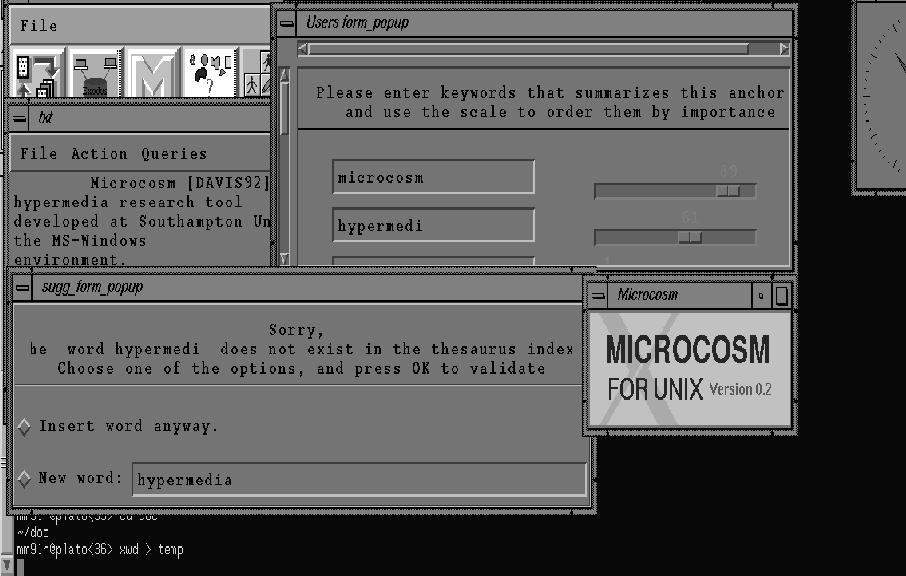
MICROCOSM: An Open Hypermedia Environment for Information Integration.
This report examines open hypermedia systems, and argues that such systems provide users with richer and more diverse ways to access and integrate information from large and dynamic data sets in a distributed, heterogeneous environment. In particular, the enhanced Microcosm model for open hypermedia is examined, and the ways in which it provides such an environment are discussed. The paper continues by investigating the advantages and the short comings of this model and identifies areas in which further work must be completed before such systems can become widely adopted, in particular the granularity of link anchors, editing, and version control. Possible solutions to these problems are presented and discussed.
Open Exchange Architecture
A specification for representing scientific documents and their components as structured objects.
Open Exchange Architecture
A specification for representing scientific documents and their components as structured objects.
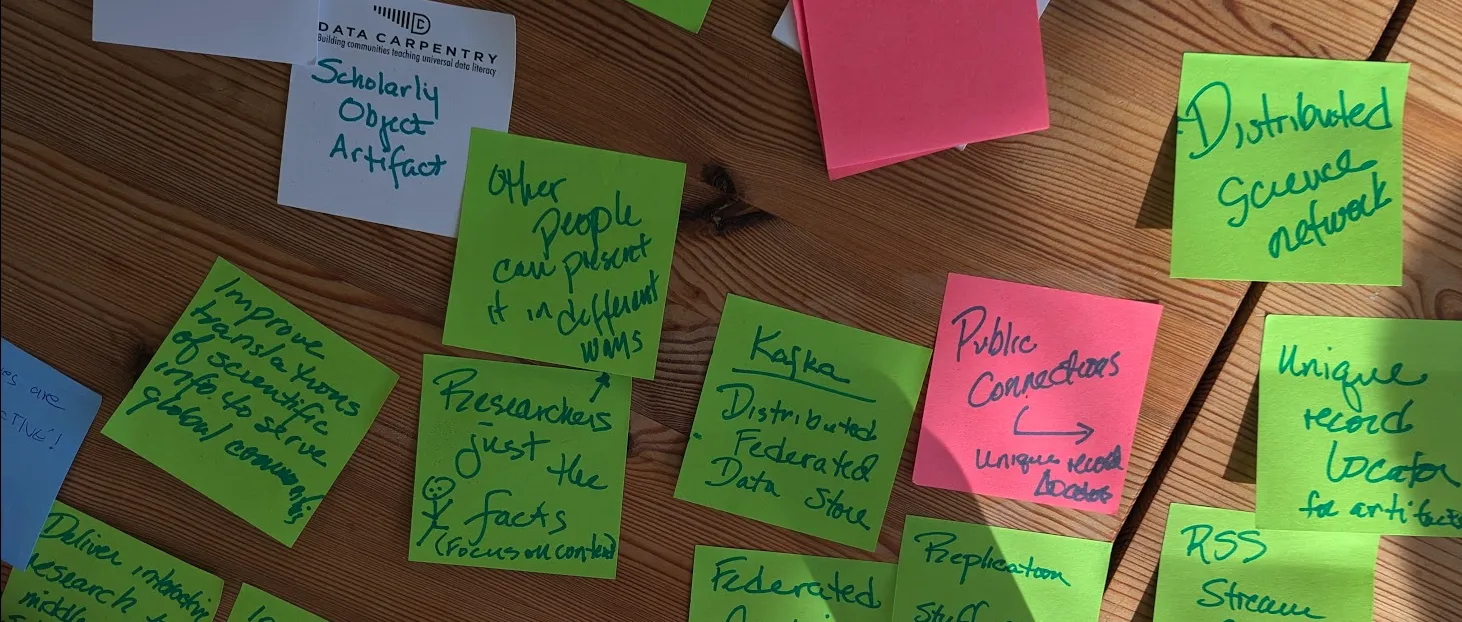
Open Exchange Architecture
A specification for representing scientific documents and their components as structured objects.
A Categorical Unification for Multi-Model Data: Part I Categorical Model and Normal Forms
Modern database systems face a significant challenge in effectively handling the Variety of data. The primary objective of this paper is to establish a unified data model and theoretical framework for multi-model data management. To achieve this, we present a categorical framework to unify three types of structured or semi-structured data: relation, XML, and graph-structured data. Utilizing the language of category theory, our framework offers a sound formal abstraction for representing these diverse data types. We extend the Entity-Relationship (ER) diagram with enriched semantic constraints, incorporating categorical ingredients such as pullback, pushout and limit. Furthermore, we develop a categorical normal form theory which is applied to category data to reduce redundancy and facilitate data maintenance. Those normal forms are applicable to relation, XML and graph data simultaneously, thereby eliminating the need for ad-hoc, model-specific definitions as found in separated normal form theories before. Finally, we discuss the connections between this new normal form framework and Boyce-Codd normal form, fourth normal form, and XML normal form.

Linked Data is a Political Agenda
Relational foundations for functorial data migration | Proceedings of the 15th Symposium on Database Programming Languages
In this paper we present a simple database definition language: that of categories and functors. A database schema is a small category and an instance is a set-valued functor on it. We show that morphisms of schemas induce three ''data migration ...
You are Crossref - Crossref
Crossref runs open infrastructure to link research objects, entities, and actions—creating a lasting and reusable scholarly record that underpins open science. Together with our >25,000 members in 167 countries, we drive metadata exchange and support 2.1 billion monthly API queries, facilitating global research communication, for the benefit of society.

Vision and Reality of Hypertext and GUIs: 2.1.13 Microcosm @mprove
Microcosm (cf. 2.1.13) is a research project at the University of Southampton. Like Intermedia five years before, Microcosm is designed around the idea that material of diverse sources and formats should be tied together into one hypertext. To achieve this goal links have to be separated from the documents. They are stored and maintained in special link databases. In contrast to Intermedia, Microcosm plays the active role in gathering the necessary data out of the documents. For each topic it stores data on which documents contain information about it and also where inside the documents the information is located. This elaborated conception of links can be seen more as a kind of Memex’ trails than simple one-to-one links. Given this structure dynamic linking becomes possible. This means that links can be associated with generic text strings. Wherever this string shows up a link is placed automatically. This has the effect that documents that are imported for the first time into Microcosm can have links immediately.
This approach to a data commons could extend to so many typically shared things. For businesses to easily and authoritatively publish things like open hours or product catalogs, discographies, every kind of -ography... creative appmakers could do so much with all that

JB Hutch
Testing an idea that I've had for a while, but I think is even better suited for atproto Internet, meet plts.at
