


Plus: the physicality of data, the second coming of froyo, and the rise of "dopamine sites"
#764: It's been a year
Plus: phone poems, low-friction friends and the decline of online travel recs

#784: The absurdity of the apocalypse
Plus: repayment avoidance, the death of “hello,” and a Cinderella story for the algorithmic era

#760: Gambling the future into existence
Plus: Cosmo for conservatives, AI;DR and being "agentic"

#785: Phoning home
Plus: Synthetic content, crashing for clicks and participatory vicarious nostalgia
#783: The end of spoken conversation
Plus: Pandora Radio, birthday mania and the “perimenopause industrial complex”

#773: Regressing to the mean
Plus: slop wildlife, the post-American internet and AI for emotional labor
#769: Nothing you see online is true
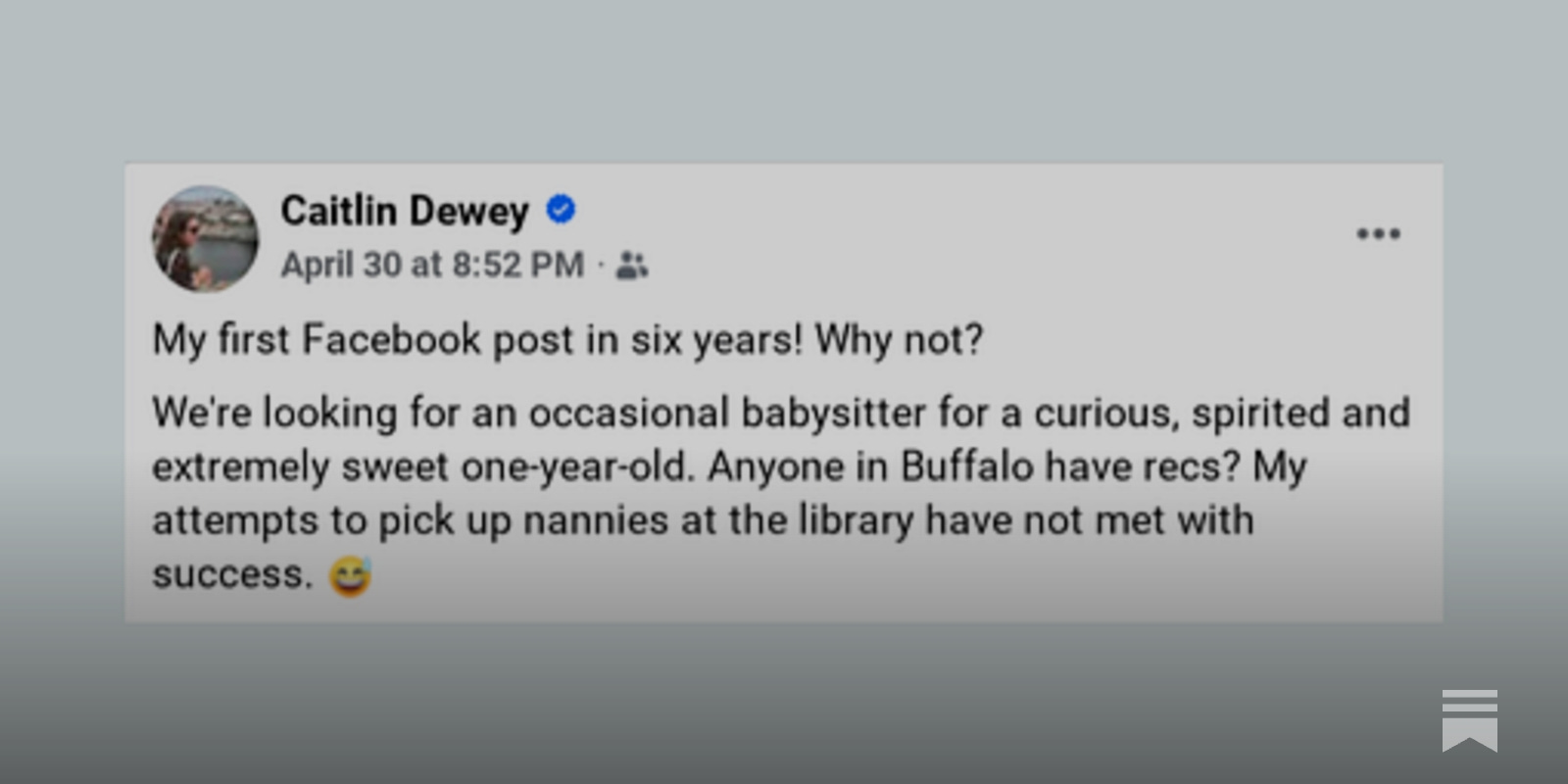
Clipping as emergent online literacy, the women self-injecting bootleg Botox and the woes of Facebook nanny groups
#766: An AI company you can wear without socks
Plus: Wedding Brain, news hustlers, the importance of talking to strangers and the best restaurant bread in America
Dec 2020 -- Jelle Bruineberg -- Embodied cognition and the attention crisis
Everything is miscellaneous : the power of the new digital disorder
Includes bibliographical references (p. [235]-257) and index; Prologue : information in space -- The new order of order -- Alphabetization and its discontents -- The geography of knowledge -- Lumps and splits -- The laws of the jungle -- Smart leaves -- Social knowing -- What nothing says -- Messiness as a virtue -- The work of knowledge -- Coda : misc; Philosopher Weinberger shows how the digital revolution is radically changing the way we make sense of our lives. Human beings constantly collect, label, and organize data--but today, the shift from the physical to the digital is mixing, burning, and ripping our lives apart. In the past, everything had its one place--the physical world demanded it--but now everything has its places: multiple categories, multiple shelves. Everything is suddenly miscellaneous. Weinberger charts the new principles of digital order that are remaking business, education, politics, science, and culture. He examines how Rand McNally decides what information not to include in a physical map (and why Google Earth is winning that battle), how Staples stores emulate online shopping to increase sales, why your children's teachers will stop having them memorize facts, and how the shift to digital music stands as the model for the future.--From publisher description; From A to Z, Everything Is Miscellaneous will completely reshape the way you think - and what you know - about the world. Includes information on alphabetical order, Amaxon.com, animals, Aristotle, authority, Bettmann Archive, blogs (weblogs), books, broadcasting, British Broadcasting Corporation (BBC), business, card catalog, categories and categorization, clusters, companies, Colon Classification, conversation, Melvil Dewey, Dewey Decimal Classification system, Encyclopaedia Britannica, encyclopedia, essentialism, experts, faceted classification system, first order of order, Flickr.com, Google, Great Books of the Western World, ancient Greeks, health and medical information, identifiers, index, inventory tracking, knowledge, labels, leaf and leaves, libraries, Library of Congress, links, Carolus Linnaeus, lumping and splitting, maps and mapping, marketing, meaning, metadata, multiple listing services (MLS), names of people, neutrality or neutral point of view, New York Public Library, Online Computer Library Center (OCLC), order and organization, people, physical space, everything having place, Plato, race, S.R. Ranganathan, Eleanor Rosch, Joshua Schacter, science, second order of order, simplicity, social constructivism, social knowledge, social networks, sorting, species, standardization, tags, taxonomies, third order of roder, topical categorization, tree, Uniform Product Code (UPC), users, Jimmy Wales, web, Wikipedia, etc

The hidden ‘rules of the game’ that dictate how we navigate the world | Psyche Videos
How free are we really, if human behaviour embodies the complex, intertwined webs of society and history?

#782: I saw this and I thought of you
Plus: Group chats, unsent love letters and optimization
Emergence: the connected lives of ants, brains, cities and software
In the tradition of Being Digital and The Tipping Point…

Had to put some thoughts to digital paper on my recent journey.

The Power of a Well Built Community
mihaizaurus.leaflet.pub