


Words are combined into phrases and sentences in a dazzling array of patterns, collectively referred to as syntax. The complexity of syntax has long confounded researchers. Consider, for example, t…
The evolution of syntactic communication
Animal communication is typically non-syntactic, which means that signals refer to whole situations1,2,3,4,5,6,7. Human language is syntactic, and signals consist of discrete components that have their own meaning8. Syntax is a prerequisite for taking advantage of combinatorics, that is, “making infinite use of finite means”9,10,11. The vast expressive power of human language would be impossible without syntax, and the transition from non-syntactic to syntactic communication was an essential step in the evolution of human language12,13,14,15,16. We aim to understand the evolutionary dynamics of this transition and to analyse how natural selection can guide it. Here we present a model for the population dynamics of language evolution, define the basic reproductive ratio of words and calculate the maximum size of a lexicon. Syntax allows larger repertoires and the possibility to formulate messages that have not been learned beforehand. Nevertheless, according to our model natural selection can only favour the emergence of syntax if the number of required signals exceeds a threshold value. This result might explain why only humans evolved syntactic communication and hence complex language.

How linguistics learned to stop worrying and love the language models
Language models (LMs) can produce fluent, grammatical text. Nonetheless, some maintain that language models don’t really learn language and also, even if they did, that would not be informative for the study of human learning and processing. On the other side, there have been claims that the success of LMs obviates the need for studying linguistic theory and structure. We argue that both extremes are wrong. LMs can contribute to fundamental questions about linguistic structure, language processing, and learning. They force us to rethink arguments and ways of thinking that have been foundational in linguistics. While they do not replace linguistic structure and theory, they serve as model systems and working proofs of concept for gradient, usage-based approaches to language. We offer an optimistic take on the relationship between language models and linguistics.
Understanding Understanding: A Pragmatic Framework Motivated by...
Motivated by the rapid ascent of Large Language Models (LLMs) and debates about the extent to which they possess human-level qualities, we propose a framework for testing whether any agent (be it...

The Philosophy of Language Models
ABSTRACT The success of large language models (LLMs) across many domains of AI research has generated intense debate. Some attribute their impressive performance on complex tasks to human‐like linguistic and cognitive capacities, whereas others ascribe it to shallow pattern matching. These disputes stem from deep‐seated philosophical disagreements about the nature of language and cognition. We provide an opinionated survey of these disagreements across core topics in the philosophy of mind and language, including syntactic competence, compositionality, linguistic meaning, representation, attitudes, reasoning, agency, and consciousness. We contend that progress on these issues requires not only clarity about background philosophical commitments but also, in many cases, close engagement with emerging empirical evidence.

Tracing the thoughts of a large language model
Anthropic's latest interpretability research: a new microscope to understand Claude's internal mechanisms

The Triadic Mind: How Language Reveals the Limits of Human Cognition
Languages are the most complex symbolic systems humans have ever created. Yet children acquire them effortlessly, without formal…

Human Intelligence, the Secret of Artificial Intelligence
Artificial intelligence is mysterious: we speak to it and it seems to understand what we say. Proof that it understands is that it responds with text or speech that makes sense, and sometimes more …

Do LLMs write like humans? Variation in grammatical and rhetorical styles
As large language models (LLMs) have grown in power and become more widely available, research has focused on their ability to complete various tasks and the biases they exhibit when doing so. In this study, we instead examine their writing style in detail. We show that instruction-tuned models, which are trained to answer questions and solve problems, have a distinct noun-heavy, informationally dense writing style, even when prompted to match the style of informal speech and writing. These findings suggest that instruction-tuned models generate text that does not align with genre conventions familiar to human audiences, and demonstrate the value of linguistic variables in evaluating the output of LLMs., Large language models (LLMs) are capable of writing grammatical text that follows instructions, answers questions, and solves problems. As they have advanced, it has become difficult to distinguish their output from human-written text. While past research has found some differences in features such as word choice and punctuation and developed classifiers to detect LLM output, none has studied the rhetorical styles of LLMs. Using several variants of Llama 3 and GPT-4o, we construct two parallel corpora of human- and LLM-written texts from common prompts. Using Douglas Biber’s set of lexical, grammatical, and rhetorical features, we identify systematic differences between LLMs and humans and between different LLMs. These differences persist when moving from smaller models to larger ones and are larger for instruction-tuned models than base models. This observation of differences demonstrates that despite their advanced abilities, LLMs struggle to match human stylistic variation. Attention to more advanced linguistic features can hence detect patterns in their behavior not previously recognized.


Slim Lim: "Concrete syntax matters, actually"
Abeba Birhane on Twitter / X
a classic case of “the human mind is afforded less complexity than is owed, and the computer is afforded more wisdom than is due.” Baria and Cross (2021)that "vibe" is at the core of what makes us human. it defies formalization and datafication https://t.co/AXELAqlYcq— Abeba Birhane (@Abebab) February 17, 2024
The interactive-alignment model: Developments and refinements
The interactive-alignment model of dialogue provides an account of dialogue at the level of explanation normally associated with cognitive psychology. We develop our claim that interlocutors align their mental models via priming at many levels of linguistic representation, explicate our notion of automaticity, defend the minimal role of “other modeling,” and discuss the relationship between monologue and dialogue. The account can be applied to social and developmental psychology, and would benefit from computational modeling.
The link between language and cognition is a red herring | Aeon Ideas
Humans alone have language, but many animals clearly have consciousness. Are parallels between the two a red herring?
Welcome | Yale Grammatical Diversity Project: English in North America
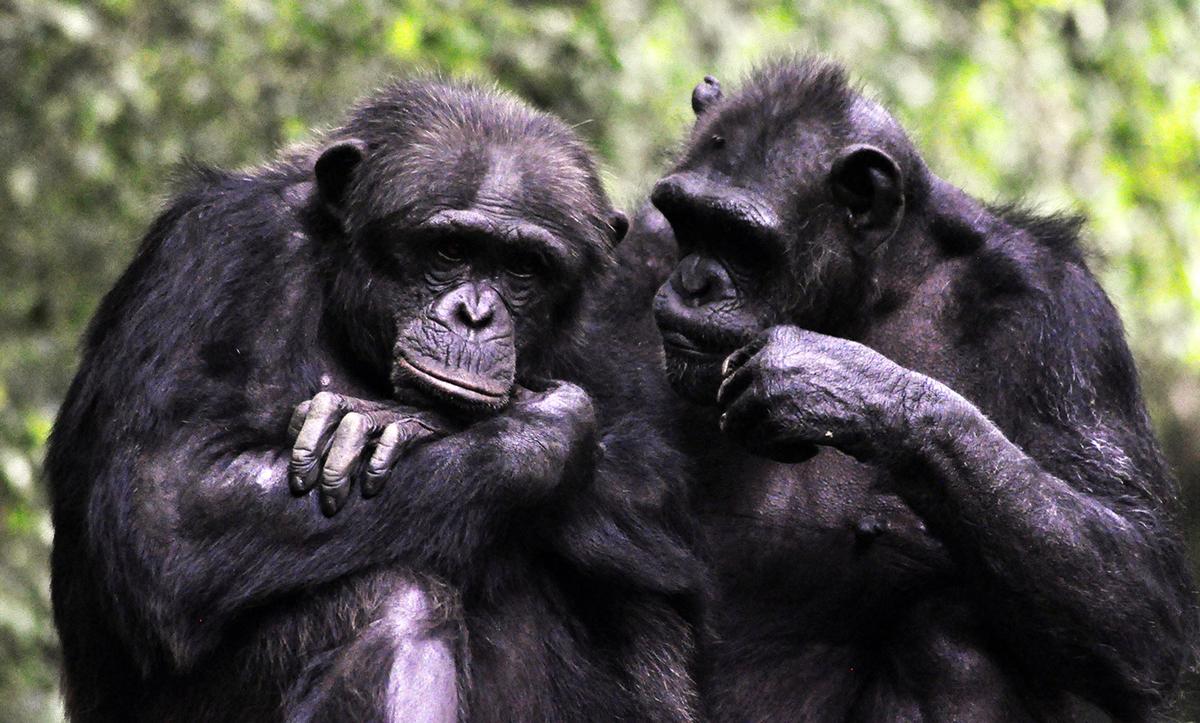
This Project explores syntactic diversity found in varieties of English spoken in North America. By documenting the subtle, but systematic, differences in the syntax of English varieties, it provides a crucial source of data for the development of theories of human linguistic knowledge.
Sense-making reconsidered: large language models and the blind spot of embodied cognition
Large Language Models (LLMs) demonstrate a kind of linguistic competence that theories of embodied and enactive cognition have long deemed impossible for systems lacking the meaningful perspective of a living being, i.e., the capacity for sense-making. Facing up to this unexpected technological development requires confronting what I propose to call the “AI dilemma”: either frontier LLMs are capable of sense-making despite lacking biological embodiment, or the kind of linguistic competence they exhibit does not necessarily require sense-making. In their chapter on cognition, Frank, Thompson, and Gleiser (2024) maintain that no AI system comes close to realizing relevance, a position that derives much of its motivation from past practical failures. However, frontier LLMs have effectively overcome Dreyfus’ commonsense knowledge problem, such that their dismissal as categorically mindless risks undermining Frank et al.’s central claim that human cognition is deeply intertwined with lived experience. I therefore argue in favor of the alternative side of the AI dilemma: human-level linguistic competence of LLMs should be recognized as a novel non‑biological form of sense‑making, based on a technologically‑mediated embodiment whose enabling properties are in need of further theoretical analysis. This reorientation invites enactive theory to clarify which aspects of sense-making may be universal and which aspects are specifically contingent on organic life, thereby advancing its conceptual framework in dialogue with contemporary AI.
Verbalizable Representations Form a Global Workspace in Language Models
If the mind is an ocean, we spend our lives floating at the surface. Beneath us, an enormous amount of processing takes place without our knowledge: our visual systems parsing the contours of a face, our motor circuits maintaining our posture. At any given moment, only a small fraction of this neural activity is accessible to us. Yet it is this privileged sliver of activity that we rely on to reason deliberately: to plan what ingredients to buy for a recipe, or to puzzle out why an engine won’t start. Such thoughts can be articulated out loud, deliberately held in mind, and brought to bear on whatever task the moment demands. This distinction, between our accessible thoughts and our unconscious processing, is perhaps the most striking feature of human cognition.