

Retrieval Augmented Generation (RAG) is a simple yet powerful approach that can be used to improve the performance of LLMs on a wide range of tasks.
Retrieval augmented generation: Keeping LLMs relevant and current - Stack Overflow
Retrieval augmented generation (RAG) is a strategy that helps address both LLM hallucinations and out-of-date training data.
RAG Techniques: A Community-Driven Collection of Retrieval-Augmented Generation Methods
This repository showcases various advanced techniques for Retrieval-Augmented Generation (RAG) systems. Each technique has a detailed notebook tutorial.
RAG Is Not Agent Memory
Although RAG provides a way to connect LLMs and agents to more data than what can fit into context, traditional RAG is insufficient for building agent memory.

Improve RAG for Your LLM Knowledge using InfraNodus and Open-WebUI, Dify, or ChatGPT
RAG, or Retrieval-Augmented Generation, is used to add additional context to AI user queries. However, one of its main problems is that it doesn't have an overview of the whole context. This is...
Faster Retrieval for Better, More Efficient RAG
Maximum inner product search (MIPS) sits at the core of recommendation systems, search, and retrieval-augmented generation (RAG). Given a…

Karpathy shares 'LLM Knowledge Base' architecture that bypasses RAG with an evolving markdown library maintained by AI
Karpathy proposes something simpler and more loosely, messily elegant than the typical enterprise solution of a vector database and RAG pipeline.

Let's build a RAG app using MetaAI's Llama-3 (100% local):
Let's build a RAG app using MetaAI's Llama-3 (100% local):— Akshay 🚀 (@akshay_pachaar) April 19, 2024
Shlok Khemani on Twitter / X
It's telling that neither ChatGPT nor Claude uses RAG for their memory systems, despite having:- the most data (oldest services, highest usage, general purpose)- strong incentives for memory (user lock-in)- A+ talent and alpha on model trajectoriesMaybe RAG just doesn't…— Shlok Khemani (@shloked) September 15, 2025
Instant LLM Updates with Doc-to-LoRA and Text-to-LoRA
Recent LLM agents have shown impressive capabilities on complex computer use and long-horizon tasks. Yet, they still struggle with long-term memory and adaptation--two of the most important cognitive capabilities that still limit LLMs today. Without long-term memory, users have to provide LLMs with relevant content at the start of every new session, creating friction, discontinuity, and longer time-to-response. Additionally, due to the lack of adaptation, they do not learn from mistakes or user preferences from previous sessions, making each interaction as cumbersome as the first. Traditionally, these two problems are tackled by "updating" the model.
Injecting Knowledge Graphs in different RAG stages
Injecting KGs in RAG in pre-processing, post-processing, chunk extraction, document and contextual hierarchies, with a concrete example.

Retrieval as Reasoning: Self-Evolving Agent-Native Retrieval via LLM-Wiki
LLM agents require retrieval to behave less like one-shot context fetching and more like reasoning: searching, reading, traversing, and deciding when evidence is sufficient. Yet current Retrieval-Augmented Generation (RAG) systems organize external knowledge as flat chunks retrieved by embedding similarity, exposing a retrieval-as-lookup interface ill-suited to iterative reasoning agents. We propose LLM-Wiki, an agent-native retrieval system that operationalizes the Retrieval-as-Reasoning paradigm by treating external knowledge as a compilable, composable, and self-evolving structure rather than a static retrieval index. LLM-Wiki compiles documents into structured Wiki pages with bidirectional links, exposes search, read, and link-following operations through standard tool-calling interfaces, and introduces an Error Book for persistent structural and semantic self-correction. LLM-Wiki achieves state-of-the-art results on HotpotQA, MuSiQue, and 2WikiMultiHopQA, outperforming HippoRAG 2, LightRAG, and GraphRAG by 2.0-8.1 F1 points. On AuthTrace, LLM-Wiki achieves the best overall accuracy, with especially strong gains on multi-document structured queries, confirming that compilation-based retrieval generalizes beyond chain-style multi-hop reasoning.

Solving a Million-Step LLM Task with Zero Errors
LLMs have achieved remarkable breakthroughs in reasoning, insights, and tool use, but chaining these abilities into extended processes at the scale of those routinely executed by humans,...
MemOS: An Operating System for Memory-Augmented Generation (MAG) in Large Language Models
Large Language Models (LLMs) have emerged as foundational infrastructure in the pursuit of Artificial General Intelligence (AGI). Despite their remarkable capabilities in language perception and generation, current LLMs fundamentally lack a unified and structured architecture for handling memory. They primarily rely on parametric memory (knowledge encoded in model weights) and ephemeral activation memory (context-limited runtime states). While emerging methods like Retrieval-Augmented Generation (RAG) incorporate plaintext memory, they lack lifecycle management and multi-modal integration, limiting their capacity for long-term knowledge evolution. To address this, we introduce MemOS, a memory operating system designed for LLMs that, for the first time, elevates memory to a first-class operational resource. It builds unified mechanisms for representation, organization, and governance across three core memory types: parametric, activation, and plaintext. At its core is the MemCube, a standardized memory abstraction that enables tracking, fusion, and migration of heterogeneous memory, while offering structured, traceable access across tasks and contexts. MemOS establishes a memory-centric execution framework with strong controllability, adaptability, and evolvability. It fills a critical gap in current LLM infrastructure and lays the groundwork for continual adaptation, personalized intelligence, and cross-platform coordination in next-generation intelligent systems.
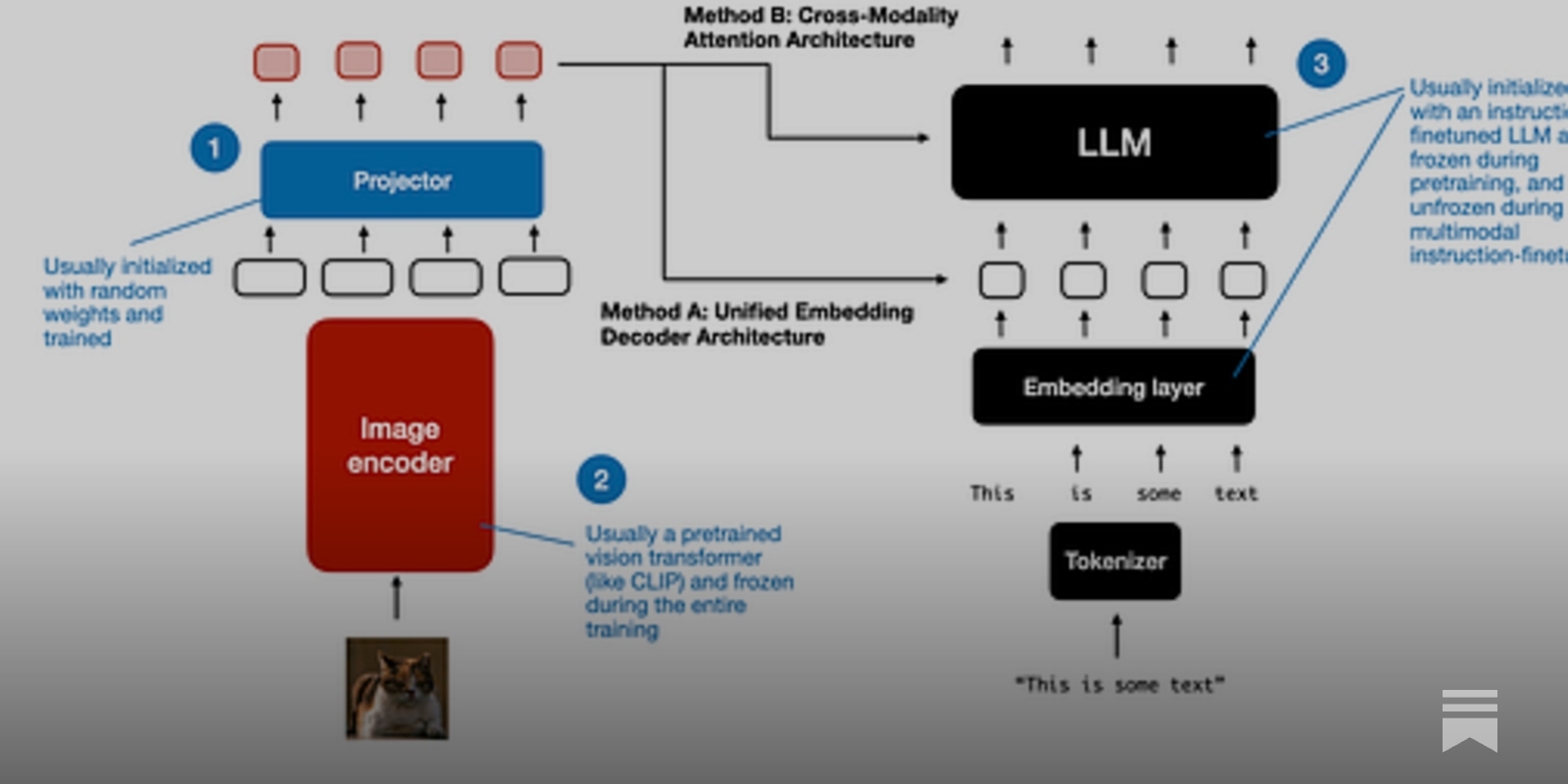
Understanding Multimodal LLMs
An introduction to the main techniques and latest models
i can’t help but think we’re far from nailing memory systems this one here is extremely interesting. two LLMs at once, one just managing and surfacing memory for the other

Asa ⭔
I'm not a fan of the decoupled 'memory retrieval → task execution' loop, so my agent has a subconscious background thread that looks for relevant, unique memory context in its experiential database while it runs and injects it on top of the live context window.

