

The shape of open source
At its core, open source is about collaboration. Whether it’s version control, licenses, or issue trackers—everything exists to support people working with each other. Open source embodies a model for…

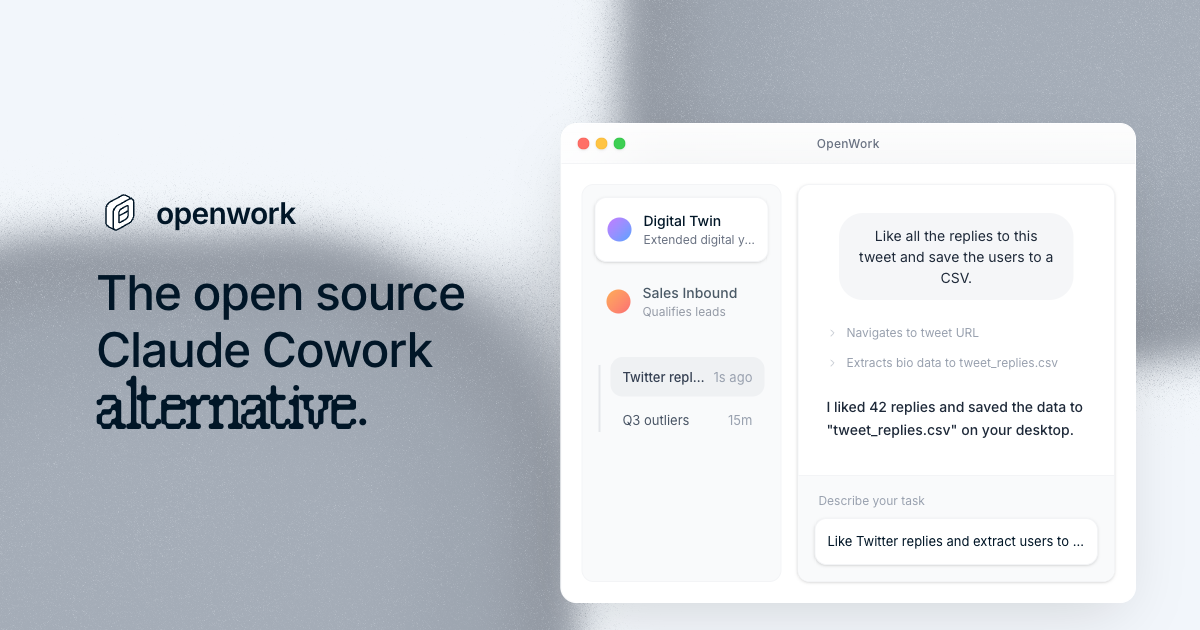
OpenWork — Open source Claude Cowork alternative for teams
Bring your own model and provider, wire in your tools and context, and ship reusable agent setups across your org — with guardrails built in.
From OSS to Open Source AI: an Exploratory Study of Collaborative...
AI development is embracing open-source paradigm, but the fundamental distinction between AI models and traditional software artifacts may lead to a divergent open-source development paradigm with...

Local-first Software
Exploring software architecture that returns data to users and enables collaboration in every tool.
Working in Public: The Making and Maintenance of Open S…
An inside look at modern open source software developer…

Delta | A Multiplayer Environment for Coding with Agents
Build and review software with teammates and agents in shared threads, with every conversation and code change kept in context.

Nibble Stew: The Nine Phases of an Open Source Project Maintainer
There is more to running an open source project than writing code. In fact most of all work has to do with something else. This places addit...
Embrace Open Source, For the Good of Nerdmanity | Fortune
More businesses are willing to use open source software for key projects.

Cline - AI Coding, Open Source and Uncompromised
Open-source AI coding agent with Plan/Act modes, MCP integration, and terminal-first workflows. Trusted by 5M+ developers worldwide.
truefoundry/trueforge
The open-source agent harness - the runtime layer that turns an LLM into a working agent.
User & Agents - Open Collective
User & Agents is a community focused on increasing user agency in the software we use every day.

Inside OpenAI’s agentic software factory
A deepdive into how Codex has “taken over” OpenAI, how the frontier lab builds its agentic software factory, and the engineering challenges of one billion users. Details from inside OpenAI
Dive into Claude Code: The Design Space of Today's and Future AI Agent Systems
Claude Code is an agentic coding tool that can run shell commands, edit files, and call external services on behalf of the user. This study describes its comprehensive architecture by analyzing the publicly available TypeScript source code and further comparing it with OpenClaw, an independent open-source AI agent system that answers many of the same design questions from a different deployment context. Our analysis identifies five human values, philosophies, and needs that motivate the architecture (human decision authority, safety and security, reliable execution, capability amplification, and contextual adaptability) and traces them through thirteen design principles to specific implementation choices. The core of the system is a simple while-loop that calls the model, runs tools, and repeats. Most of the code, however, lives in the systems around this loop: a permission system with seven modes and an ML-based classifier, a five-layer compaction pipeline for context management, four extensibility mechanisms (MCP, plugins, skills, and hooks), a subagent delegation mechanism with worktree isolation, and append-oriented session storage. A comparison with OpenClaw, a multi-channel personal assistant gateway, shows that the same recurring design questions produce different architectural answers when the deployment context changes: from per-action safety classification to perimeter-level access control, from a single CLI loop to an embedded runtime within a gateway control plane, and from context-window extensions to gateway-wide capability registration. We finally identify six open design directions for future agent systems, grounded in recent empirical, architectural, and policy literature.
Decision-making software for groups and organizations
Make important decisions together without endless meetings. Loomio keeps discussion, voting, outcomes, and the reasoning behind them in one clear place.

Lody helps teams understand the context behind software decisions. We are moving Lody toward local-first, with the goal of making that context durable, portable, and ultimately controlled by the team