

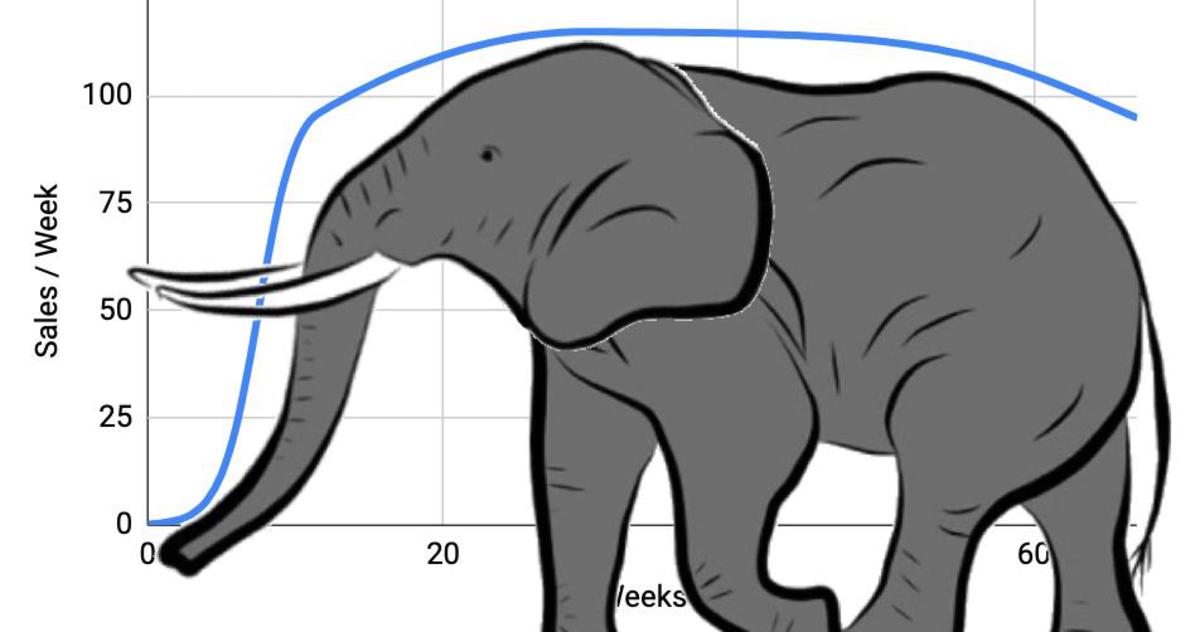
Even Facebook and Slack did not grow "exponentially," as frequently described. Here is the correct model that you can use to understand and affect growth.
Exponential Growth Arithmetic, Population and Energy, Dr. Albert A. Bartlett
reality is exponential · cory.news
I’ve always loved the juxtaposition of linear and exponential growth.

AMP IT UP: Leading for Hypergrowth by Raising Expectations, Increasing Urgency, and Elevating Intensity
Exponential growth is a critical goal for today's emerging ventures. And while such growth can feel elusive, game-changing transformation is within our
Enough
This guy never had enough, is that really you?The underpinning tenet of chasing exponential growth is that anything less than “all of it” is never enough. If there’s more possible, more out there, …

Dopplersky - Bluesky Analytics & Growth Tracking
Track your Bluesky growth with powerful analytics. Get instant insights on followers, engagement, and trends.

Degrowth: The awakening of consciousness before an alternative
Degrowth fights for the construction of positive, healthy scenarios for future generations, respecting the environment and cultural diversity through a reorientation of economic activity that abandons unlimited individual growth for a social growth that is measured, such that others can simply live.

Degrowth can work — here’s how science can help
Wealthy countries can create prosperity while using less materials and energy if they abandon economic growth as an objective.

On technology and degrowth (notes on Hickel 2023)
Jason Hickel is one of the leading voices in the degrowth/postgrowth movement, and recently laid out his thoughts on the relationship between degrowth and technology. He raises a number of importan…

Post-Growth - P2P Foundation
"The term postgrowth defines a range of approaches to socioecological challenges. They address these challenges in ways that are diametrically opposed to green-growth, which expresses the belief that society can simultaneously expand economic activity and reduce emissions and the demand for materials. Postgrowth approaches, by contrast, argue that the unlimited expansion of production and consumption is impossible and undesirable on a finite planet.
Growth Hacking Made Simple: Definition
Learn how big brands like Spotify and Facebook use growth hacking to increase their influence and user base in this ultimate guide.

Capitalism and the Death Drive
What we call growth today is in fact a tumorous growth,…

If you want to grow on X, try using ChatGPT to analyze your X account. Here's a tutorial on how to do it in 5 simple steps:
If you want to grow on X, try using ChatGPT to analyze your X account.Here's a tutorial on how to do it in 5 simple steps: pic.twitter.com/r7PeQBl76l— The Rundown AI (@TheRundownAI) December 10, 2023

Uneconomic growth
Uneconomic growth is economic growth that reflects or creates a decline in the quality of life. The concept is used in human development theory, welfare theory, and ecological economics. It is usually attributed to ecological economist Herman Daly, though other theorists may also be credited for the incipient idea, According to Daly, "uneconomic growth occurs when increases in production come at an expense in resources and well-being that is worth more than the items made." The cost, or decline in well-being, associated with extended economic growth is argued to arise as a result of "the social and environmental sacrifices made necessary by that growing encroachment on the eco-system."

How Bluesky, Alternative to X and Facebook, Is Handling Explosive Growth (Published 2024)
The fledgling social media site has been flooded with new users since the election. It hasn’t all been easy.

Exponential Growth Bias and Household Finance
ABSTRACT Exponential growth bias is the pervasive tendency to linearize exponential functions when assessing them intuitively. We show that exponential growth bias can explain two stylized facts in household finance: the tendency to underestimate an interest rate given other loan terms, and the tendency to underestimate a future value given other investment terms. Bias matters empirically: More‐biased households borrow more, save less, favor shorter maturities, and use and benefit more from financial advice, conditional on a rich set of household characteristics. There is little evidence that our measure of exponential growth bias merely proxies for broader financial sophistication.
