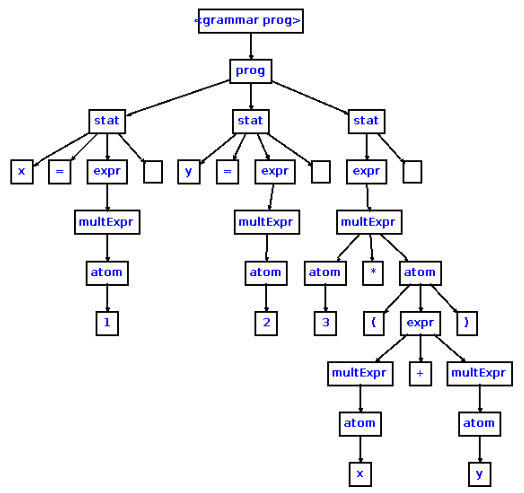
You already know that a + b * c + d is calculated as a + (b * c) + d. But how do you encode that knowledge precisely enough for a machine to act on it?
Prologue: How to Program
Naturally, when DrRacket calculates for you, it uses the rules that you know and love from math. Like you, it can determine the result of an addition only when all the operands are plain numbers. If an operand is a parenthesized operator expression—something that starts with a “(” and an operation—it determines the result of that nested expression first. Unlike you, it never needs to ponder which expression to calculate first—because this first rule is the only rule there is.
Why Can't Transformers Learn Multiplication?...
Language models are increasingly capable, yet still fail at a seemingly simple task of multi-digit multiplication. In this work, we study why, by reverse-engineering a model that successfully...

Why Can't Transformers Learn Multiplication?...
Language models are increasingly capable, yet still fail at a seemingly simple task of multi-digit multiplication. In this work, we study why, by reverse-engineering a model that successfully...
Grade 3 » Operations & Algebraic Thinking » Represent and solve problems involving multiplication and division. » 1 | Common Core State Standards Initiative
Interpret products of whole numbers, e.g., interpret 5 × 7 as the total number of objects in 5 groups of 7 objects each. For example, describe a context in which a total number of objects can be expressed as 5 × 7.
Why can’t powerful AIs learn basic multiplication?
New research reveals why even state-of-the-art large language models stumble on seemingly easy tasks—and what it takes to fix it

Why Can’t Powerful LLMs Learn Multiplication?
These days, large language models (LLMs) can handle increasingly complex tasks, writing complex code and engaging in sophisticated reasoning. But when it comes to 4-digit multiplication, a task taught in elementary school, even state-of-the-art systems fail. Why? A new paper by Computer Science PhD student Xiaoyan Bai and Faculty Co-Director of the Data Science Institute’s …
Efficient and flexible incremental parsing | ACM Transactions on Programming Languages and Systems
Previously published algorithms for LR (k) incremental parsing are inefficient, unnecessarily restrictive, and in some cases incorrect. We present a simple algorithm based on parsing LR(k) sentential forms that can incrementally parse an arbitrary number ...

Simply Typed Reverse-Mode Automatic Differentiation with Variants: Denotational Correctness via Idempotent Completion
Reverse-mode automatic differentiation can be derived denotationally as a structure-preserving interpretation of program syntax. In the usual simply typed model, each source type has one cotangent type. Variants break this representation because the valid cotangent space depends on the branch selected at run time; established correctness results therefore use primal-indexed families of cotangent spaces, whose direct internal language is dependent.
Learnable Programming
Here's a trick question: How do we get people to understand programming?
p-code
Niklaus Wirth specified a simple p-code machine in the 1976 book Algorithms + Data Structures = Programs. The machine had 3 registers - a program counter p, a base register b, and a top-of-stack register t. There were 8 instructions:
Packrat parsing: | Proceedings of the seventh ACM SIGPLAN international conference on Functional programming
For decades we have been using Chomsky's generative system of grammars, particularly context-free grammars (CFGs) and regular expressions (REs), to express the syntax of programming languages and protocols. The power of generative grammars to express ...

Circuit Tracing: Revealing Computational Graphs in Language Models
We describe an approach to tracing the “step-by-step” computation involved when a model responds to a single prompt.

Calculating with lenses | Proceedings of the 20th ACM SIGPLAN workshop on Partial evaluation and program manipulation
Functional programs are particularly well suited to formal manipulation by equational reasoning. In particular, it is straightforward to use calculational methods for program transformation. Well-known transformation techniques, like tupling or the ...

AI Engineer Claims to Have Deciphered Linear A - GreekReporter.com
An AI engineer working outside academia says he has deciphered Linear A, a Bronze Age writing system from Minoan Crete.

</> htmx ~ Working With AI: A Concrete Example
In this essay, Carson Gross walks through a concrete bug fix in hyperscript to show where AI helped, where it fell short, and why keeping a knowledgeable human in the loop is what kept complexity in check.
Quantization from the ground up | ngrok blog
A complete guide to what quantization is, how it works, and how it's used to compress large language models