
Collaboration of Rufus Pollock with David Joseph to build tooling for structured thinking — specifically a Logical Thinking Process (LTP) / Issue Tree app. Both David and Rufus share a long-standing desire to improve public discourse and improve collaboration: aligning efforts to goals, making claims or hypotheses and their logical structure clearer (claim-trees), allowing debate to accumulate, mapping evidence clearly to specific sub-claims.
Reason Commons | Reason Commons — Issue Trees & Logical Thinking Process
Structure the thinking as trees — a tree of change, and a tree of action — with every claim and every step still connected to the goal it serves. Let ordinary discussion attach where it belongs, and let AI keep the tree current. The point is that our thinking should accumulate.
We argue badly, and nothing accumulates. How could we do better? | Reason Commons — Issue Trees & Logical Thinking Process
Millions of people argue every day about the things that matter most — climate change, what to do about AI, how we might build a better world. Some of it is sharp, even insightful. And almost none of it accumulates.
Page 4: POW+TREE Writing Strategy
As Ms. Lin reflects on the trouble her students are having with writing, she realizes that many of her students need help incorporating the four elements of the writing process (i.e., planning, organizing, writing, and editing and revising) into their essays. She concludes that they need a guide or strategy to follow as they write.[.....]
Tools for better thinking
Collection of thinking tools and frameworks to help you solve problems, make decisions and understand systems.
The Illusion of Thinking: Understanding the Strengths and Limitations of Reasoning Models via the Lens of Problem Complexity
Recent generations of frontier language models have introduced Large Reasoning Models (LRMs) that generate detailed thinking processes…

Design Sprints
A structured, time-boxed process for rapidly exploring problems, generating ideas, and validating solutions with real users.

Brian D. Earp, Ph.D. on Twitter / X
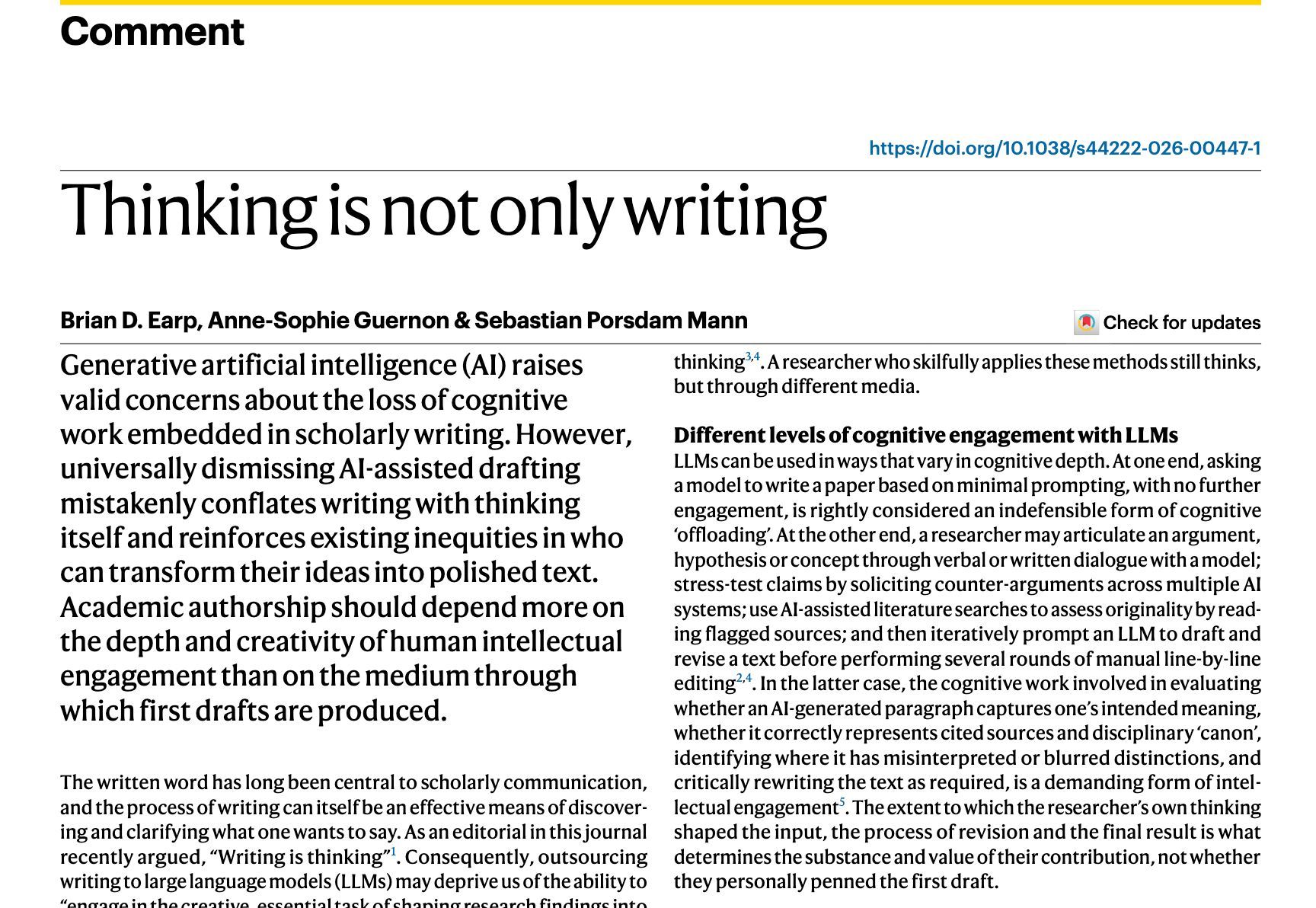
"Writing is thinking." This phrase went viral recently (from https://t.co/EQqohfhUMd), often quoted in the context of objections to use of AI in drafting academic prose. In Nature Reviews Bioengineering we respond: "Thinking is not only writing." Preview below. Shareable full… pic.twitter.com/cZtGdoSwqV— Brian D. Earp, Ph.D. (@briandavidearp) May 15, 2026
Thinking with Sand: A Talk Series Exploring New Software Tools for Creative Exploration and Augmented Thinking At the MIT Media Lab
Most arguments scatter across papers, posts, and threads — and evaporate. A claim tree gives them a stable structure to gather against, the way a cathedral gathers centuries of work into a single, standing thing.
Issue Trees, Hypothesis Trees and SCQA - the Minto Pyramid Principles
(PDF) Why is dialogical solving of a logical problem more effective than individual solving?: A formal and experimental study of an abstract version of Wason’s task
PDF | We study the accomplishment of the abstract version of Wason’s selection task in a cooperative dialogue context that has been neglected in the... | Find, read and cite all the research you need on ResearchGate

How to Research Tools for Thought
Logseq | The Paper Pilot
The Paper Pilot's digital garden of thoughts on philosophy, politics, and sociology
Co-creating with emergent processes ✦ Hijinx World
Existential musings over algorithmic design with creative programming legend Dan Tapper.

The Mind-Expanding Ideas of Andy Clark
The tools we use to help us think—from language to smartphones—may be part of thought itself.