


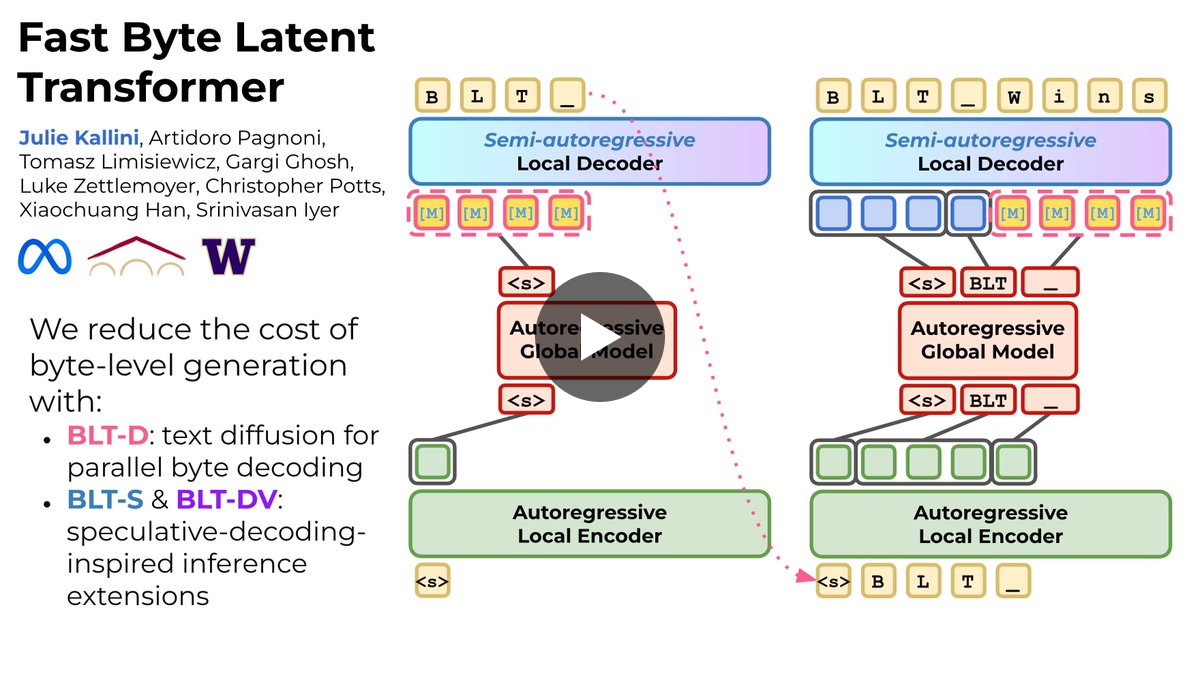
Highlights the desire to replace tokenization with a general method that better leverages compute and data. We'll see tokenization's fragility and review the Byte Latent Transformer arch.
Julie Kallini ✈️ ICML✨ on Twitter / X
Fast Byte Latent Transformer is accepted to ICML 2026! ⚡🥪Byte-level LMs promise to free us from subword tokenizers, but decoding one byte at a time is super slow.We make BLT generation more efficient with BLT-D: text diffusion for parallel byte decoding. 1/ pic.twitter.com/ZIvUgavXvt— Julie Kallini ✈️ ICML✨ (@JulieKallini) May 11, 2026
Tokenization Tax 2026: LLM Tokenizer Comparison | ellamind
A measurement study of 20 LLM tokenizers across 12 languages and 21 kinds of text. On German, Claude 4.7+ needs 2.01x the tokens of the OpenAI reference, and Cohere Command A+ the fewest.
Transformer (deep learning)
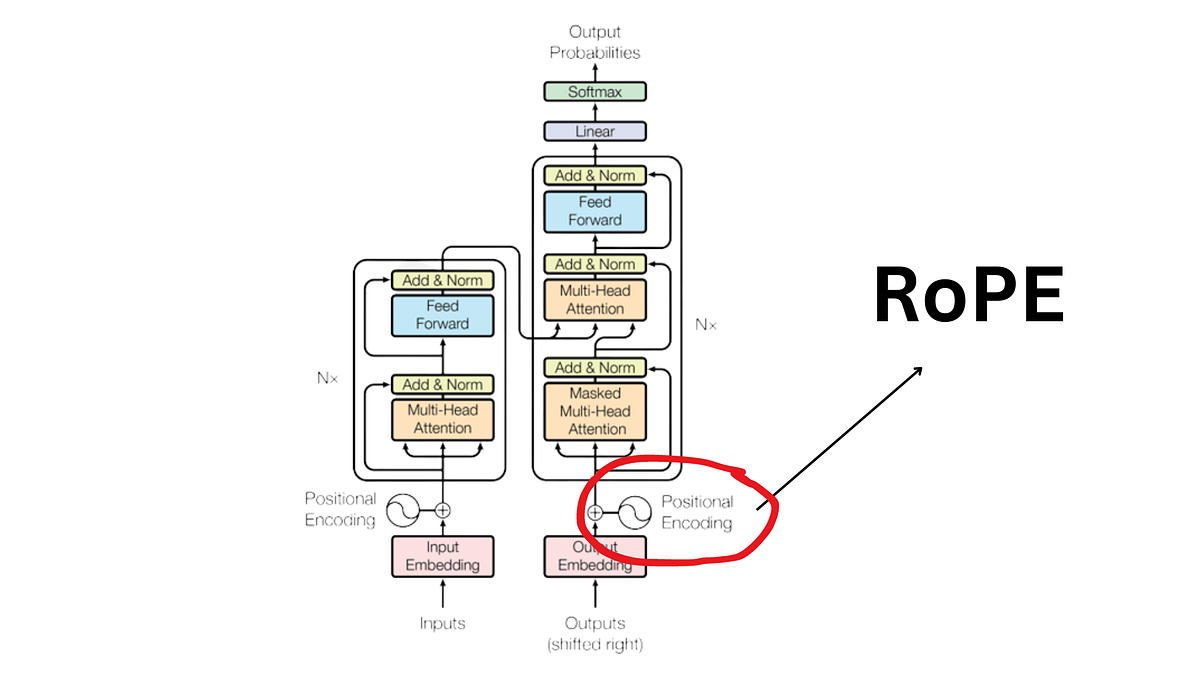
In deep learning, the transformer is a family of artificial neural network architectures based on the multi-head attention mechanism, in which text is converted to numerical representations called tokens, and each token is converted into a vector via lookup from a word embedding table. At each layer, each token is then contextualized within the scope of the context window with other (unmasked) tokens via a parallel multi-head attention mechanism, allowing the signal for key tokens to be amplified and less important tokens to be diminished. Because self-attention alone is permutation-invariant, transformers inject positional information, typically through positional encodings or learned positional embeddings, so token order can affect the output.

Rotary Positional Embeddings: A Detailed Look and Comprehensive Understanding
Since the “Attention Is All You Need” paper in 2017, the Transformer architecture has been a cornerstone in the realm of Natural Language…
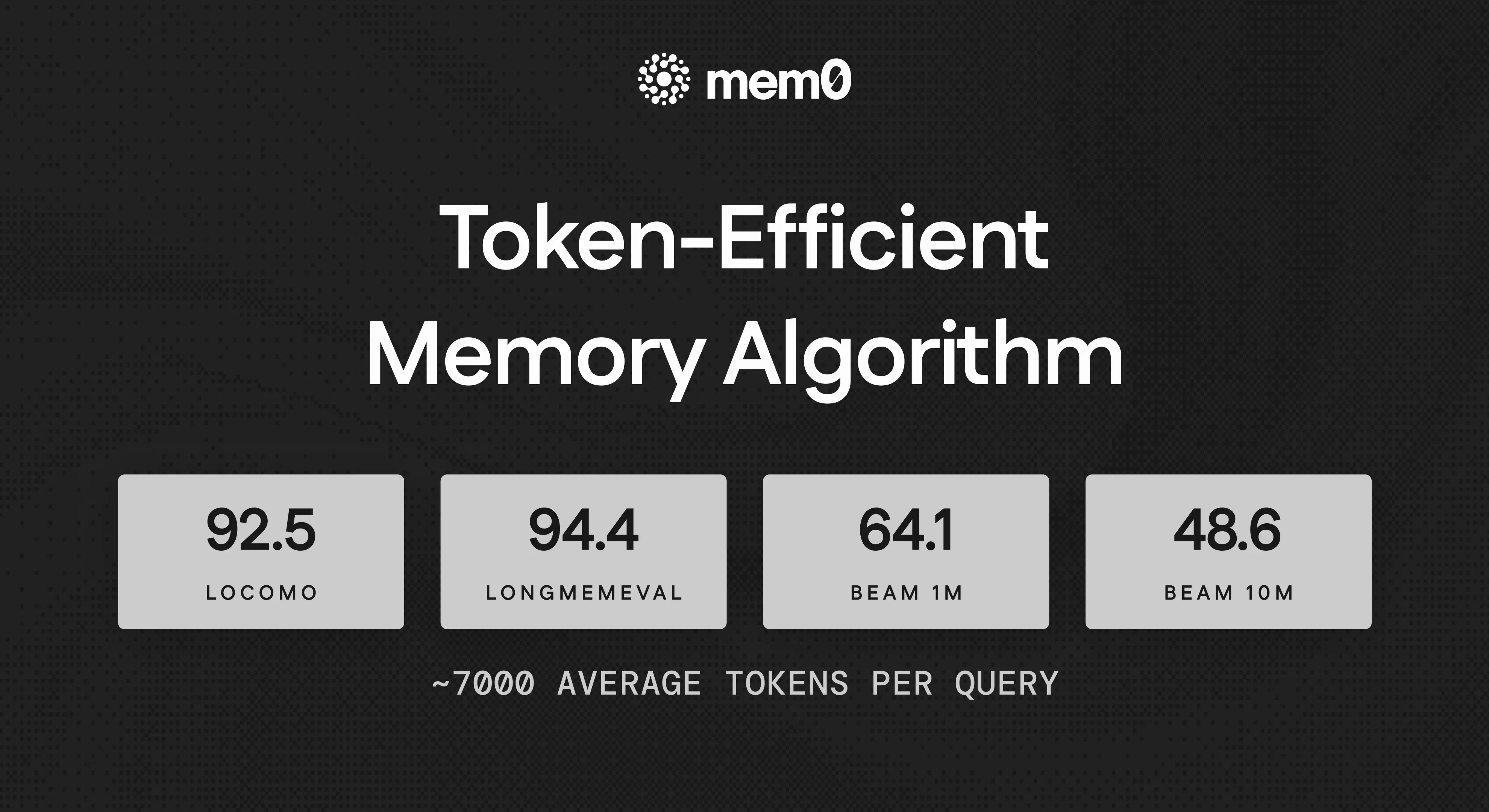
Mem0 Research Paper: Token-Efficient Memory Algorithm
Benchmarked across LoCoMo, LongMemEval, and BEAM, achieves competitive accuracy while using under 7,000 tokens per retrieval call. For comparison, full-context approaches on these benchmarks routinely consume 25,000+ tokens per query.
I Built an LLM From Scratch
The Illustrated Transformer
Discussions: Hacker News (65 points, 4 comments), Reddit r/MachineLearning (29 points, 3 comments) Translations: Arabic, Chinese (Simplified) 1, Chinese (Simplified) 2, French 1, French 2, Italian, Japanese, Korean, Persian, Russian, Spanish 1, Spanish 2, Vietnamese Watch: MIT’s Deep Learning State of the Art lecture referencing this post Featured in courses at Stanford, Harvard, MIT, Princeton, CMU and others Update: This post has now become a book! Check out LLM-book.com which contains (Chapter 3) an updated and expanded version of this post speaking about the latest Transformer models and how they've evolved in the seven years since the original Transformer (like Multi-Query Attention and RoPE Positional embeddings). In the previous post, we looked at Attention – a ubiquitous method in modern deep learning models. Attention is a concept that helped improve the performance of neural machine translation applications. In this post, we will look at The Transformer – a model that uses attention to boost the speed with which these models can be trained. The Transformer outperforms the Google Neural Machine Translation model in specific tasks. The biggest benefit, however, comes from how The Transformer lends itself to parallelization. It is in fact Google Cloud’s recommendation to use The Transformer as a reference model to use their Cloud TPU offering. So let’s try to break the model apart and look at how it functions. The Transformer was proposed in the paper Attention is All You Need. A TensorFlow implementation of it is available as a part of the Tensor2Tensor package. Harvard’s NLP group created a guide annotating the paper with PyTorch implementation. In this post, we will attempt to oversimplify things a bit and introduce the concepts one by one to hopefully make it easier to understand to people without in-depth knowledge of the subject matter. 2025 Update: We’ve built a free short course that brings the contents of this post up-to-date with animations: A High-Level Look Let’s begin by looking at the model as a single black box. In a machine translation application, it would take a sentence in one language, and output its translation in another.
Caveman | Lithic Token Compression
A semantic constraint engine for Claude Code & Codex. Forces agentic communication into minimal-token lithic structures. Retain 100% technical accuracy while destroying up to 87% of output latency.
Concise Binary Object Representation (CBOR)
The Concise Binary Object Representation (CBOR) is a data format whose design goals include the possibility of extremely small code size, fairly small message size, and extensibility without the need for version negotiation. These design goals make it different from earlier binary serializations such as ASN.1 and MessagePack. This document obsoletes RFC 7049, providing editorial improvements, new details, and errata fixes while keeping full compatibility with the interchange format of RFC 7049. It does not create a new version of the format.
Why Can't Transformers Learn Multiplication?...
Language models are increasingly capable, yet still fail at a seemingly simple task of multi-digit multiplication. In this work, we study why, by reverse-engineering a model that successfully...

Why Can't Transformers Learn Multiplication?...
Language models are increasingly capable, yet still fail at a seemingly simple task of multi-digit multiplication. In this work, we study why, by reverse-engineering a model that successfully...
Mixture-of-Recursions: Learning Dynamic Recursive Depths for Adaptive Token-Level Computation
Scaling language models unlocks impressive capabilities, but the accompanying computational and memory demands make both training and deployment expensive. Existing efficiency efforts typically target either parameter sharing or adaptive computation, leaving open the question of how to attain both simultaneously. We introduce Mixture-of-Recursions (MoR), a unified framework that combines the two axes of efficiency inside a single Recursive Transformer. MoR reuses a shared stack of layers across recursion steps to achieve parameter efficiency, while lightweight routers enable adaptive token-level thinking by dynamically assigning different recursion depths to individual tokens. This allows MoR to focus quadratic attention computation only among tokens still active at a given recursion depth, further improving memory access efficiency by selectively caching only their key-value pairs. Beyond these core mechanisms, we also propose a KV sharing variant that reuses KV pairs from the first recursion, specifically designed to further decrease memory footprint. Across model scales ranging from 135M to 1.7B parameters, MoR forms a new Pareto frontier: at equal training FLOPs and smaller model sizes, it significantly lowers validation perplexity and improves few-shot accuracy, while delivering higher throughput compared with vanilla and existing recursive baselines. These gains demonstrate that MoR is an effective path towards large-model quality without incurring large-model cost.
Your LLM Knows the Future: Uncovering Its Multi-Token Prediction Potential
Autoregressive language models are constrained by their inherently sequential nature, generating one token at a time. This paradigm limits inference speed and parallelism, especially during later stages of generation when the direction and semantics of text are relatively certain. In this work, we propose a novel framework that leverages the inherent knowledge of vanilla autoregressive language models about future tokens, combining techniques to realize this potential and enable simultaneous prediction of multiple subsequent tokens. Our approach introduces several key innovations: (1) a masked-input formulation where multiple future tokens are jointly predicted from a common prefix; (2) a gated LoRA formulation that preserves the original LLM's functionality, while equipping it for multi-token prediction; (3) a lightweight, learnable sampler module that generates coherent sequences from the predicted future tokens; (4) a set of auxiliary training losses, including a consistency loss, to enhance the coherence and accuracy of jointly generated tokens; and (5) a speculative generation strategy that expands tokens quadratically in the future while maintaining high fidelity. Our method achieves significant speedups through supervised fine-tuning on pretrained models. For example, it generates code and math nearly 5x faster, and improves general chat and knowledge tasks by almost 2.5x. These gains come without any loss in quality.
something that has come up fairly recently with LLMs - for coding, specifically - is that it’s become a lot easier to burn stupefying amounts of tokens on stuff very fast, with agents running 24/7 or managing more agents (see: Yegge’s Gas Town) even with low inference costs that adds up in a hurry

Jesse Felder
‘While some cling to the promise of an AI “revolution,” the cost of adoption is proving a stubborn bottleneck. These developments also suggest that the economics of replacing human labor with AI may be more complicated than some early forecasts originally implied.’ fortune.com/2026/05/22/microsoft-ai-cost-…
