

The recent innovations in the AI space, most notably those such as GPT-4, obviously have far-reaching implications for society, ranging from the utopian eliminating of drudgery, to the dystopian damage to the livelihood of artists in a capitalist society, to existential threats to humanity itself.
I Will Fucking Piledrive You If You Mention AI Again — Ludicity
The recent innovations in the AI space, most notably those such as GPT-4, obviously have far-reaching implications for society, ranging from the utopian eliminating of drudgery, to the dystopian damage to the livelihood of artists in a capitalist society, to existential threats to humanity itself.
AI FOR EPISTEMICS & COORDINATION
Civilization and technology have radically improved the human condition. Nonetheless, the world sometimes goes in directions which essentially nobody would prefer — e.g., nuclear arms races, unexpected financial crashes, predatory marketing, or ubiquitous political misinformation.
The Age of Wonders and Terrors
Twenty years ago, when the idea of AI taking over the world in our lifetimes still struck most of us as the unconstrained fantasy of those who knew too much science fiction and too little science, …

AI Science Fiction Versus Reality
3: Consulting the Record: AI Consistently Fails the Public - AI Now Institute
Amid the excitement over AI’s (speculative, hypothetical) potential, we have lost sight of the sobering reality of its present and recent past. AI is already intermediating critical social infrastructures, materially reshaping our institutions in ways that ratchet up inequality and concentrate power in the hands of the already powerful. It is consistently deployed in ways […]
When will average people feel AI’s impact?
We’re <5 years into a compounding revolution which could take a century, and how the AI industry should manage this.
The Scaling Era: An Oral History of AI, 2019–2025
An inside view of the AI revolution, from the people an…

‘I Don’t Think We’re All F***ed Anymore’
Kevin Roose’s new book explores the terrifying implications of AI, but he’s feeling a bit more sanguine these days.
Gradual disempowerment | 80,000 Hours
The proliferation of advanced AI systems may lead to the gradual disempowerment of humanity, even if efforts to prevent them from becoming power-seeking or scheming are successful. Humanity may be incentivised to hand over increasing amounts of control to AIs, giving them power over the economy, politics, culture, and more. Over time, humanity's interests may be sidelined and our control over the future undermined, potentially constituting an existential catastrophe. There's disagreement over how serious a problem this is and how it relates to [other concerns about AI alignment](https://80000hours.o

AI as Social Technology
Our debates about ‘AI’ grow out of 1990s science fiction. Back then, Vinge (1993) wrote essays and novels urging us to face up to the oncoming “Singularity”: a moment of rapid change that would fundamentally transform the human condition. On that day, AI would rapidly evolve from merely human-level intelligence, what some now call ‘artificial general intelligence’ (AGI), into something super-intelligent with its own interests and goals. Humanity would then either be casually eliminated by out-of-control machines, or humans would become as gods, with super-human servitors at our command.
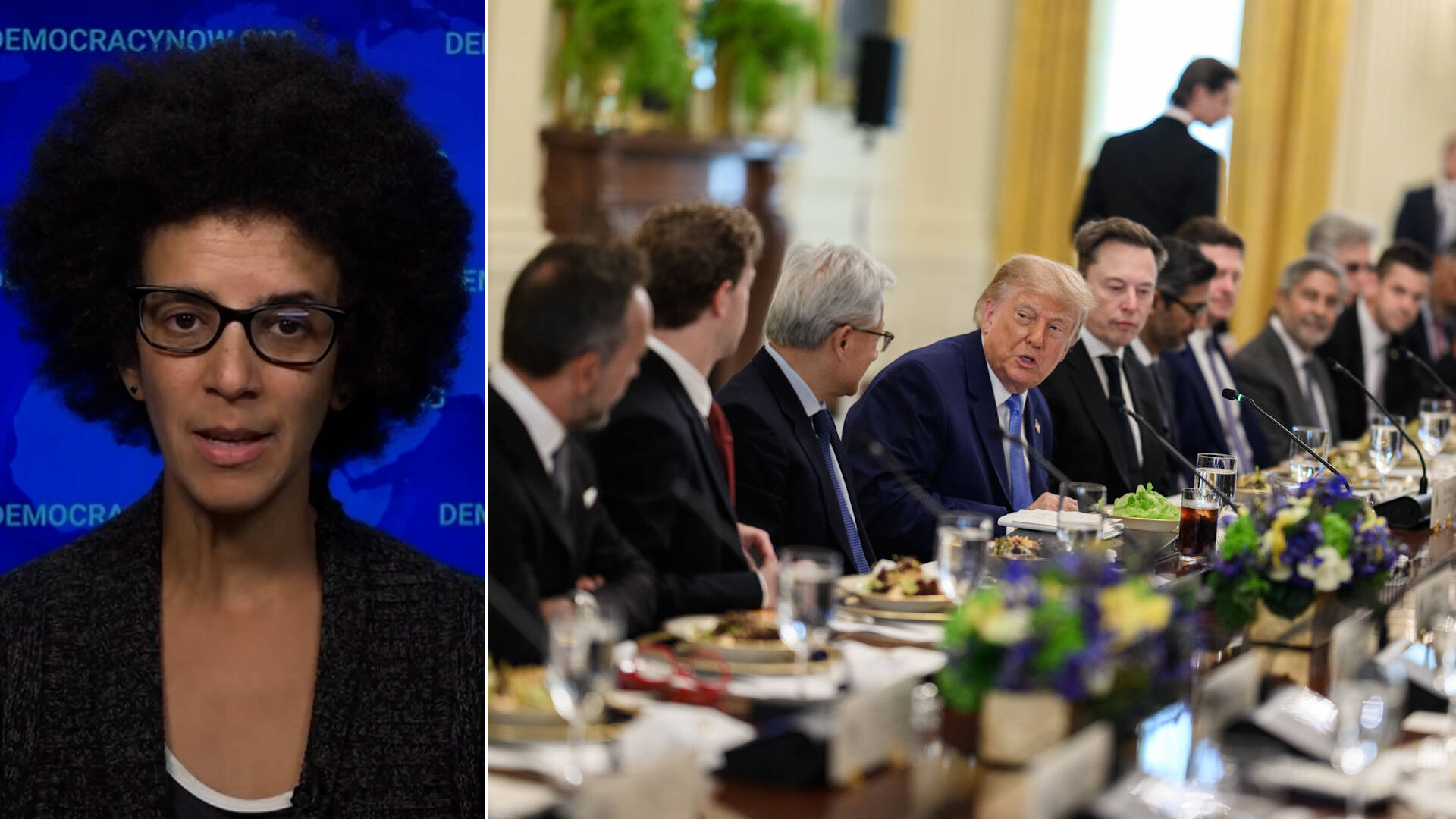
The Real Existential Risk Is AI CEOs Avoiding Oversight: “Alternative Nobel” Winner Timnit Gebru
We speak to the prominent AI researcher and leading critic of the AI industry, Timnit Gebru, who was recently awarded a 2026 Right Livelihood Award for her work investigating the harms and hype behind the global buildup of artificial intelligence. “Instead of discussing faulty, unreliable systems,” Gebru says tech leaders like SpaceXAI’s Elon Musk, OpenAI’s Sam Altman and Anthropic’s Dario Amodei are “marketing their systems as all-knowing, superpowerful, superintelligent,” and lobbying for “self-policing and self-regulation” to avoid being held “liable through existing laws.” Gebru expresses skepticism over increasingly widespread claims that AI algorithms pose an existential risk to humanity, warning that such claims are overblown and that “what is actually happening is regulatory capture.”
For years, they warned AI could kill all humans. Now people are listening.
A doomsaying community once on the periphery of the tech industry has gained influence, as AI “agents” perform amazing and alarming feats.

Billie Eilish, Pearl Jam, 200 artists say AI poses existential threat to their livelihoods
Artists say AI will "set in motion a race to the bottom that will degrade the value of our work."

AI, Ethics, and Society — Home
"The forces that are now shaping AI are the same forces that turned the open internet into monopolistic platforms, converted peer-to-peer participation into precarious labor, and enclosed the digital commons. They are now threatening to capture and enclose thought itself." osf.io/preprints/socarxiv/qahd3_v1/


