

I recently took a deep dive into web site archival for friends who were worried about losing co [...]
Webrecorder: Web Archiving for All
Webrecorder provides open source solutions for everyone to archive the complex, interactive Web.
ArchiveBox - Open-source self-hosted web archiving
Preserve websites, media, bookmarks, feeds, source code, evidence, and research material in durable files you control.
IIPC WAC 2024 Presentation: A Conceptual Model of Decentralized Storage for Community-Based Archives
Archiving URLs
Archiving the Web, because nothing lasts forever: statistics, online archive services, extracting URLs automatically from browsers, and creating a daemon to regularly back up URLs to multiple sources.

Rethinking Digital Storage for Community-Based Archives
Over the last few decades, the standard procedure for storing and backing up data has been ‘put it in the cloud.’ Many of us use cloud…

Internet Archive
We saw the www.lostlandscapes.org show which was put on to benefit the Internet Archive which suffered from a fire recently. The show featured footage of SF from the 1920s to 1980s. The soundtrack is the crowd, as they yell out recognized locations and ask questions, etc. The Internet Archive (which has the Wayback Machine) is located in a former church. The grand hall is where the show was held, and you can see that the church pews are still in tact. In the alcoves at the back are two server racks which store the master copy of the archives. On the edges are little statues. Those are representations of people who dedicated many hours volunteering for the archive. The one I happened to photograph is Aaron Swartz.

The Vintage Technology Digital Archive
Solutions for Link Rot on the Modern Web
Web links are fundamental to the web, enabling navigation between pages and citations in research articles. However, web links suffer from "link rot", a phenomenon in which links are likely to become inaccessible over time. This can occur if a link’s site disappears, making it impossible to resolve the hostname or establish a server connection, or the linked page has been deleted, resulting in an HTTP 404 "Not Found" error. Today, a common solution to tackle link rot is to rely on web archives, which capture snapshots of web pages for future reference. However, the modern web has evolved significantly since web archives were first introduced, leading to several limitations in their effectiveness. First, the scale of the web has grown tremendously, making it infeasible to crawl every page whenever it changes. As a result, many broken links either have no archived copies, or the archived copies have stale content. Second, modern web pages rely heavily on increasingly complex and diverse JavaScript. This shift has made it more challenging for preserving fidelity in archived copies, significantly increasing both the computational cost of operating browser-based crawlers and engineering effort required to maintain accurate replay systems. This thesis presents a set of solutions to cope with link rot on the modern web. My work aims to mitigate the various limitations of web archives. First, for broken links without any archived copy, or if the archived copy includes stale content or unavailable functionalities, I built Fable. Fable revives the dead link with the new URL to the same page whenever available. Compared to prior approaches, Fable revives 4.6K broken links—a 50% increase—with much higher accuracy. Second, for pages that require dynamic crawling, I show how web archives can achieve a better tradeoff between efficiency and fidelity. By carefully choosing 8.9% of pages to crawl dynamically and strategically reusing resources from those crawls, an archive can serve 99% of the remaining statically crawled pages without any fidelity loss. Third, for fidelity violations in archived copies that are caused by incorrect edits to crawled scripts, I built FidEx. FidEx reliably detects when an archived page differs from its original version and pinpoints the root cause. After fixing the most common errors pinpointed by FidEx, I reduced the fraction of pages for which FidEx reports a violation of fidelity from 15% to 9%.
Solutions for Link Rot on the Modern Web
Web links are fundamental to the web, enabling navigation between pages and citations in research articles. However, web links suffer from "link rot", a phenomenon in which links are likely to become inaccessible over time. This can occur if a link’s site disappears, making it impossible to resolve the hostname or establish a server connection, or the linked page has been deleted, resulting in an HTTP 404 "Not Found" error. Today, a common solution to tackle link rot is to rely on web archives, which capture snapshots of web pages for future reference. However, the modern web has evolved significantly since web archives were first introduced, leading to several limitations in their effectiveness. First, the scale of the web has grown tremendously, making it infeasible to crawl every page whenever it changes. As a result, many broken links either have no archived copies, or the archived copies have stale content. Second, modern web pages rely heavily on increasingly complex and diverse JavaScript. This shift has made it more challenging for preserving fidelity in archived copies, significantly increasing both the computational cost of operating browser-based crawlers and engineering effort required to maintain accurate replay systems. This thesis presents a set of solutions to cope with link rot on the modern web. My work aims to mitigate the various limitations of web archives. First, for broken links without any archived copy, or if the archived copy includes stale content or unavailable functionalities, I built Fable. Fable revives the dead link with the new URL to the same page whenever available. Compared to prior approaches, Fable revives 4.6K broken links—a 50% increase—with much higher accuracy. Second, for pages that require dynamic crawling, I show how web archives can achieve a better tradeoff between efficiency and fidelity. By carefully choosing 8.9% of pages to crawl dynamically and strategically reusing resources from those crawls, an archive can serve 99% of the remaining statically crawled pages without any fidelity loss. Third, for fidelity violations in archived copies that are caused by incorrect edits to crawled scripts, I built FidEx. FidEx reliably detects when an archived page differs from its original version and pinpoints the root cause. After fixing the most common errors pinpointed by FidEx, I reduced the fraction of pages for which FidEx reports a violation of fidelity from 15% to 9%.
The Comprehensive Digital Preservation Platform
Create, curate, and collaborate on living archives. Start with a FREE GB.

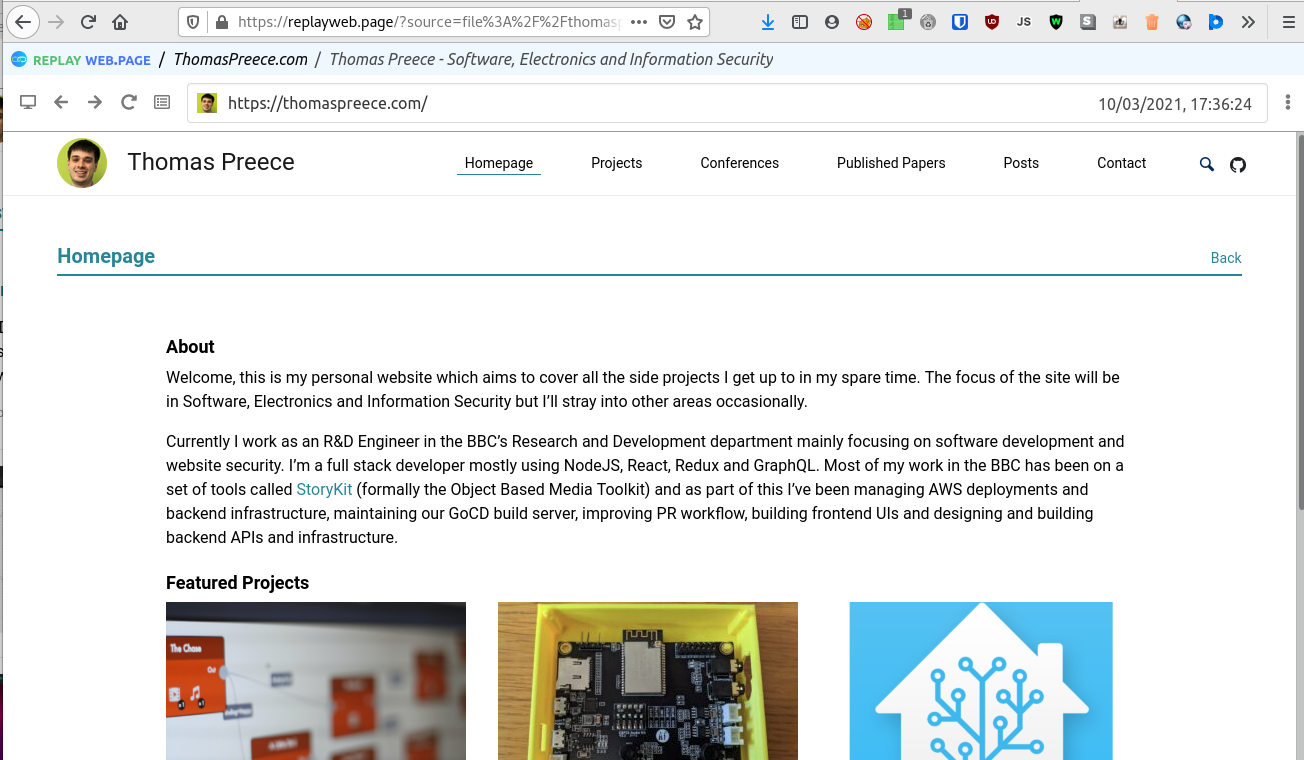
Web Archiving: Playback Tools - Thomas Preece
Web Archiving: Playback Tools - Below I've listed some of the tools I found to playback web archives. The two most popular tools that I found were OpenWayback and PyWb. Of the tests I
Archivist - Storage That Can't Be Stopped
Archivist is a decentralized durable storage network. Data is encrypted, erasure-coded, and dispersed across independent operators. Verified by zero-knowledge proofs. Sovereign storage that survives censorship, provider failure, and time.
DIY Web Archiving | Zine Bakery
Zine Bakery Bakeshop #2, by Quinn Daedel, Tessa Walsh, Anna Kijas, Ilya Kreymer, and Amanda Wyatt Visconti
On Link Rot
The web suffers from link rot: hyperlinks that were valid upon creation will often point into nothingness after some time has passed. Within the framework of the web, the typical solution is to link to a snapshot of the original page, hosted on archive.org.
Back into blogging and just published something I've been thinking about for a while now – making archival content more resilient and discoverable on atproto. Oral history, interactive transcripts, content addressing, and keeping important stories from being quietly erased. maboa.it/resilient-archives-on-the-at-…

Keeping Archives Alive: Resilience and Discovery on ATProto
maboa.itHow long does a web page live 🤔 >5yrs ago I asked the internet, and made some new friends: x.com/dietrich/status/1135778377766… After a multi-year research collab with @archive.org, ODU and Filecoin Fdn... (largest study like this ever done) ... we have results! tldr: It's bad. fil.org/blog/the-web-isn-t-forever-ne…

