


I’ve written about the class I’d like to teach, but what I’ve been thinking about lately is the class I’d like to attend. Not necessarily now, but when I was growing up. In the 6th grade, let’s say…
Surfacing Teachable Moments in Community
I’ve had this post sitting in draft for a while now, but was nudged to work on it a bit more — after reading, and being inspired by…

Teaching how to code is broken
Typically: * Chapter 1: Types * Chapter 2: Variables * Chapter 3: Operators/Math * Chapter 4: Control structures * Chapter 5: Arrays * Chapter 6: Functions * Chapter 7: Structs * Chapter 8: Classes and Objects * Chapter 9: Methods * Chapter 10: Inheritance and Polymorphism * Chapter 11: Some advanced thing X * Chapter 12: Some esoteric thing Y * Chapter

Khan Academy Blog
News, updates, and stories from the nonprofit that helps learners, teachers, and districts accelerate learning. Show all Educators ... Read more
Transitioning to a Living Curriculum
The Principles and Practices to building a new way of Learning

An Uncluttered retrospective: Teachable is a mess and I need to pick a lane
Writing at the end of the world, from Hveragerði, Iceland
Callysto: Bringing Jupyter and Computational Thinking to the K-12 Curriculum
Cybera and the Pacific Institute for Mathematical Sciences are participating in the new national CanCode program, to develop coding and digital skills from kindergarten to grade 12. With the launch of the Callysto project, we are creating tools and frameworks that help teachers bring computational thinking into their math, science, social sciences, and humanities courses - giving students the analytical skills needed to comprehend the digital world. Leveraging the Jupyter 'All-in-One' Science Platform to put friendly yet powerful compute tools in classroom settings, we are creating showcase modules and workshop training for K-12 teachers to incorporate data and computing into the broad curriculum. At this presentation, you will learn about how Callysto will: Bring computational thinking to classrooms through K-12 teacher training Create opportunities to participate in free workshop training sessions and content creation Help K-12 teachers gain public recognition for participating in this educational training project Note: This presentation is related to our 2017 BCNET presentation on "Bringing The Thunder: Deploying Jupyter Notebooks For Research, Education, And Innovation." View Slidedeck
A free, online course taught by Lachlan Kermode and Erika Bussmann. Our next semester runs from March 27th to June 7th.
The Self-Determined Learner
Most of what I do is toward deepening my abilities as a self-determined learner. I believe any adult learner can develop their own curriculu...
How to write good prompts: using spaced repetition to create understanding
Using spaced repetition to create understanding

Opinion | The Semester That Shook My Faith as a Professor
AI has taken something fundamental from the business of teaching and learning.

No One Dies in this Dystopia
I am all done with grading for the semester just past, but the work sticks to me in a way I can’t yet manage to fling off.

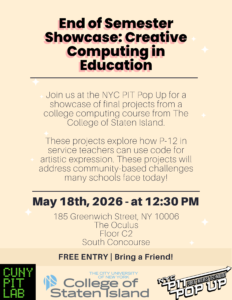
Creative Computing in Education Course Showcase
This event will showcase creative computing final projects from a College of Staten Island course that explores how P-12 in-service teachers can use code for artistic expression. These projects will […]
Mastery learning
Mastery learning is an instructional strategy and educational philosophy that emphasizes the importance of students achieving a high level of competence (e.g., 90% accuracy) in prerequisite knowledge before moving on to new material. This approach involves providing students with individualized support and repeated opportunities to demonstrate mastery through assessments. If a student does not initially achieve mastery, they receive additional instruction and support until they do. Mastery learning is based on the idea that all students can learn effectively with appropriate instruction and sufficient time, and it contrasts with traditional teaching methods that often focus on covering a set amount of material within a fixed timeframe, regardless of individual student needs.
Announcing CodeCombat Classroom Curriculum, Seed Round from 3KVC, a16z, and Allen & Co
I remember when I wrote my first lines of code. I was a freshman in college, and I had signed up for the introductory computer science course on a whim after choosing my practical career-advancing courses: writing, chemistry, poetry, and go [https://en.wikipedia.org/wiki/Go_(game)]. I
