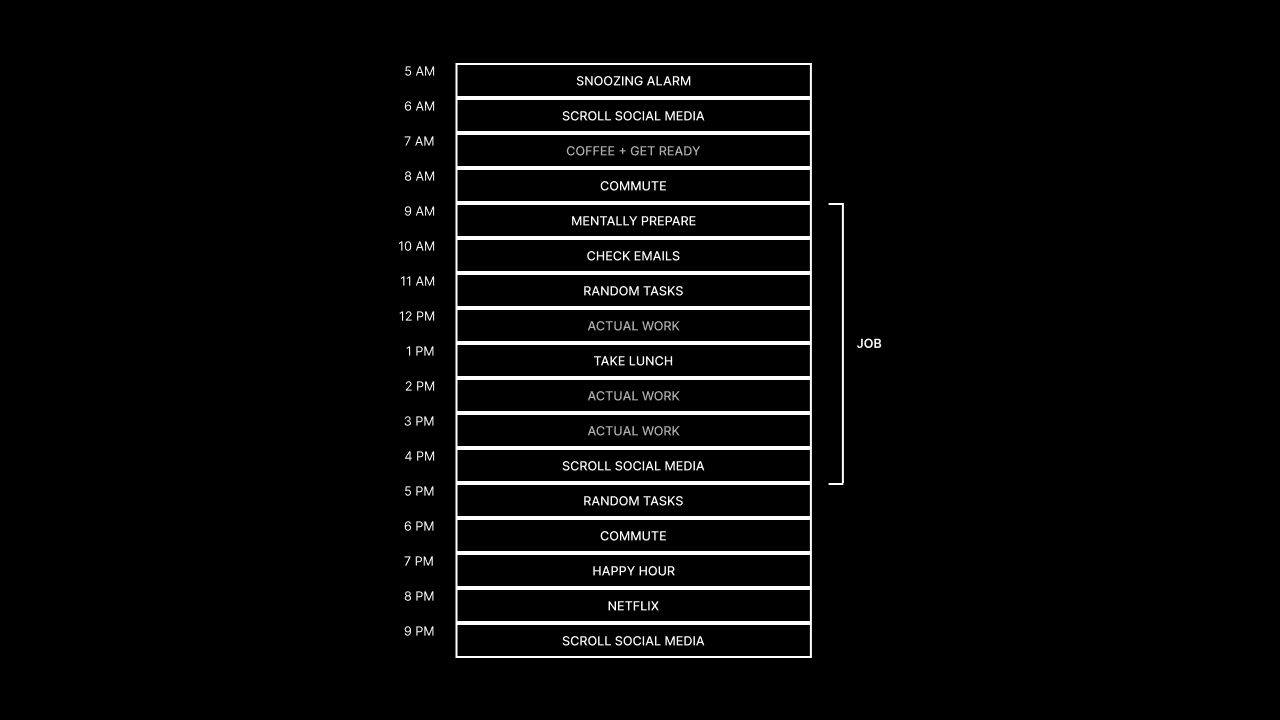
“And then I said anyone not willing to break their backs working for me was a tourist!”If you want to understand why so many startups become infected with unhealthy work habits, or outright workaho…
The Rise of the Decentralized Startup
I think we’re seeing a very big shift right now in how startups are created and operate. But before we dig into that, I want to spend some time talking about work. For centuries, work has bee…


You Weren't Meant to Have a Boss
March 2008, rev. June 2008Technology tends to separate normal from natural. Our bodies weren't designed to eat the foods that people in rich countries eat, or to get so little exercise. There may be a similar problem with the way we work: a normal job may be as bad for us intellectually as white flour or sugar is for us physically.I began to suspect this after spending several years working with startup founders. I've now worked with over 200 of them, and I've noticed a definite difference between programmers working on their own startups and those working for large organizations. I wouldn't say founders seem happier, necessarily; starting a startup can be very stressful. Maybe the best way to put it is to say that they're happier in the sense that your body is happier during a long run than sitting on a sofa eating doughnuts.Though they're statistically abnormal, startup founders seem to be working in a way that's more natural for humans.I was in Africa last year and saw a lot of animals in the wild that I'd only seen in zoos before. It was remarkable how different they seemed. Particularly lions. Lions in the wild seem about ten times more alive. They're like different animals. I suspect that working for oneself feels better to humans in much the same way that living in the wild must feel better to a wide-ranging predator like a lion. Life in a zoo is easier, but it isn't the life they were designed for. TreesWhat's so unnatural about working for a big company? The root of the problem is that humans weren't meant to work in such large groups.Another thing you notice when you see animals in the wild is that each species thrives in groups of a certain size. A herd of impalas might have 100 adults; baboons maybe 20; lions rarely 10. Humans also seem designed to work in groups, and what I've read about hunter-gatherers accords with research on organizations and my own experience to suggest roughly what the ideal size is: groups of 8 work well; by 20 they're getting hard to manage; and a group of 50 is really unwieldy. [1] Whatever the upper limit is, we are clearly not meant to work in groups of several hundred. And yet—for reasons having more to do with technology than human nature—a great many people work for companies with hundreds or thousands of employees.Companies know groups that large wouldn't work, so they divide themselves into units small enough to work together. But to coordinate these they have to introduce something new: bosses.These smaller groups are always arranged in a tree structure. Your boss is the point where your group attaches to the tree. But when you use this trick for dividing a large group into smaller ones, something strange happens that I've never heard anyone mention explicitly. In the group one level up from yours, your boss represents your entire group. A group of 10 managers is not merely a group of 10 people working together in the usual way. It's really a group of groups. Which means for a group of 10 managers to work together as if they were simply a group of 10 individuals, the group working for each manager would have to work as if they were a single person—the workers and manager would each share only one person's worth of freedom between them.In practice a group of people are never able to act as if they were one person. But in a large organization divided into groups in this way, the pressure is always in that direction. Each group tries its best to work as if it were the small group of individuals that humans were designed to work in. That was the point of creating it. And when you propagate that constraint, the result is that each person gets freedom of action in inverse proportion to the size of the entire tree. [2]Anyone who's worked for a large organization has felt this. You can feel the difference between working for a company with 100 employees and one with 10,000, even if your group has only 10 people. Corn SyrupA group of 10 people within a large organization is a kind of fake tribe. The number of people you interact with is about right. But something is missing: individual initiative. Tribes of hunter-gatherers have much more freedom. The leaders have a little more power than other members of the tribe, but they don't generally tell them what to do and when the way a boss can.It's not your boss's fault. The real problem is that in the group above you in the hierarchy, your entire group is one virtual person. Your boss is just the way that constraint is imparted to you.So working in a group of 10 people within a large organization feels both right and wrong at the same time. On the surface it feels like the kind of group you're meant to work in, but something major is missing. A job at a big company is like high fructose corn syrup: it has some of the qualities of things you're meant to like, but is disastrously lacking in others.Indeed, food is an excellent metaphor to explain what's wrong with the usual sort of job.For example, working for a big company is the default thing to do, at least for programmers. How bad could it be? Well, food shows that pretty clearly. If you were dropped at a random point in America today, nearly all the food around you would be bad for you. Humans were not designed to eat white flour, refined sugar, high fructose corn syrup, and hydrogenated vegetable oil. And yet if you analyzed the contents of the average grocery store you'd probably find these four ingredients accounted for most of the calories. "Normal" food is terribly bad for you. The only people who eat what humans were actually designed to eat are a few Birkenstock-wearing weirdos in Berkeley.If "normal" food is so bad for us, why is it so common? There are two main reasons. One is that it has more immediate appeal. You may feel lousy an hour after eating that pizza, but eating the first couple bites feels great. The other is economies of scale. Producing junk food scales; producing fresh vegetables doesn't. Which means (a) junk food can be very cheap, and (b) it's worth spending a lot to market it.If people have to choose between something that's cheap, heavily marketed, and appealing in the short term, and something that's expensive, obscure, and appealing in the long term, which do you think most will choose?It's the same with work. The average MIT graduate wants to work at Google or Microsoft, because it's a recognized brand, it's safe, and they'll get paid a good salary right away. It's the job equivalent of the pizza they had for lunch. The drawbacks will only become apparent later, and then only in a vague sense of malaise.And founders and early employees of startups, meanwhile, are like the Birkenstock-wearing weirdos of Berkeley: though a tiny minority of the population, they're the ones living as humans are meant to. In an artificial world, only extremists live naturally. ProgrammersThe restrictiveness of big company jobs is particularly hard on programmers, because the essence of programming is to build new things. Sales people make much the same pitches every day; support people answer much the same questions; but once you've written a piece of code you don't need to write it again. So a programmer working as programmers are meant to is always making new things. And when you're part of an organization whose structure gives each person freedom in inverse proportion to the size of the tree, you're going to face resistance when you do something new.This seems an inevitable consequence of bigness. It's true even in the smartest companies. I was talking recently to a founder who considered starting a startup right out of college, but went to work for Google instead because he thought he'd learn more there. He didn't learn as much as he expected. Programmers learn by doing, and most of the things he wanted to do, he couldn't—sometimes because the company wouldn't let him, but often because the company's code wouldn't let him. Between the drag of legacy code, the overhead of doing development in such a large organization, and the restrictions imposed by interfaces owned by other groups, he could only try a fraction of the things he would have liked to. He said he has learned much more in his own startup, despite the fact that he has to do all the company's errands as well as programming, because at least when he's programming he can do whatever he wants.An obstacle downstream propagates upstream. If you're not allowed to implement new ideas, you stop having them. And vice versa: when you can do whatever you want, you have more ideas about what to do. So working for yourself makes your brain more powerful in the same way a low-restriction exhaust system makes an engine more powerful.Working for yourself doesn't have to mean starting a startup, of course. But a programmer deciding between a regular job at a big company and their own startup is probably going to learn more doing the startup.You can adjust the amount of freedom you get by scaling the size of company you work for. If you start the company, you'll have the most freedom. If you become one of the first 10 employees you'll have almost as much freedom as the founders. Even a company with 100 people will feel different from one with 1000.Working for a small company doesn't ensure freedom. The tree structure of large organizations sets an upper bound on freedom, not a lower bound. The head of a small company may still choose to be a tyrant. The point is that a large organization is compelled by its structure to be one. ConsequencesThat has real consequences for both organizations and individuals. One is that companies will inevitably slow down as they grow larger, no matter how hard they try to keep their startup mojo. It's a consequence of the tree structure that every large organization is forced to adopt.Or rather, a large organization could only avoid slowing down if they avoided tree structure. And since human nature limits the size of group that can work together, the only way I can imagine for larger groups to avoid tree structure would be to have no structure: to have each group actually be independent, and to work together the way components of a market economy do.That might be worth exploring. I suspect there are already some highly partitionable businesses that lean this way. But I don't know any technology companies that have done it.There is one thing companies can do short of structuring themselves as sponges: they can stay small. If I'm right, then it really pays to keep a company as small as it can be at every stage. Particularly a technology company. Which means it's doubly important to hire the best people. Mediocre hires hurt you twice: they get less done, but they also make you big, because you need more of them to solve a given problem.For individuals the upshot is the same: aim small. It will always suck to work for large organizations, and the larger the organization, the more it will suck.In an essay I wrote a couple years ago I advised graduating seniors to work for a couple years for another company before starting their own. I'd modify that now. Work for another company if you want to, but only for a small one, and if you want to start your own startup, go ahead.The reason I suggested college graduates not start startups immediately was that I felt most would fail. And they will. But ambitious programmers are better off doing their own thing and failing than going to work at a big company. Certainly they'll learn more. They might even be better off financially. A lot of people in their early twenties get into debt, because their expenses grow even faster than the salary that seemed so high when they left school. At least if you start a startup and fail your net worth will be zero rather than negative. [3]We've now funded so many different types of founders that we have enough data to see patterns, and there seems to be no benefit from working for a big company. The people who've worked for a few years do seem better than the ones straight out of college, but only because they're that much older.The people who come to us from big companies often seem kind of conservative. It's hard to say how much is because big companies made them that way, and how much is the natural conservatism that made them work for the big companies in the first place. But certainly a large part of it is learned. I know because I've seen it burn off.Having seen that happen so many times is one of the things that convinces me that working for oneself, or at least for a small group, is the natural way for programmers to live. Founders arriving at Y Combinator often have the downtrodden air of refugees. Three months later they're transformed: they have so much more confidence that they seem as if they've grown several inches taller. [4] Strange as this sounds, they seem both more worried and happier at the same time. Which is exactly how I'd describe the way lions seem in the wild.Watching employees get transformed into founders makes it clear that the difference between the two is due mostly to environment—and in particular that the environment in big companies is toxic to programmers. In the first couple weeks of working on their own startup they seem to come to life, because finally they're working the way people are meant to.Notes[1] When I talk about humans being meant or designed to live a certain way, I mean by evolution.[2] It's not only the leaves who suffer. The constraint propagates up as well as down. So managers are constrained too; instead of just doing things, they have to act through subordinates.[3] Do not finance your startup with credit cards. Financing a startup with debt is usually a stupid move, and credit card debt stupidest of all. Credit card debt is a bad idea, period. It is a trap set by evil companies for the desperate and the foolish.[4] The founders we fund used to be younger (initially we encouraged undergrads to apply), and the first couple times I saw this I used to wonder if they were actually getting physically taller.Thanks to Trevor Blackwell, Ross Boucher, Aaron Iba, Abby Kirigin, Ivan Kirigin, Jessica Livingston, and Robert Morris for reading drafts of this.
The Cult of Work You Never Meant to Join
Are our most valuable qualities being exploited at work? How our strengths get twisted into forming bad habits that just might kill us.

Political Aspects of Full Employment
Why do capitalists hate full employment? Because it weakens their power over workers.

When to Fold: The Cost of Failing Slow in a Startup
Failing Slow: Why One Founder Regretted Keeping His Startup Alive
Stanford professor: "The workplace is killing people and nobody cares" - Fast Company
From the disappearance of good health insurance to the psychological effects of long hours, the modern workplace is taking its toll on all of us.

Taking a Vacation May Actually Save Your Career
Workaholism is hurting the American economy.

Why I turned down $500K, Pissed off my investors, and Shut down my startup
Why I turned down $500K, Pissed off my investors, and Shut down my startup I just did what no startup founder is ever supposed to do. I gave up. It wasn’t even one of those glorious “fail fast …

More work for your labor-value - The Wobbly World of Miftah's Words
...and more exploitation for your location.
Why to Start a Startup in a Bad Economy
October 2008The economic situation is apparently so grim that some experts fear we may be in for a stretch as bad as the mid seventies.When Microsoft and Apple were founded.As those examples suggest, a recession may not be such a bad time to start a startup. I'm not claiming it's a particularly good time either. The truth is more boring: the state of the economy doesn't matter much either way.If we've learned one thing from funding so many startups, it's that they succeed or fail based on the qualities of the founders. The economy has some effect, certainly, but as a predictor of success it's rounding error compared to the founders.Which means that what matters is who you are, not when you do it. If you're the right sort of person, you'll win even in a bad economy. And if you're not, a good economy won't save you. Someone who thinks "I better not start a startup now, because the economy is so bad" is making the same mistake as the people who thought during the Bubble "all I have to do is start a startup, and I'll be rich."So if you want to improve your chances, you should think far more about who you can recruit as a cofounder than the state of the economy. And if you're worried about threats to the survival of your company, don't look for them in the news. Look in the mirror.But for any given team of founders, would it not pay to wait till the economy is better before taking the leap? If you're starting a restaurant, maybe, but not if you're working on technology. Technology progresses more or less independently of the stock market. So for any given idea, the payoff for acting fast in a bad economy will be higher than for waiting. Microsoft's first product was a Basic interpreter for the Altair. That was exactly what the world needed in 1975, but if Gates and Allen had decided to wait a few years, it would have been too late.Of course, the idea you have now won't be the last you have. There are always new ideas. But if you have a specific idea you want to act on, act now.That doesn't mean you can ignore the economy. Both customers and investors will be feeling pinched. It's not necessarily a problem if customers feel pinched: you may even be able to benefit from it, by making things that save money. Startups often make things cheaper, so in that respect they're better positioned to prosper in a recession than big companies.Investors are more of a problem. Startups generally need to raise some amount of external funding, and investors tend to be less willing to invest in bad times. They shouldn't be. Everyone knows you're supposed to buy when times are bad and sell when times are good. But of course what makes investing so counterintuitive is that in equity markets, good times are defined as everyone thinking it's time to buy. You have to be a contrarian to be correct, and by definition only a minority of investors can be.So just as investors in 1999 were tripping over one another trying to buy into lousy startups, investors in 2009 will presumably be reluctant to invest even in good ones.You'll have to adapt to this. But that's nothing new: startups always have to adapt to the whims of investors. Ask any founder in any economy if they'd describe investors as fickle, and watch the face they make. Last year you had to be prepared to explain how your startup was viral. Next year you'll have to explain how it's recession-proof.(Those are both good things to be. The mistake investors make is not the criteria they use but that they always tend to focus on one to the exclusion of the rest.)Fortunately the way to make a startup recession-proof is to do exactly what you should do anyway: run it as cheaply as possible. For years I've been telling founders that the surest route to success is to be the cockroaches of the corporate world. The immediate cause of death in a startup is always running out of money. So the cheaper your company is to operate, the harder it is to kill. And fortunately it has gotten very cheap to run a startup. A recession will if anything make it cheaper still.If nuclear winter really is here, it may be safer to be a cockroach even than to keep your job. Customers may drop off individually if they can no longer afford you, but you're not going to lose them all at once; markets don't "reduce headcount."What if you quit your job to start a startup that fails, and you can't find another? That could be a problem if you work in sales or marketing. In those fields it can take months to find a new job in a bad economy. But hackers seem to be more liquid. Good hackers can always get some kind of job. It might not be your dream job, but you're not going to starve.Another advantage of bad times is that there's less competition. Technology trains leave the station at regular intervals. If everyone else is cowering in a corner, you may have a whole car to yourself.You're an investor too. As a founder, you're buying stock with work: the reason Larry and Sergey are so rich is not so much that they've done work worth tens of billions of dollars, but that they were the first investors in Google. And like any investor you should buy when times are bad.Were you nodding in agreement, thinking "stupid investors" a few paragraphs ago when I was talking about how investors are reluctant to put money into startups in bad markets, even though that's the time they should rationally be most willing to buy? Well, founders aren't much better. When times get bad, hackers go to grad school. And no doubt that will happen this time too. In fact, what makes the preceding paragraph true is that most readers won't believe it—at least to the extent of acting on it.So maybe a recession is a good time to start a startup. It's hard to say whether advantages like lack of competition outweigh disadvantages like reluctant investors. But it doesn't matter much either way. It's the people that matter. And for a given set of people working on a given technology, the time to act is always now.
Anti-work
An obsession with work is a colonial, patriarchal, and capitalist construct. As such, the anti-work movement is an important part of decolonization, feminism, and anti-capitalism. Work is a tool of oppression By anti-work, I don’t mean that no one ever works. That’s preposterous of course. There are things that need to get done, and people need to do them. But this obsession with hard work as a virtue, as a good and righteous thing to do, the glorification of toil and sweat and labor… that’s a tool the wealthy who don’t work for a living use to oppress those who do.

Anarchy and modern convenience
A major part of anarchy and socialism is the concept of anti-work. An obsession with work is a colonial, patriarchal, and capitalist construct. As such, the anti-work movement—a focus on working less overall and sharing labor more equally—is an important part of decolonization, feminism, and anti-capitalism. A common criticism of this is that reducing the amount everyone works to something like 20 hours a week instead of 40+ means we would have to give up a lot of conveniences.
Stop Working So Hard
In response to a thoughtful reply from John Carmack, I share some thoughts on why we all need to stop working so damn hard.

Opinion | Let’s Be Less Productive (Published 2012)
The relentless drive for productivity may have some limits; if our economies don’t continue to expand, we risk putting people out of work.

The 80-Hour Myth (Why We're Addicted To Being Busy) - Dan Koe
Ever since I could remember, I didn’t want to work my life away. Anti role models were all around me. And I was pretty observant as a child. I didn’t want to wake up at 4am, drive to work at 5am, grind away, and get home at 7pm because I was trying to support a […]